
Search Companies, News, Members & more
Terms of ServicePrivacy PolicySecurity PolicyLegal InformationCommunity GuidelinesSitemapsCookie Settings
2026 Copyright © Liquidity Finder Ltd. All rights reserved.
Liquidity Finder Ltd is incorporated in England and Wales, company number 10610740, registered address 167-169 Great Portland Street, Fifth Floor, London W1W 5PF, United Kingdom.


One broker I spoke to recently summed up the rush towards 24/7 trading:
"I think that the whole broker world wants 24/7 revenue."
That was Stuart Pettman at @MarketsVox - everyone is looking for the next bit of juice to squeeze out of their business. Brokers want their clients trading seven days a week, not five. And if their competitors are offering weekend trading, nobody wants to be left behind.
Gold has become the main focus. Over the past few months, we've seen a succession of brokers sending out PR about 24/7 gold CFDs, liquidity providers introducing weekend pricing, and crypto venues such as Hyperliquid offering new ways to trade gold when traditional markets are closed.
It was a subject that I was asking when going around at Forex Expo Dubai in September. Is anyone actually trading it?
But there's a difference between brokers wanting to generate revenue seven days a week and traders actually wanting to trade seven days a week.
I've been asking a number of the companies on LiquidityFinder what they're seeing. How many traders are actually active at weekends? What are the spreads like? Who is providing the liquidity? And, perhaps most importantly, are brokers making any money from it?
I've had some particularly interesting feedback from Tapaas ( @Tapaas ), iSAM Securities ( @iSAMSecurities ) , Gold-i ( @Gold-i ), Broktinger ( @broktinger ) and L7 Prime, including trading data that gives us a much clearer picture of what's happening.
The short answer is that weekend gold trading is still tiny, but it is growing. The brokers are getting ready. Whether their clients will follow is I think inevitable - eventually. But what's the current state of play?
Who Is Offering 24/7 Gold?
By my count, at least ten retail brokers have pushed out marketing about them offering gold through the weekend, with most of the recent launches over the past 3-4 months. But i think there are considerably more rolling it out without the press release (is it a bit 'whatever' now?)
IG was offering weekend gold to international clients by October 2024, well before the current rush, while CMC Markets introduced its own weekend gold instrument in April 2026.
Then came a wave of launches from Vantage, VT Markets, XM, @startrader, Ultima Markets, @MarketsVox, @VSCapital , CFI and HFM, among others.
MarketsVox went further, adding 24/7 trading in silver and oil CFDs alongside gold.
Some brokers are taking a more gradual approach. When I asked Youssef Bouz ( @youssefb53bea )at @GCCBrokers whether the firm was offering 24/7 gold, he told me:
"Yes we are, but still currently to select clients only. Ready for everyone, will release soon"
So GCC Brokers already has the product available to selected clients, with a wider rollout planned.
On the liquidity side, prime-of-prime providers including Scope Prime, Match-Prime and GBE Prime have been offering weekend gold solutions to brokers, while LMAX Group has offered gold perpetual futures since February.
Another important development came on 24 July, when CME Group introduced round-the-clock trading in its 1-Ounce Gold futures contract, followed by 100-Ounce Silver futures in September.
This provides another source of weekend gold trading and price discovery, although these smaller futures contracts should not be confused with the much larger established gold futures market.
Much of the technology required to offer weekend trading is now readily available. Brokers can connect to a liquidity provider, introduce a dedicated instrument and extend their trading hours.
The difficult part is ensuring there is sufficient liquidity behind the price.
And, of course, finding customers who actually want to trade.
Is Anyone Actually Trading It?
The answer is yes, but the volumes are still tiny compared with normal weekday activity.
CME provides one useful public benchmark. On 14 September, it reported that more than 140,000 of its 1-Ounce Gold futures contracts had traded during weekend sessions since the July launch, representing over $600 million in notional value.
That sounds reasonably impressive for a new market, but it is a very small amount compared with CME's normal gold futures turnover.
The more revealing figures come from the retail brokers themselves.
Tapaas: Weekend Gold Trading Has Quadrupled Since June
I asked Michael Maltsev, Head of ML/AI at broker risk analytics provider @Tapaas, whether he could find any evidence of a meaningful increase in weekend trading.
Michael, who is also a LiquidityFinder member @MichaelMaltsev, and his team examined aggregate, anonymised client flow across brokers using the Tapaas platform, covering June to early October 2026.
His opening observation puts the market into perspective:
"Saturday and Sunday together come to well under half a per cent of volume - and 99.5% of that is crypto, which has always traded 24/7."
Tapaas sees around a million crypto trades every weekend, compared with only a few thousand non-crypto trades across all the brokers in its sample combined.
That is quite a difference, particularly when you consider the number of brokers announcing new 24/7 products.
However, gold is starting to stand out.
"Weekend gold trading has roughly quadrupled since June. And it is spreading too - the number of brokers with regular weekend gold flow tripled by late summer."
Michael also found that the trend held even after removing the single largest weekend gold broker from the sample, so the growth is not simply being driven by one particularly active firm.
In volume terms, non-crypto weekend trading grew around seven-fold as a share of volume between June and September.
Other products, including FX, indices and oil, have yet to show a clear trend.
This is probably the most encouraging evidence I've seen that weekend gold could develop into a meaningful product. But it comes with an important qualification: it is growing rapidly from an extremely small base.
Michael's conclusion was:
"Your read - brokers are set up, but it isn't habitual yet - matches what we see. If anything, gold is where the habit is starting to form: still very small, but growing month on month and spreading across more brokers."
iSAM Securities Sees a Similar Picture
Liquidity and technology provider @iSAMSecurities has also been examining weekend trading activity through Radar, its risk analytics platform.
Its findings are broadly consistent with Tapaas.
At a typical CFD broker on the Radar Network, weekend trading accounts for approximately 0.2% of total weekly volume, almost all of it crypto.
Even at brokers offering weekend gold, the product accounts for less than 0.1% of their total gold volume.
However, within weekend trading itself, gold's share has been growing. According to Radar, gold accounted for just 0.4% of weekend volume in June, rising to 1.0% in September and 1.7% in October.
Radar has also observed several large brokers introducing weekend gold during the past quarter, particularly firms that internalise much of their client risk.
Interestingly, 96% of the accounts trading gold at weekends also trade gold during the week.
So this is not necessarily attracting a large new audience. It is mainly giving existing gold traders another opportunity to trade.
The Problem With Weekend Liquidity
This is where the enthusiasm for 24/7 gold runs into a practical problem.
Retail gold traders are accustomed to very competitive pricing during normal market hours. When the underlying market closes, liquidity becomes considerably thinner, and somebody still has to take the other side of the trade.
XTB Institutional ( @XOpenHub ) provides a useful weekday benchmark with advertised spreads of 0.09–0.10 for its standard GOLD offering. (XTB's 24/7 GOLD CFD is a separate instrument based on tokenized PAX Gold, with different trading conditions. No indications of spreads from XTB for weekend Gold)
[N.B: This is a weekday reference point, rather than a like-for-like comparison of XTB Institutional’s weekday and weekend pricing. The spread multiples below come from Tapaas and Radar’s comparisons within their own broker samples.]
The Tapaas data is particularly interesting here.
"We compared each broker's weekend spreads with that same broker's weekday spreads. For crypto, the weekend is just another day. Liquidity is natively 24/7, and spreads are flat-to-tighter."
Gold is a very different story.
"Gold is where your liquidity point bites. At every broker with enough weekend gold trades to measure, weekend spreads were wider - typically more than five to seven times their own weekday spreads."
Michael says this is consistent with brokers quoting defensively because there is very little liquidity available behind the price.
Silver was trading so infrequently at weekends that Tapaas could not obtain a meaningful spread comparison.
Radar's data tells a similar story, finding median weekend gold spreads around four times weekday levels.
These trading conditions are one reason why the initial excitement has not yet translated into substantial volumes.
I discussed this with Dany Mawas, Co-Founder and CEO of L7 Prime, during a recent interview on LiquidityFinder.
Dany was not particularly enthusiastic about the current trading conditions.
"It's a hot topic. We had demand maybe six weeks to two months ago, but it has cooled down. It isn't being traded, and I can guarantee you that, because the trading conditions are terrible. The leverage is terrible and the spreads are terrible."
He added:
"Retail gold traders are used to trading on super-tight spreads. Over the weekend, you have no choice but to offer gold on much wider spreads, because there is no liquidity."
I think that explains much of the problem. A broker can advertise that gold is available 24/7, but if the spread is five or seven times wider than usual, how attractive is that to the average gold trader?
When the Gold Price Barely Moves
Alex Hristov, CEO and Co-Founder of outsourced dealing and risk technology provider @broktinger, also shared some observations from liquidity feeds used by brokers he works with.
Looking at the weekends of 3–4 and 10–11 October, he found that gold barely moved, holding within a range of roughly $10–$20 with very little trading volume. WTI showed similar behaviour.
Alex compared some of the weekend pricing characteristics with synthetic Boom and Crash indices, rather than the normal trading conditions of a commodity CFD.
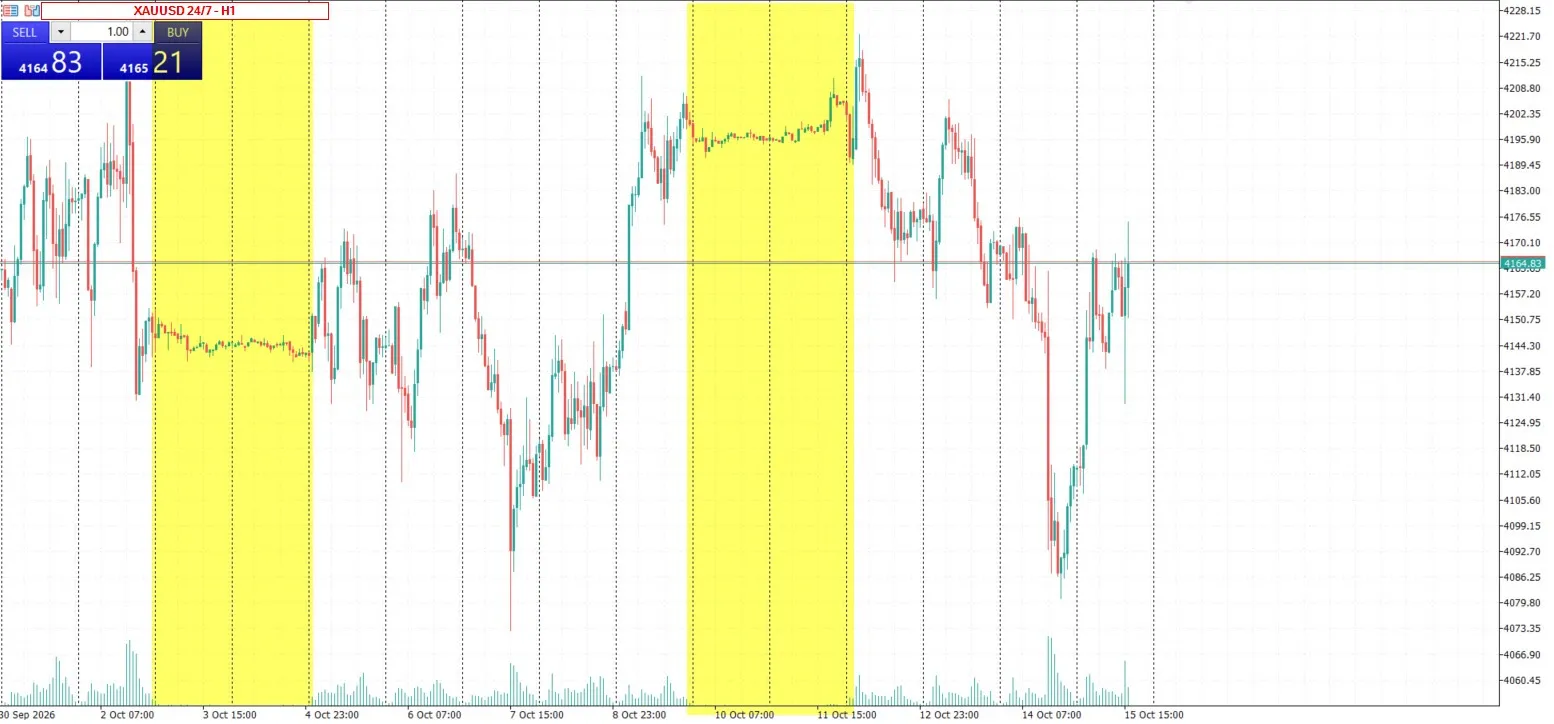
Gold — XAUUSD 24/7 hourly chart, with the weekends of 3–4 and 10–11 October 2026 highlighted in yellow. Source: Alex Hristov, Broktinger.
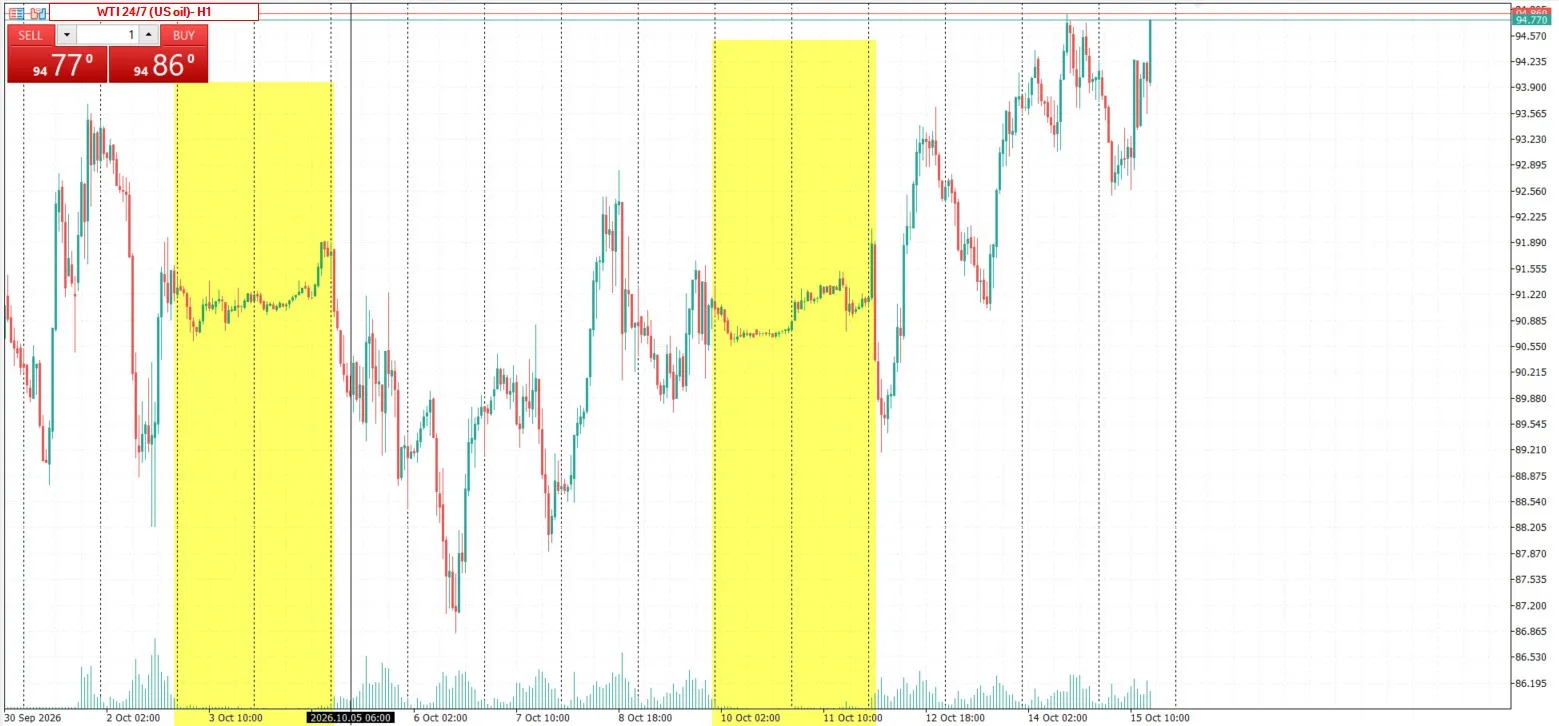
WTI oil — 24/7 hourly chart, with the same weekends highlighted in yellow. Source: Alex Hristov, Broktinger.
When I suggested that brokers were at least making themselves available for the weekends when something significant did happen, Alex had a rather different take:
"I agree, but I consider it more for gambling purposes than for real trading professionals"
That is probably a fair description of some of the activity taking place at the moment.
For professional traders, paying a substantially wider spread to trade a market with very little movement or underlying liquidity is difficult to justify.
But the real test comes when something unexpected happens while the main market is closed.
Hyperliquid: Another Way to Trade Gold at the Weekend
An interesting development is the availability of gold perpetual futures on crypto trading venues such as Hyperliquid.
For those unfamiliar with it, Hyperliquid is a decentralised trading platform offering perpetual futures through on-chain order books.
Its HIP-3 framework, introduced in October 2025, allows third parties to deploy perpetual futures markets, including contracts based on traditional financial assets.
One of these is xyz:GOLD, operated by trade[XYZ].
The instrument is a perpetual derivative referencing the US dollar spot price of one troy ounce of gold, XAU/USD. Unlike a conventional gold CFD, it trades through crypto-market infrastructure.
According to trade[XYZ]'s contract specifications, the gold market offers maximum leverage of 25x, uses cross margin and has a price discovery bound of ±4%, with two permitted resets.
What's interesting is the distinction between its external reference price and the market's own trading hours.
The external gold pricing session runs from Sunday at 6pm to Friday at 5pm Eastern Time. Outside those hours, the usual external reference is unavailable, although trading can continue on the platform, subject to its market rules.
This is an important distinction. A contract can trade 24/7 without having access to the same underlying liquidity throughout the week.
I looked at the daily trading chart for gold on Hyperliquid, and it is pretty clear that volume is significantly down over weekends:
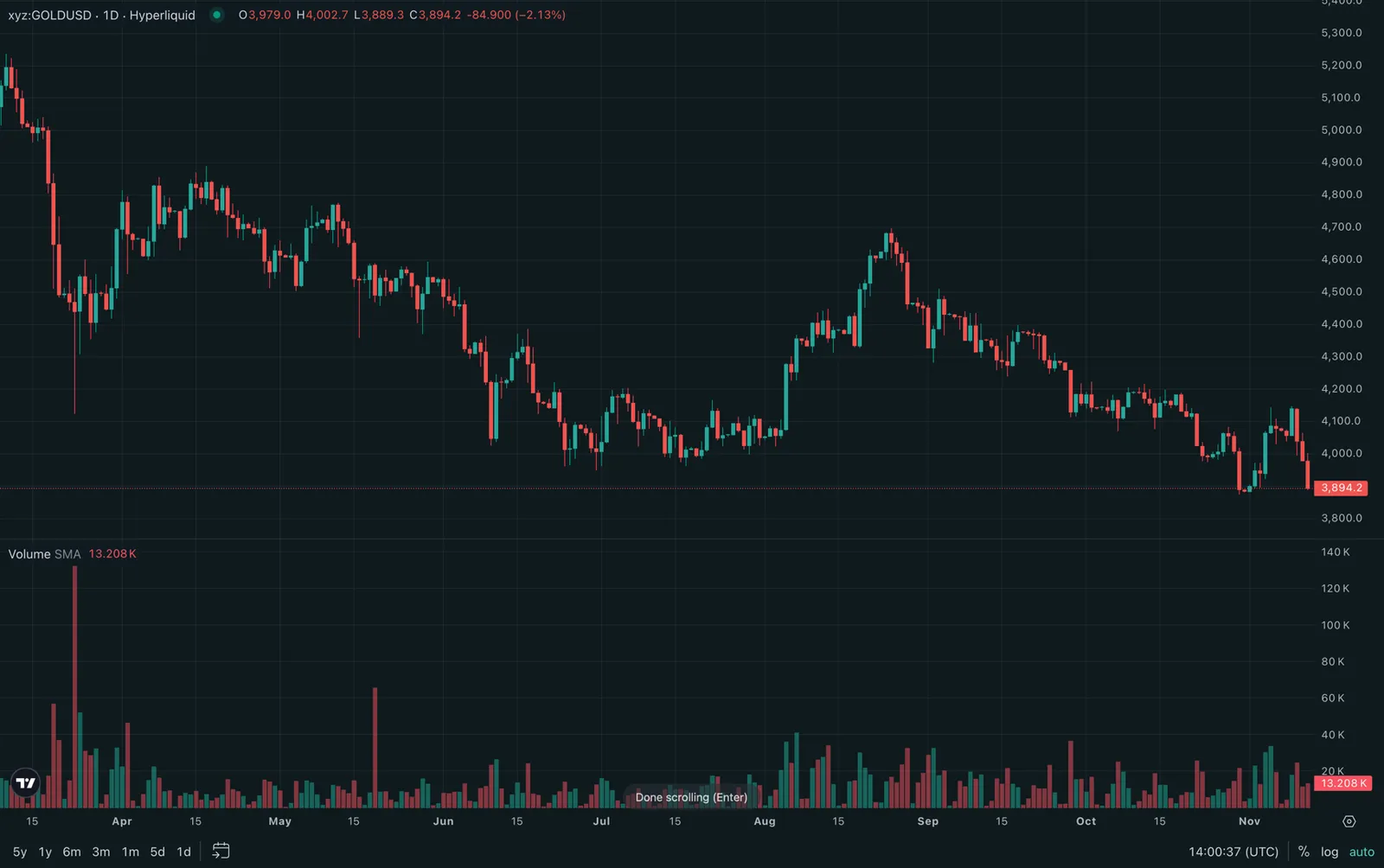
Hyperliquid xyz:GOLD daily price and volume chart. Source: Hyperliquid
The volume bars show that traders are considerably less active at weekends than during the normal trading week, which is consistent with what we're seeing in the broker data.
This is a useful additional source of price discovery, and the existence of a gold perpetual on Hyperliquid does not mean the underlying gold market suddenly has deep institutional liquidity on Saturday afternoon.
I asked Tom Higgins ( @tomhcd290 ), Founder and CEO of @Gold-i , whether Hyperliquid was the main central source of weekend gold pricing and liquidity, and whether it was the pricing source most brokers were using. He confirmed that this was the case for both gold and oil, through perpetual futures.
There is an important difference between using Hyperliquid as a pricing reference and actually routing trades there to execute or hedge exposure. A broker may use its perpetual prices to inform its own CFD quotes without executing client trades or hedges on the venue.
The broker's CFD and the Hyperliquid perpetual remain different instruments, with their own counterparties, margin arrangements and execution conditions. Even where they share a price reference, access to executable liquidity depends on the broker's or liquidity provider's arrangements, the available depth and the size being traded.
That makes the source of the price only part of the question. If brokers are referencing the same perpetual market, what happens if its liquidity thins out or its price becomes distorted during a major weekend event?
IG Was Offering Weekend Gold Before Hyperliquid
IG was offering weekend gold before trade[XYZ] introduced gold perpetuals on Hyperliquid.
So how was IG doing it before these crypto-based gold markets existed?
The answer is that IG makes its own weekend prices.
According to IG's explanation of weekend trading, weekend prices are quoted separately from the weekday instruments, taking account of market conditions, volatility, client activity and news flow.
IG is effectively making a market in gold while the conventional underlying market is closed.
It doesn't need Hyperliquid to do that, and it was already offering weekend gold before Hyperliquid became an alternative source of trading and price discovery.
The important distinction is between being able to quote a price and being able to hedge that price.
IG can manage opposing client positions internally and carry whatever net risk remains until the regular market reopens. Other brokers may obtain weekend pricing from a liquidity provider, which then has to manage the exposure.
That means somebody in the chain is taking the risk of providing a price when the normal gold market is unavailable.
Hyperliquid and other crypto-based venues provide additional sources of price discovery and potentially new ways of transferring that risk.
But they don't remove the underlying challenge.
The comparison with IG shows that 24/7 gold is not really a new invention. What’s changed is the number of brokers offering it now the infrastructure is being developed to support them.
Gold-i: Brokers Want 24/7, Even If Their Clients Aren't Trading Yet
I also asked Tom Higgins, Founder and CEO of trading technology provider @Gold-i, what he is seeing among brokers using Gold-i technology.
Tom's response was particularly interesting because it highlights the difference between the number of brokers already trading at weekends and the demand coming from prospective clients.
Gold-i has approximately 100 brokers using its technology, and Tom estimates that around ten are currently trading over the weekend.
That is roughly one in ten.
He also made the point that trading activity depends heavily on what is happening in the wider world.
"If nothing's going on in the world particularly, then you don't get that much gold trade. You get some, but you don't get that much going on."
But when something unexpected happens, the situation changes.
"If there is some event, something that was not expected to happen, or is announced late Friday night after markets close, then yes, you get lots of activity."
(NB: See the list of significant global events from recent history at the bottom of this piece which is a reminder of what type of significant events have happened over the weekend)
What’s interesting is what Tom's is saying about new business enquiries.
"All of the people we've talked to for new leads all want 24/7."
And when those prospective clients are asked which products they're interested in, gold and oil are the markets they are most interested in.
Tom's conclusion:
"It is not going away. It is very much in demand and increasing."
Only around 10% of Gold-i's existing brokers are currently trading over the weekend, but the demand from prospective brokers appears to be considerably stronger.
So Why Are Brokers Offering It?
The obvious reason is the opportunity to generate additional trading revenue.
But I think there are several other things at work here.
First, there is competitive pressure. If rival brokers are offering 24/7 gold, nobody wants to explain to prospective clients why they cannot do the same. In other words, FOMO.
Second, it gives brokers another product to promote to their existing clients. A new instrument creates a reason to send an email, publish a news story or launch a campaign. In other words, Marketing.
Announcing a new product is one thing. Getting customers to trade it regularly is another.
Third, the economics of weekend flow can be attractive. Fat Spreads!
iSAM’s Radar's analysis found that most brokers in its sample earned at least twice as much profit per million dollars traded on weekend gold compared with weekday gold, measured ten minutes after execution.
With spreads several times wider and fewer high-frequency trading strategies competing for execution, the flow that does arrive can be relatively profitable.
Of course, that does not necessarily translate into meaningful overall revenue when the volumes are so small. As always, competition and increased volume will put pressure on spreads, but hey, if you’re going to do it, maximise the opportunity before it goes away.
And those wider spreads are compensation for taking on additional risk.
Overall - the most compelling reason to offer weekend trading is to be able to offer clients the opportunity to trade when something significant happens. Itis interesting that most of the major military actions we have seen over the past 20 years or so have been at the weekend when markets are closed. They aren’t now. (See table at the bottom of the article).
Who Takes the Risk on Saturday Night?
This was the subject of an excellent contribution from Lars Holst, CEO of prime broker @GCEX, in his recent piece, Who Takes the Other Side at 2am on Sunday?.
Lars explained why operating a 24/7 market is not the same as having continuous access to genuine underlying liquidity.
As he put it:
"The venue may be open around the clock. The ability to hedge is not."
This is of course critical for brokers.
The technology to offer weekend trading is relatively straightforward to obtain but the difficult part is managing positions when normal markets are shut, particularly if clients become heavily positioned in one direction.
Most liquidity providers will respond by quoting wider prices, offering smaller sizes or restricting their exposure.
Radar's analysis suggests that most brokers in its sample actually hedge very little of their weekend gold exposure.
Interestingly, when Radar compared weekend positions with prices at the Sunday reopening, approximately half the brokers had made money and half had lost money on that exposure.
So far, the weekend gaps it observed during the period studied were all below 0.5%.
The market has therefore not yet faced a particularly severe test.
iSAM Securities' assessment is that current volumes alone probably do not justify making weekend gold a major priority for brokers, especially given that almost all weekend gold traders are already existing gold clients.
That’s possibly a sensible conclusion, until it’s not. There will be an event over a weekend where some brokers will be glad they have a weekend gold product for their clients.
The product may be relatively easy to launch, but brokers should understand exactly what risk they're taking on.
Is It Worth Setting Up?
My view is that weekend gold is worth considering, provided the costs are modest and the broker has a clear plan for managing the risk.
Dany Mawas made a practical suggestion when we discussed the subject: offer weekend gold as a separate symbol rather than simply extending the hours of the existing XAUUSD instrument.
That gives the broker more control over pricing, margin requirements and trading conditions. It also makes it easier to place the instrument into close-only mode if a liquidity provider has a problem.
I would also want to understand exactly where the weekend price comes from, how much liquidity is really available behind it, and what happens if a large position needs to be hedged when the normal market is closed.
Position limits, margin requirements and automated risk controls all become particularly important.
And somebody still needs to be responsible for the book when the usual dealing desk is not there.
@Brokerpilot, which develops risk management software for multi-asset brokers, made this point in The Weekend Now Has a Risk Desk Problem.
Automated exposure limits and close-only triggers are useful, but they can only respond once certain conditions have been reached.
There still needs to be an effective process for monitoring exposure and responding to unexpected events.
For brokers that do not want to staff a dealing desk throughout the weekend, an outsourced service may be an option.
Broktinger is one provider offering this type of support, and Alex Hristov recently explained what an outsourced dealing desk actually does for LiquidityFinder.
I would also be cautious about automatically internalising weekend flow just because spreads are wider.
The additional revenue per trade needs to be weighed against the possibility of being caught on the wrong side of a substantial market move.
For a broker without the necessary resources to manage weekend risk, it may make more sense to pass the flow to a liquidity provider, at least initially, provided the provider can offer a reliable service.
To give a shout out to another firm on LiquidityFinder, PLUGIT apparently have the go-to Dynamic Margining tool that should be an essential bit of kit for managing changes in margin - dynamically - over the weekend. (all enquiries to [email protected] - you’re welcome PLUGIT!)
What Happens Next?
Inevitably more brokers will be pushing out press releases about weekend gold over the coming months, along with oil etc.
The infrastructure is available, liquidity providers are offering the product, and nobody wants to be the broker that cannot give clients access when the next significant weekend event occurs.
Gold is likely to remain the focus, at least initially.
Tom Higgins says oil is also high on the list of products that prospective brokers want to offer, but the trading data suggests that demand is not yet developing in the same way as gold.
There are also genuine concerns about extending trading hours in other commodity markets.
On 2 October, CME Group withdrew its plans to launch a 24/7 10-Barrel Crude Oil futures contract, following discussions with market participants about the potential risks. (There is more to this than meets the eye I am sure).
That is a reminder that extending trading hours is not always as straightforward as it might appear.
Another development worth watching is the increasing availability of traditional financial instruments on crypto trading platforms.
Hyperliquid and other venues are bringing gold, oil, equities including pre-IPO stocks (brace yourselves for all the marketing announcements about Anthropic) and indices into a trading environment where clients are already accustomed to 24/7 access.
The crypto trading audience is different from the traditional CFD broker's client base, but there will be convergence over time.
Radar's analysis found that Binance's XAU/USDT perpetual was quoted at a one-tick spread for 99.99% of the time during the three months it examined, with median top-of-book size of $122,000 at weekends compared with $139,000 during the week.
That suggests that some crypto-based gold markets can maintain relatively tight displayed pricing even at weekends.
But displayed spreads are only part of the picture. Fees, executable depth and the cost of trading larger sizes all matter.
Radar found that trading gold on crypto exchanges remained considerably more expensive for larger trades than at leading CFD brokers. That makes it unlikely that crypto venues will immediately take substantial gold trading volumes away from established brokers.
Nevertheless, they provide another source of activity and price discovery outside traditional market hours.
Over time, increased competition between venues and liquidity providers should improve trading conditions.
Dany Mawas made an interesting comparison with the FX market in 2008, when EUR/USD spreads were commonly two and a half to three pips.
The arrival of non-bank liquidity providers and more competitive pricing helped transform that market.
He expects weekend trading conditions to improve in a similar way, although he thinks it will take time.
I think it’s all only a matter of time. Gen Z doesn’t go out like we used to in ‘the old days’. They are more likely to stay at home and trade after early morning yoga.
The Tapaas data already shows that weekend gold activity is growing, albeit from a very low base. Radar is seeing a similar pattern, and Gold-i's experience suggests that brokers are increasingly asking for 24/7 capability even if they aren't using it yet.
There is a clear commercial ambition behind all of this. As Stuart Pettman suggested, brokers want the opportunity to generate revenue seven days a week.
For now, weekend Gold is still a small market, with much wider spreads, limited liquidity and relatively few active traders. The infrastructure is being put in place ahead of the demand. Which will come. I am sure it is a case of 'build it and they will come'. Not the same volumes as mid-week (for the foreseeable future at least), but more profitable if risk is managed diligently.
My feeling is that the real test will come on a weekend when something major happens. (“psst - Mr Trump - just fyi - markets are 24/7 now.)
The brokers that are open at the weekend will be in place to benefit. Technically it’s not a heavy lift now to add 24/7 gold - just remember the additional risk though people.
Found this interesting? Become a member of LiquidityFinder and get daily industry news direct to your inbox — join here.

Recent significant events where having access to weekend Gold or Oil would have produced heightened activity (and risk!)
Big moves at the Monday open
• September 2019, Abqaiq. On Saturday 14 September, drones and missiles hit Saudi Aramco’s Abqaiq processing plant and the Khurais oil field, knocking out 5.7 million barrels a day, about half of Saudi output. When trading reopened on Monday, Brent jumped as much as 19.5% to $71.95, its biggest intraday rise on record.
• March 2014, Crimea. Russian troops took control of Crimea, and on Saturday 1 March Russia’s upper house approved Putin’s request to use force in Ukraine. On Monday the rouble fell 2.2% to an all-time low against the dollar and the MICEX dropped 10.8%. The Bank of Russia raised its key rate by 150bp to 7% and sold $11bn to support the currency. theglobaltreasurer
• August 1991, Soviet coup. Communist hardliners detained Mikhail Gorbachev at his Crimean holiday home on Sunday 18 August and seized power. The takeover was announced just after 6am Moscow time on Monday, so markets opened straight into it. The Dow fell more than 100 points in early trading and closed 2.36% lower, while the dollar surged and Brent spot rose from $19.45 to $20.62. 1991 Soviet coup attempt +2
• October 2023, Hamas attack on Israel. Hamas launched a surprise attack on southern Israel at dawn on Saturday 7 October, killing around 1,200 people and taking about 250 hostages. Oil rose as much as 5% at Monday’s open and gold gained 1%.
• February 2026, US and Israel strike Iran. US and Israeli strikes on Iran on Saturday 28 February killed Supreme Leader Ali Khamenei. On Monday, Brent jumped 9%, gold touched $5,400 and Iran reportedly closed the Strait of Hormuz.
• July 2016, Turkey coup attempt. A faction of the Turkish military tried to overthrow President Erdoğan on the night of Friday 15 July, putting tanks on the streets of Istanbul and Ankara, but the coup collapsed by Saturday morning. The lira fell 5% late on Friday, and the BIST 100 dropped more than 7% when markets reopened on Monday.
Would have gapped hard if things hadn’t calmed down
• June 2025, US strikes on Iran’s nuclear sites. US bombers struck three Iranian nuclear facilities on the evening of Saturday 21 June. Brent rose almost 6% in early Asian trade on Monday. Iran then retaliated with a missile attack on the US base at Al Udeid in Qatar, leaving Gulf tanker traffic untouched, and Brent settled 7.2% lower at $71.48. gcaptain
• April 2024, Iran’s first direct attack on Israel. Iran launched more than 300 drones and missiles at Israel on Saturday 13 April, in retaliation for a strike on its consulate in Damascus, and nearly all of them were shot down. Bitcoin fell about 8% on Saturday evening, but oil slipped about 1% on Monday as the attack proved less damaging than feared. thenationalnewsbusinesslive
• October 2024, Israel strikes Iran. Israel hit Iranian military targets early on Saturday 26 October, in retaliation for an Iranian missile attack earlier that month, but avoided oil and nuclear sites. Oil fell more than 6% on Monday, its biggest daily drop in over two years.
• June 2023, Wagner mutiny. On Saturday 24 June, Yevgeny Prigozhin’s Wagner mercenaries seized the city of Rostov-on-Don and advanced on Moscow, before standing down that evening. Oil rose more than 1% when futures reopened on Sunday, and the rouble hit a 15-month low on Monday.
• May 2025, India and Pakistan. After days of missile and drone strikes between the two nuclear powers, a ceasefire was announced on Saturday 10 May. On Monday, the Sensex rose 3.7%, its biggest points gain on record, and Pakistan’s KSE-30 jumped 9.2%, triggering a trading halt.
• April 2018, Syria strikes. The US, UK and France fired missiles at Syrian chemical weapons sites on the night of Friday 13 April, after a suspected chemical attack on the town of Douma. The strikes proved limited, so stocks rose and oil fell on Monday.
• January 2026, Venezuela. US forces captured President Nicolás Maduro in a surprise operation on Saturday 3 January. Gold rose over 2% to $4,430 on Monday.
• September 2017, North Korea nuclear test. North Korea carried out its sixth and most powerful nuclear test on Sunday 3 September. Gold and the yen rose when Asian markets opened on Monday.
Share this article

Comments
Most Recent
Find The Right Partners for
Your Trading Business
Sign up and join over 5,000 professional members who receive personalized news alerts, curated professional connections, and more for free!

How can foreign brokers enter Brazil? Henrique Conte of FinPlus explains the local partner route, your own licence, CVM rules, costs and capital.

Scope Prime's Andrew Taylor sets out how brokers serving Asian clients should measure and price sharp gold flow, citing the October 2025 and January 2026 sell-offs, thin liquidity at the Asian open, segmentation over relationship-wide repricing and the questions to ask a prime of prime provider.

Scope Prime's Andrew Taylor sets out how brokers serving Asian clients should measure and price sharp gold flow, citing the October 2025 and January 2026 sell-offs, thin liquidity at the Asian open, segmentation over relationship-wide repricing and the questions to ask a prime of prime provider.

Some thoughts from Forex Expo Dubai 2026 about forex brokers: what was going on in the competition for attention, offshore unregulated entities on the same playing field as multi regulated brokers, in-house AI builds and the rise of prediction markets.

A comprehensive interactive guide to 50+ global financial regulators - including FCA, ASIC, CFTC, MAS and ESMA - rated across five dimensions: risk management, licence value, investor protection and more. Updated 2026.

A comprehensive look at SEBI regulations, permitted currency pairs, broker options, and what the institutional landscape looks like.
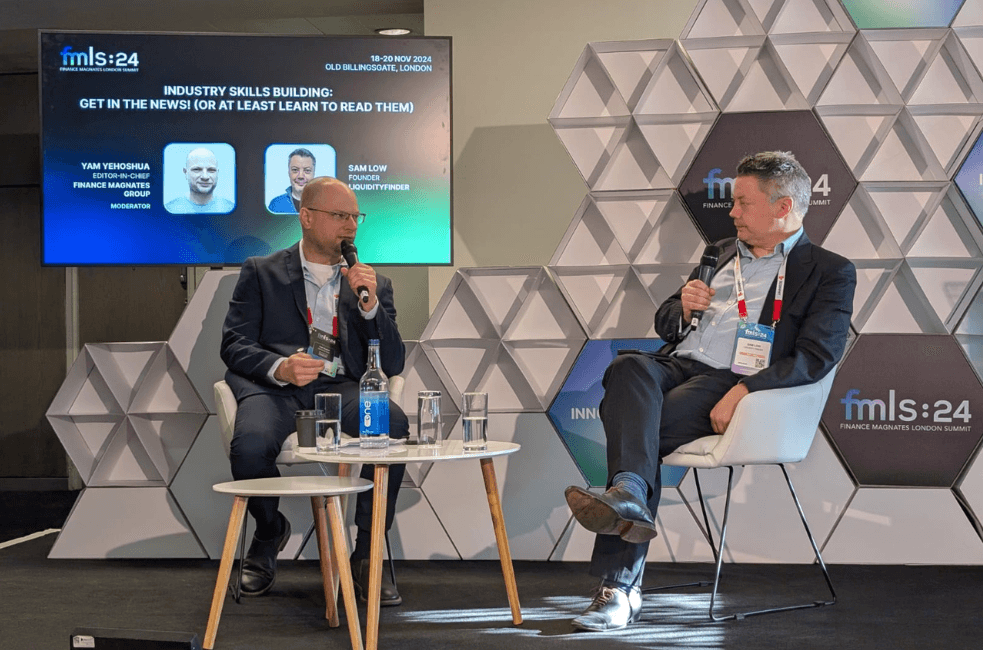
As someone who receives hundreds of press releases and news submissions, I wanted to share some insights on how financial firms can more effectively work with industry publishers. During a recent panel discussion with Yam Yehoshua from Finance Magnates at FMLS24, we explored the key elements that make for successful PR in our industry.

Mauritius is an attractive destination for retail brokerages, and the FSC of Mauritius continues to support the development of regulatory frameworks. Here’s everything you need to know if you’re considering setting up a retail brokerage in Mauritius.
Create Your FREE Account
Get access to latest news, updates, real-time data, brokerage and trading firm insights and customized information feeds.


smartTrade Technologies SAS has acquired Celoxica, a provider of ultra-low latency execution infrastructure for listed markets across 80+ venues worldwide. The deal extends the smartTrade Group’s reach from OTC to listed markets, and Celoxica General Manager Jean-Marc Bouhelier joins the smartTrade Executive Committee.


The collaboration adds outsourced dealing, real-time risk intelligence and trading-flow surveillance to STARPRIME's institutional liquidity offering.

MAS Markets has appointed Gareth Palmer as eFX Sales, bringing more than 20 years of financial services experience to develop the FCA-regulated liquidity provider’s electronic FX sales capabilities, strengthen institutional client relationships and expand its electronic trading offering across global markets.

Usio has reported third quarter 2026 revenue of $23.8 million, up 12%, with Adjusted EBITDA up 222% to $1.2 million, total payment dollars processed up 25% to $2.73 billion and a sixth consecutive quarterly record in ACH transactions, and has reiterated its guidance of 14% to 16% revenue growth for 2026.

Macquarie Bank has admitted failures in how it promoted its Welcome Rate offer for new savings account customers, with ASIC and Macquarie jointly proposing a $14 million penalty to the NSW Supreme Court, on top of $8.8 million in remediation that Macquarie has already paid to nearly 40,000 customers.

Alta, a new blockchain designed for banks and payment firms, has raised a $47.5 million Series A led by Index Ventures, with GV joining, taking total funding to $80 million. What caught my eye is that Airwallex CEO Jack Zhang is a co-founder and Airwallex is an early design partner, giving Alta access to fiat rails in around 200 countries from day one. Privacy and compliance built into the chain itself is exactly what institutions have been asking for.

DriveWealth, the embedded brokerage engine behind a long list of fintech apps, has secured MiCA authorisation from the Bank of Lithuania. Its EU entity already held a MiFID II licence, so one Vilnius-based firm can now offer partners securities and crypto-assets under a single regulatory roof, with crypto services due in the new year. Add the recent Ripple tie-up for RLUSD settlement and the direction is obvious: stocks, stablecoins and tokenised assets through one API. A shot across the bows for white-label brokerage rivals in Europe.

Revolut has been handed a conditional banking licence by the Bank of Israel, only the third new bank licence there since 2019 in a market long dominated by Hapoalim and Leumi. It cannot take customers yet, but with former Leumi chairman Muli Ben Zvi and ex-Pepper CEO Uri Nathan running the show, it clearly means business. Israel is a sophisticated, internationally minded market where FX and cross-border payments matter, so Revolut's multi-currency proposition should land well. Another notch on a remarkable 2026 licence tally.

Two weeks after launching round-the-clock RFQ trading in DAX 40 shares on 360X, Deutsche Börse has gone further: all 40 DAX constituents are now available as tokenised xStocks, built with Kraken parent Payward and within reach of investors in more than 110 markets. When an exchange group of this calibre distributes its own blue chips on-chain, tokenised equities stop being a crypto-native experiment. Brokers offering German stock CFDs to Asian and LatAm clients should be paying close attention.

eToro's Q3 numbers made for uncomfortable reading. Net income fell 74% to $15 million and net contribution slipped 13% to $186 million as crypto activity cooled, and the shares touched an all-time low. Yet funded accounts grew 18% to 4.39 million, so the client franchise is intact; this is a revenue mix problem, not a growth problem. The $250 million buyback tells you management thinks the market has it wrong. My take: the multi-asset story only works if capital markets can carry the quarters when crypto goes quiet.
Feed