
Search Companies, News, Members & more
Terms of ServicePrivacy PolicySecurity PolicyLegal InformationCommunity GuidelinesSitemapsCookie Settings
2026 Copyright © Liquidity Finder Ltd. All rights reserved.
Liquidity Finder Ltd is incorporated in England and Wales, company number 10610740, registered address 167-169 Great Portland Street, Fifth Floor, London W1W 5PF, United Kingdom.
What Does an Outsourced Dealing Desk Actually Do?

Published on Sep 9, 2026
Updated on Sep 9, 2026
Most brokers do not fail because they cannot find clients. They fail due to poor risk management, poor processes and judgement on how to manage client risk. Or put another way, some brokers succeed through risk management (stay in business) but don't optimise the opportunity to be as profitable as possible.
The place where this really matters is the dealing desk. For a large brokerage it is a department. For a start-up or a small firm it is often one person, part-time, or sometimes the CEO himself. The outsourced dealing desk (ODD) model fills that gap. Small / start-up brokers who often cannot afford an in-house around-the-clock team of dealers can benefit from the cumulative years of experience from dealers who have cut their teeth at other brokerages. Instead of 'winging it' in the hope that the business at least is not losing money and hoping to become profitable enough to attract experienced dealers to your business, you can hand over this critical part of your business to an experienced team that will work with you without having to compete for experienced, expensive and sometimes disloyal dealers from rival brokers. The Outsourced Dealing Desk sector has grown as the cost of hiring experienced dealers has risen, and the number of newly licensed brokers competing for them has increased.
To understand what the ODD service actually covers I put a set of questions to Alex Hristov ( @alexanderh29acf ) of outsourced dealing and risk technology provider Broktinger ( @broktinger . He has been behind a dealing desk for seven years and now runs a team providing dealing, risk management and a suite of monitoring tools to brokers at Broktinger.
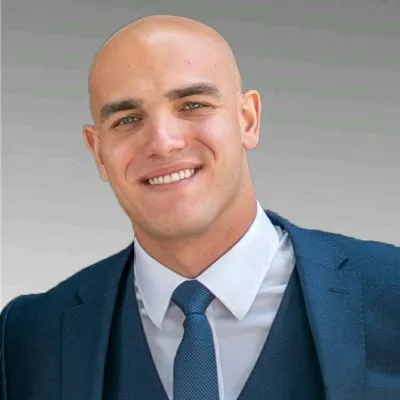
Alexander Hristov, CEO & Co-founder of Broktinger
What is an outsourced dealing desk, and why do brokers use one?
Alex Hristov, Broktinger: An outsourced dealing desk is essentially a partnership between a broker and a group of professional dealers and risk managers, where the broker allocates the majority of its day-to-day dealing and risk-management operations to that external team while focusing its own resources on other areas of the business. The main advantage is that the broker gets direct access to experienced, trained professionals who have already spent years managing trading flow, execution, exposure, liquidity and risk across different brokerage environments, without having to build that expertise from scratch.
This is particularly valuable for start-up, small and mid-sized brokers, which are usually the best fit for an outsourced dealing desk. Building an internal team means hiring several experienced dealers to provide proper shift coverage, paying competitive salaries for highly sought-after professionals, training them on the broker's specific setup, and then going through the inevitable trial-and-error period before the team is fully operational.
An outsourced desk removes much of that cost, time and operational risk, and gives the broker immediate access to a team that is already trained and operational. It also allows the broker to concentrate on what actually grows the business, marketing, business development, customer acquisition and retention, customer service and entering new markets, while experienced dealers take care of the operational side.
Ultimately, it is not about simply having someone monitor a trading platform. It is about having professionals who know what to monitor, understand what could go wrong, and know how to react when something does. For a start-up or smaller broker in particular, that combination of expertise, immediate availability and cost-effectiveness can be far more practical than building an expensive in-house dealing and risk-management department from the ground up.
Have you seen brokers go from unpredictable results to predictable growth on the back of that?
AH: Many brokers come to us after they have suffered because they tried to manage it on their own, or somebody inexperienced did it for them. That costs money and time, and it damages their reputation. We try to avoid all of that by providing what is needed straight away, without an unclear path and promises. We guarantee a smooth and fast operational launch, which is crucial for start-ups.
A broker signs with you on Monday. What are your dealers doing on the broker's behalf by Friday that they were doing themselves the week before?
AH: When a new broker signs with us, the first thing we do is conduct a full and thorough review of their setup. This starts with the smallest trading-platform settings and goes all the way through execution rules, bridge mappings, feed supervision, and ultimately LP execution.
We identify the weak points in the setup, explain what the problem is, what is causing it, and how we recommend resolving it. Once the broker confirms how they would like each issue to be handled, we take action and optimise the setup where necessary.
From there, we move into ongoing monitoring, something the broker may have been doing themselves, or at least believed they were doing. This includes real-time exposure monitoring, feed and execution monitoring, and trading-flow and book monitoring.
Our team makes sure that no symbol is left without pricing for an unexplained reason, no exposure remains uncovered, no orders become stuck in the queue, and that execution continues to adhere to best-execution standards and provide the best possible customer experience.
Our dealers and risk managers also continuously monitor and review clients' trading behaviour and profile them accordingly. Toxic flow and abusive patterns are identified in time, while B-book and A-book profiling is established. The broker can then decide whether a particular client should be STP'd, B-booked, or potentially C-booked.
The dealing service is not something that you set up once and expect to work forever. Quite the opposite: the ongoing monitoring and continuous optimisation are what make the service valuable.
A broker has to continuously adapt to market tendencies by introducing new offerings, adjusting execution, onboarding new LPs, and making other operational changes. This is not work for inexperienced eyes. It should be handled by professionals who constantly ask, "What could go wrong?"
That is a question many brokers only ask after something has already happened. We ask it before it happens.
What does coverage actually look like? Talk us through the shifts, the team, and the key times in the week: the Sunday open, the data releases, the gaps.
AH: Depending on our arrangement with the broker, we can provide 9/5, 24/5, 24/7, or dedicated weekend coverage.
Our standard coverage is typically from 09:00 to 18:00, but this can be adjusted according to the broker's requirements. Depending on the scope, there can be one, two, three, or more dealers covering the desk, allowing us to make sure that the required operational hours are properly covered.
The moments that require particular attention are market opens and closes, as well as major economic news releases (NFPs for example). These periods are normally associated with increased volatility and therefore a higher probability of execution issues, pricing problems, liquidity changes, or abusive trading activity.
The team pays particular attention to these periods rather than simply following a fixed schedule. The objective is not just to have someone sitting behind the desk, but to have the right level of supervision when the market actually requires it.
What stays with the broker? You have said the appeal is that they can focus on business development and winning clients, so how thin does the operational side realistically get, and what can never be handed over?
AH: Broktinger can provide full coverage of the brokerage's dealing and risk-management operations.
This allows the broker to concentrate on the areas where its own resources are most valuable: business development, payments, advertising, client acquisition and retention, and expansion into new markets.
At the same time, we make sure that the operational side of the brokerage runs smoothly and that the trading environment and client experience remain properly managed.
The idea is not simply to remove work from the broker's team. It is to transfer the specialist operational responsibilities to people whose day-to-day job is dealing, risk management, platform operations, and execution, while the broker's management can focus on growing the business.
How does the commercial arrangement work?
AH: All of our commercial arrangements are highly individual and tailored to the specific needs of each client.
We normally start by understanding exactly what the broker needs. After several discussions and a detailed assessment, we provide our recommendations and define what the service or product should include. The final decision remains with the client.
One important principle for us is that we do not upsell simply for the sake of increasing the contract value. We do not try to sell a broker something they do not need or something that would unnecessarily become a financial burden.
Our approach is simple: we aim to resolve problems rather than create new ones.
We also keep the relationship flexible. If a client is not satisfied with our services, our agreements include a flexible termination policy that allows them to end the relationship.
Ultimately, we want the commercial arrangement to work for both sides over the long term, rather than forcing a client into a service that is not delivering value.
if I am a broker coming to you to manage my dealing desk and I have existing LP relationships, what happens to those relationships?
Everything that the broker has in place stays as it is unless they decide to change it. We do not apply our LP, bridge providers, CRMs etc. Our intention is not to convince the broker to change their infrastructure if they do not want to, but to optimise it. In the broker asks for an advice or recommendation, we will do it, but not if they didn't.
I know some of our competitors rush to up-sale their relationship partners and to get a rebate from traded volume figures or profit share, this is something strongly against our policies and intentions.
You are a dealer yourself. Across the brokers you have worked with, what are the most common risk-management mistakes you see when a firm runs the desk in-house?
AH: I have personally been behind the dealing desk for the last seven years, while some of the dealers on our team have more than 15 years of experience.
One of the biggest mistakes we see is that, when starting a brokerage, people approach it like any other business. They often begin by setting up the brokerage themselves, using a standard template provided by a platform provider, or relying on an unauthorised or inexperienced dealer specialist.
The reality is that a brokerage is a very specialised business, particularly when it comes to the operational side. It cannot simply be compared with other businesses.
Many brokers underestimate this, and I believe this is one of the reasons a significant number of new brokers fail within their first year.
Having successfully run a multimillion-dollar business in another industry does not necessarily mean that you will successfully run a brokerage. Bringing clients into the business is only one part of it.
There are thousands of small operational details that need to be considered to make a brokerage run smoothly. Every single one can be important, even when it appears insignificant.
We often see brokers prioritising things such as onboarding large numbers of symbols, adding multiple liquidity providers, or creating numerous group types that may never actually be used. In some cases, this only makes the setup more complicated and can increase costs, when a much simpler configuration would have been a better choice for the business.
I often compare running a brokerage to owning a private jet. You can buy the aircraft and fill it with passengers, but without an experienced pilot, the plane either may never leave the ground or may eventually crash, and the consequences of that can be extremely damaging to the company's reputation.
Hiring an in-house dealing and risk-management team is not always the most efficient solution either. The people need to have the right experience. If they do not, there can be a long learning curve, mistakes, and operational failures before they are ready to run the business properly.
Broktinger gives brokers direct and immediate access to an experienced team for a fraction of the cost of building a comparable internal team, while significantly reducing the operational risk.
And we do not simply promise high-quality work. We can demonstrate it within days.
Some of our clients are completely new brokers who need to launch their trading platform as quickly as possible. In those cases, using an experienced external team can make a significant difference. Within a matter of days, the broker can have a fully functional and tested trading environment ready to onboard real clients, without going through a prolonged trial-and-error period.
In such a highly competitive industry, that can be crucial.
What has changed in dealing over the past two years? Prop-firm crossover, flow quality, the role AI is starting to play on both sides of the trade?
AH: The brokerage industry is one of the fastest-developing and most constantly evolving industries, and a lot has changed over the past few years.
Traders are increasingly using Expert Advisors and algorithmic trading bots. AI is also playing a growing role in this development. It is now significantly easier to develop and deploy a trading strategy than it was five years ago, even for someone with little or no development experience.
Prop firms have also changed significantly. The traditional proprietary model was largely focused on identifying talented traders, funding them, and allowing them to trade on behalf of the company. Today, many prop firms have moved towards challenge-based models, where large numbers of smaller traders attempt challenges and, in many cases, eventually fail.
Prop is a very niche type of brokerage business and can be particularly difficult to manage. However, when structured and managed correctly, it can be a highly profitable business both for the broker and for its customers.
At the same time, toxic flow and abusive trading behaviour have become increasingly sophisticated and more difficult to identify, especially before the broker has already been exposed to the consequences.
Today, obtaining a brokerage licence and establishing the basic infrastructure is arguably one of the easier parts of the business. Launching smoothly, onboarding clients who remain with you for the long term, maintaining the required standards, and remaining competitive are much more difficult, and this is where many brokers fail.
Almost anyone can obtain a trading platform, a bridge, an LP feed, and various brokerage tools. Far fewer companies know how to manage all of those components properly and build a successful brokerage without damaging their margins or reputation within the FX community.
That is where Broktinger comes in. We make sure that things are not simply done, but that they are done correctly.
Over the last year you built a set of tools for your own desk and now offer them to brokers. Take us through them, starting with the general brokerage tools and then the BI Risk Detector, and tell us what problem each one was solving for you first.
AH: Broktinger's main goal is to develop and provide tools developed by dealers, for dealers.
Everything we offer to our clients is something that we have used, and in many cases continue to use, ourselves on a daily basis. The solutions were created because we identified a real operational need and because they help solve practical problems, not simply because we wanted another product to sell on a subscription basis.
We do provide general brokerage tools such as the Swap Changer, Inactivity Fee, Spread Report, Holiday Setter, Dividend Allocator, and Balance Processor, offering them at an affordable price and often with better quality than the alternatives available on the market.
However, one of the solutions we are particularly proud of is our BI Risk Detector Tool, which consists of several components:
Exposure Monitor
The Exposure Monitor provides real-time monitoring of exposure across both the trading platform and LP exposure.
It continuously monitors factors such as lots, notional-value limits, P&L, and other exposure parameters. If there is a mismatch or uncovered exposure, an alert is generated immediately.
There is no need for manual calculations or constant checking of the A-book and B-book split or overall exposure. The system monitors it live for you.
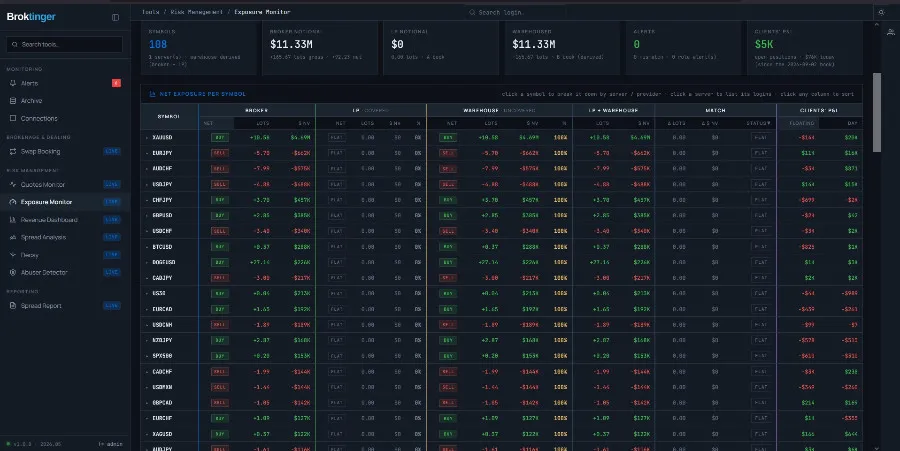
The Exposure Monitor shows net exposure per symbol across broker, LP and warehouse in a single view.
Quotes Monitor
The Quotes Monitor provides real-time monitoring of all quotes received by the trading platform and helps investigate potential issues.
It generates immediate alerts when quotes are delayed or missing. Holidays and session breaks are automatically taken into consideration.
Instead of logging into server after server and manually checking whether something is wrong with the pricing, or waiting for a client to complain, the system identifies the problem for you.
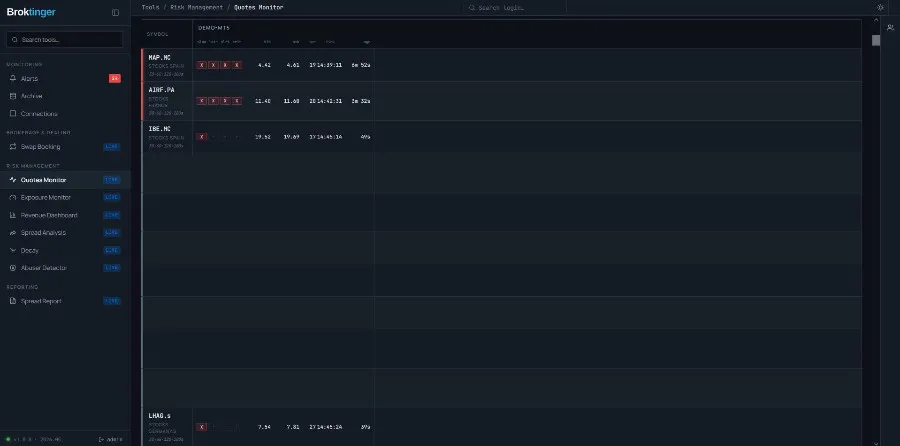
The Quotes Monitor flags stale and missing quotes by symbol, with the age of the last tick alongside.
Spread Analysis
Spread Analysis provides real-time monitoring of spreads between different feeds or different servers.
It can generate automatic alerts when there are delays, negative quotes, or situations where one feed is slower than another. It can also reveal potential arbitrage opportunities.
Historical events can then be investigated down to the second, allowing the broker to understand exactly what happened during a particular spread movement.
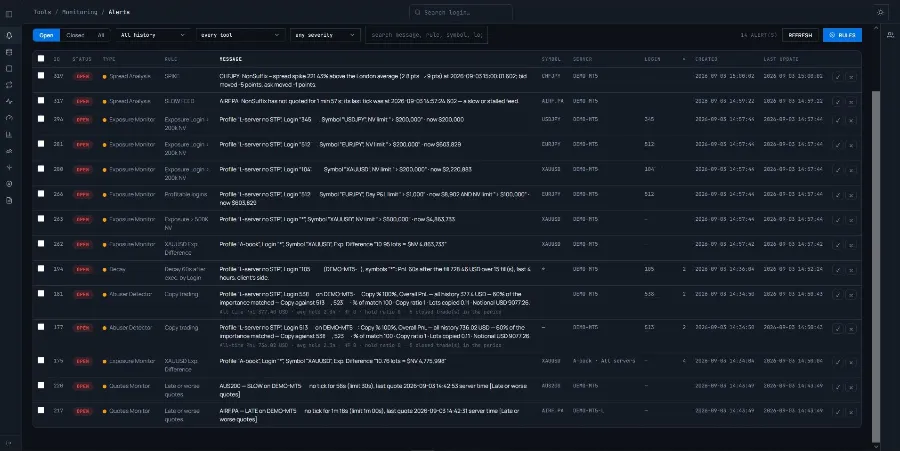
Spread Analysis alerts covering a spread spike above the London average and a stalled feed.
Decay Analysis
Decay Analysis examines order behaviour before and after every execution.
The objective is to provide a detailed picture of potential abusive traders who consistently become profitable immediately after execution.
This helps the broker determine whether its pricing feed is optimal and whether it follows genuine market movements, rather than leaving the broker unnecessarily exposed to traders who can exploit weaknesses in the feed.
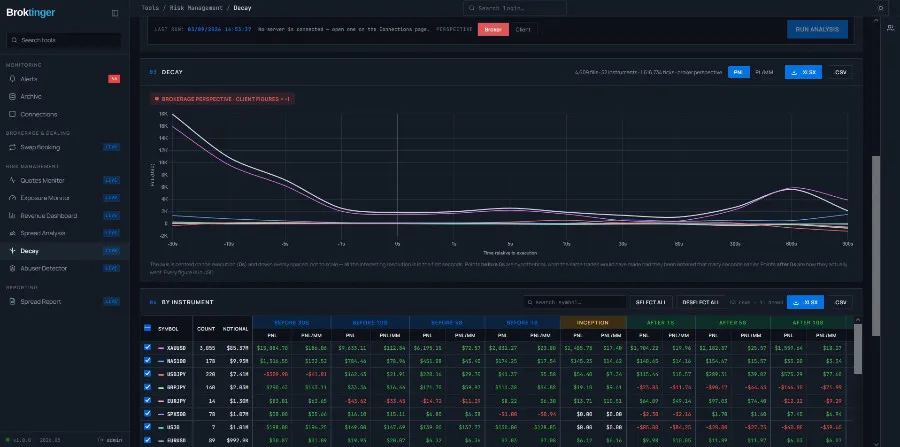
Decay Analysis plots P&L either side of execution, from 30 seconds before the fill to 900 seconds after.
Revenue Dashboard
The Revenue Dashboard provides immediate access to historical and current performance figures.
This includes realised and floating P&L, revenue from swaps, commissions and fees, negative-balance corrections, and total traded notional volume.
The broker can also identify its most active clients, the most profitable or loss-making clients, the most traded symbols, and the realised results associated with them.
Deposits, withdrawals, equity, and credit changes can be accessed with a single click.
The dashboard also provides current NOP information and historical NOP information as of any previous rollover.
All of this information can be exported into well-organised reports and is automatically refreshed in real time, giving the broker the ability to monitor server performance continuously.
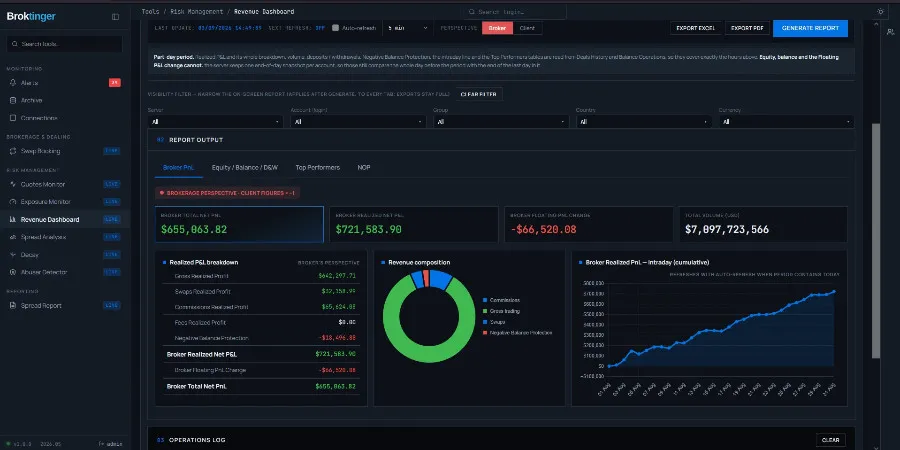
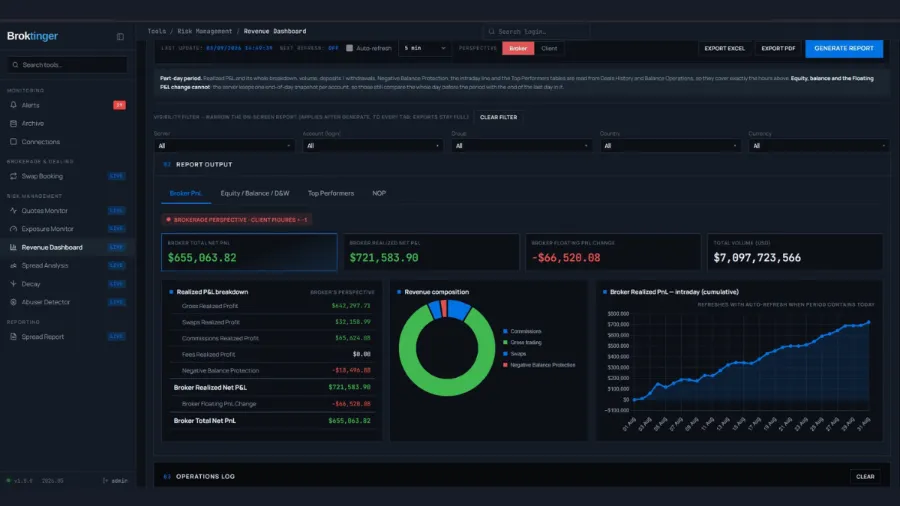
The Revenue Dashboard breaks realised P&L into gross trading, swaps, commissions and negative balance protection.
Abuser Detector
The Abuser Detector identifies 25 different types of abusive strategies by scanning historical trading activity to create client profiles, or by running checks in real time and generating immediate alerts when toxic flow is detected.
It checks for patterns such as latency arbitrage, HFT, scalping, insider activity, CID, IP matching, and many others.
The objective is to give the broker greater protection and improve the overall stability and quality of its trading flow.
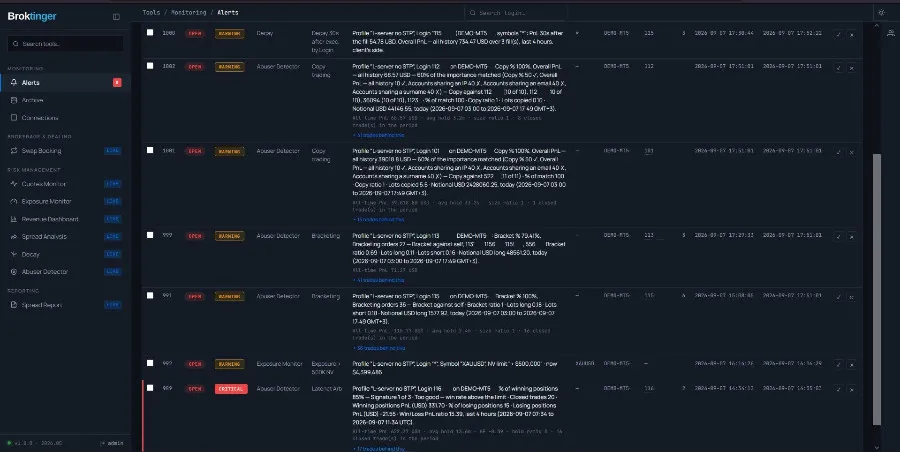
Abuser Detector alerts covering copy trading, bracketing and latency arbitrage, with the underlying trades one click away.\
Alerts
All of the above Risk Detector components can generate real-time alerts.
Every tick, trade, and volume can be monitored, with warnings generated whenever something falls outside the expected parameters.
The idea behind all of these tools is simple: take the monitoring work that dealers were previously doing manually and make it faster, more consistent, and easier to act upon.
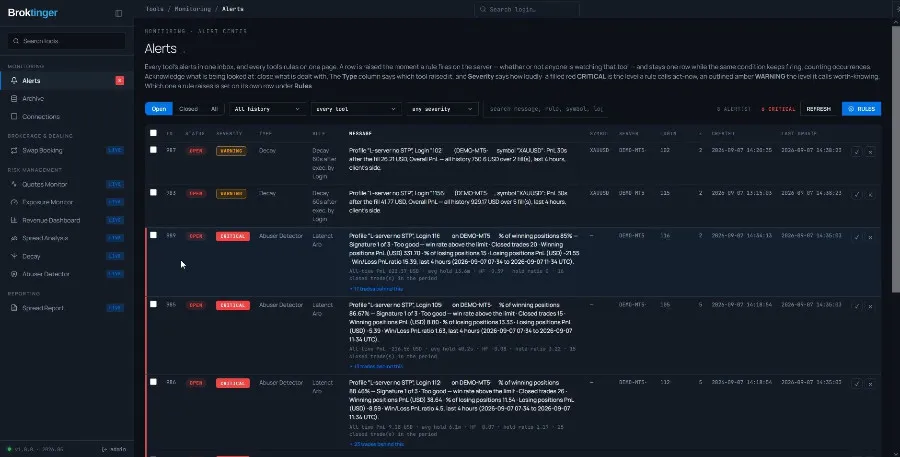
Every tool's alerts arrive in one inbox, separated into warning and critical severity.
What do they show a broker that the platform's own reporting does not, particularly one running exposure across multiple MT5 servers?
AH: A trading platform such as MT5 was not designed to be interpreted by the naked eye.
It provides a wide range of server reports, but those reports are often not particularly user-friendly. They may need to be exported in inconvenient formats and usually require additional calculations before the broker can obtain the information it actually needs.
That creates additional time and manual work, increases the possibility of human error, and often requires someone with data-analysis experience to interpret the information correctly.
The tools we provide, both configuration tools and monitoring and reporting solutions, are designed to be much more user-friendly. The information is presented in a structured and segregated way, so the user does not have to perform additional calculations just to understand what is happening.
Another important advantage is that our solutions can connect to multiple MT5 instances and provide an overall picture across the brokerage, rather than forcing the user to analyse each server individually.
This is particularly important when monitoring exposure or client performance.
It is physically impossible for someone to effectively monitor four different screens, ten different dashboards, and multiple server reports simultaneously.
And more importantly, there is no reason to do that manually when a single system can consolidate the information, monitor it continuously, and send an alert whenever something requires attention.
The goal is not to replace the dealer. It is to give the dealer the information they need, at the right time, so they can make the right decision quickly.
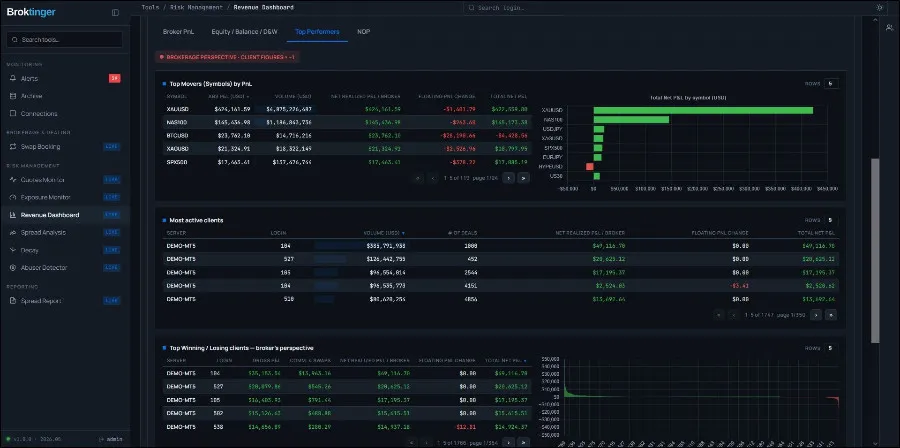
Top movers by symbol, most active clients and top winning and losing clients, consolidated across servers.
These kinds of tools have a reputation for being expensive, which leaves large brokers building in-house and smaller ones going without. What does your testing period give a broker who wants to judge for themselves?
AH: That statement is correct. Many brokerage tools are expensive and therefore not affordable for some brokers.
In some cases, the price is partly driven by the reputation of the provider, while the underlying technology may actually be quite outdated and may not have been meaningfully updated for years simply because brokers continue purchasing it.
But what happens when a broker cannot afford those solutions?
One option is to build the tools internally. However, doing this properly requires experienced dealers to supervise the requirements, developers with genuine experience in the brokerage industry to build the system, and QA resources to thoroughly test it.
Without those elements, an in-house project can easily become a significant drain on time and resources.
The other option is to operate without the tools. But that means the broker loses visibility into market exposure and potential optimisation opportunities that other brokers may have, while its own team spends time manually monitoring processes that should ideally be automated.
Human work will always carry a certain level of risk: typing mistakes, fatigue, unexpected negligence, or simply missing something at the wrong moment. An automated system significantly reduces these risks.
Broktinger provides more affordable solutions because we believe that every broker should have the opportunity to operate competitively and efficiently, not only the largest brokers.
In fact, we work with many small and mid-sized brokers that are able to offer better conditions to their end customers than some much larger brokers. That is exactly the point.
All of our tools come with a free testing period, ranging from two weeks to one month depending on the particular tool.
If the client tests the product and does not like it, they simply do not pay for it.
If they like it and see value in it, we then work with them to establish the best possible commercial arrangement and make sure the solution works for both sides.
Ultimately, we created these tools from the dealing room, for brokers, so that they can afford the technology and run their operations more efficiently.
And if the technology alone is not enough, we can also run the dealing and risk-management operations for them for a fraction of the cost of building a comparable internal team.
That is something many service providers do not offer, simply because it is not their focus.
For us, it is.
Our approach is built around trust, experience, and collaboration, with the objective of providing dealing and risk management as if we were running the broker's own business.
Found this interesting? Become a member of LiquidityFinder, join the community and join the discussion - join here.
Share this article

Comments
Most Recent
Find The Right Partners for
Your Trading Business
Sign up and join over 5,000 professional members who receive personalized news alerts, curated professional connections, and more for free!
Scope Prime's Andrew Taylor sets out how brokers serving Asian clients should measure and price sharp gold flow, citing the October 2025 and January 2026 sell-offs, thin liquidity at the Asian open, segmentation over relationship-wide repricing and the questions to ask a prime of prime provider.

Risk and dealing analytics provider BrokerPilot helps multi-asset brokers spot toxic flow before it eats into their P&L. Chief Revenue Officer Sergey Berezhnoy talks to Sam Low about catching toxic patterns across MT4, MT5 and cTrader, why new brokers get targeted from day one, and where AI fits into the dealing room without replacing the human dealer.
In Part 5 of his A-Book STP series, Youssef Bouz from GCC Brokers provides a guide to distinguishing healthy algorithmic trading from latency arbitrage and structural abuse — and why behavior, not profitability, is the real risk indicator.

In Part 3 of his A-Book STP series, Youssef Bouz explains why STP should be viewed as a trading environment—not a feature—exploring execution realism, market behaviour, and why professional and algorithmic traders prefer true STP models for long-term alignment and scalability.

Guest insight from Olaf Ransome on UNITE Global FMI and a “single pool of liquidity” vision to reduce nostro reliance, cut buffers and enable real-time PvP/DvP.

S&P Global Ratings gave Tether (USDT) the weakest Stablecoin Stability Assessment. Olaf Ransome breaks down what drives stablecoin risk—asset backing, custody/correspondent chains, transparency and reporting.

Money Markets are a cornerstone of day-to-day cash aka liquidity management for both financial institutions and corporate treasuries; we need those instruments to fine tune what we do. And things are changing post the “run-on-the-bank 21st century version” which hit Silicon Valley Bank & Credit Suisse. So, understanding what is changing helps us make the most out of the necessity of optimising what we do around cash management. To gain some insight on the latest market developments, I spoke to Hugh MacMillen from iIxNotes. Hugh is a long-time Money Markets guy who has a passion for developing new products and marketplaces.
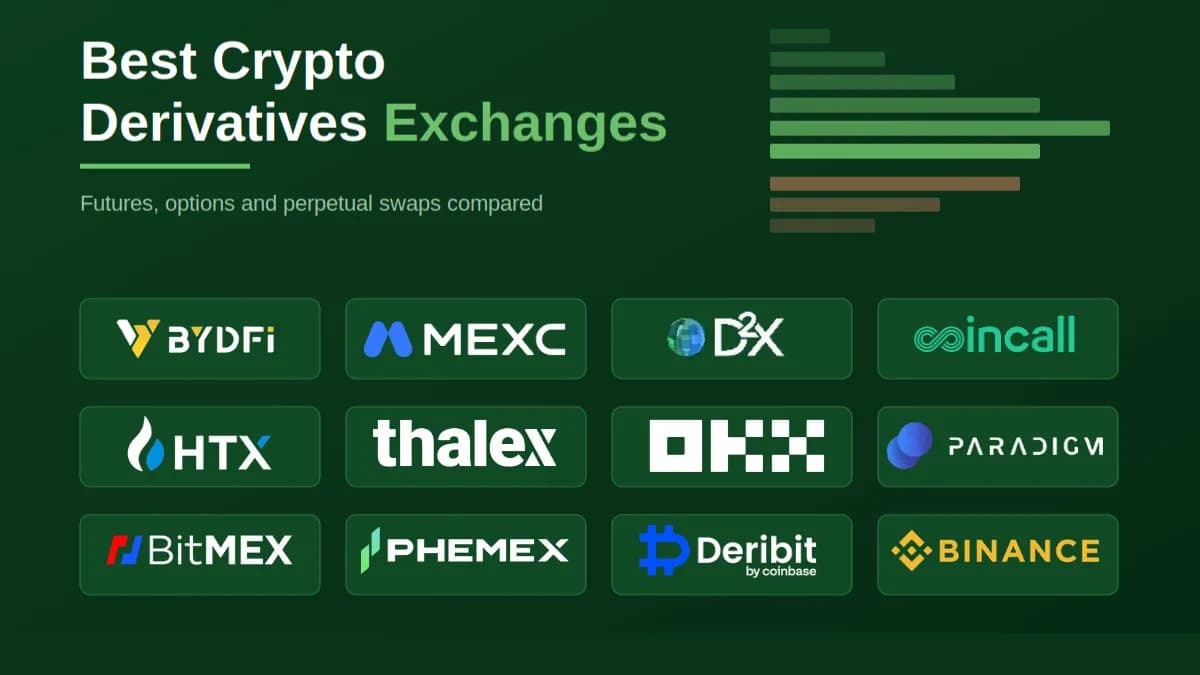
A curated list of the top exchanges for trading crypto futures, options, and perpetual swaps.
Create Your FREE Account
Get access to latest news, updates, real-time data, brokerage and trading firm insights and customized information feeds.


Thunes and Coinbase have announced a strategic collaboration at Money20/20 USA. Coinbase will integrate Thunes’ Direct Global Network for payouts to local clearing systems, while Coinbase will power Thunes’ stablecoin infrastructure, supporting enterprise supplier payments, gig worker payouts and global remittances.
Hantec Group's prop firm brand Hantec Trader began operating as RZR Funded on 19 October.

Online investment platform Webull (NASDAQ: BULL) will offer perpetual futures to eligible US customers from November. The first contracts will be on Bitcoin and other crypto assets.
Market data and financial technology provider dxFeed has launched dxFeed ZeroDTE, a quantitative analytics solution for the zero-days-to-expiration (0DTE) options market.


US stock futures edged higher this morning after Wall Street rebounded on Monday, with the S&P 500 rising 0.4% and the Nasdaq Composite gaining over 1%, led by technology stocks such as Nvidia, Tesla, and Alphabet.

Gold is trading at $4,128. Following its recent high of $4,198, the precious metal has entered a clear downward move, with successive lower highs and lower lows.


Was the recent AI infrastructure sell-off a warning sign, or a market overreaction? As earnings season takes centre stage, investors are looking beyond market volatility to assess the strength of corporate spending, financial resilience and future growth. With major technology, semiconductor and defence companies set to report, this week's results could offer important clues about where market confidence stands. In this Weekly Outlook, we examine the key developments and earnings signals that could shape market sentiment. Read the full article for our latest analysis. BitDelta Securities Financial Services LLC, regulated by the Capital Market Authority under Category 5 (Introduction Only), acts solely as an introducer and does not provide trading, execution, dealing, advisory, portfolio management, or custody services. All trading, execution, and investment-related services are provided by BitDelta Limited, Mauritius, a licensed Investment Dealer. All trading and investments involve risk. The value of investments may fluctuate, and you may receive less than your initial investment.


Nasdaq 100 turns bearish after breaking weekly support. Watch 29,800–30,400 resistance for a potential rejection toward the 29,000 target.

Tradeweb Markets Inc. has agreed to acquire electronic credit trading platform Trumid Holdings, LLC for about $1.97 billion, combining credit protocols and extending its reach into new issue and grey market trading. The deal is targeted to close in the first half of 2027, subject to regulatory approvals.

The Cboe has launched pre-market and post-market trading sessions for select single stock and exchange-traded fund (ETF) options on its Cboe Options Exchange (C1). Trading began today with options on 24 single stocks and 5 ETFs.
Feed