just now

Liquidity Finder Ltd is incorporated in England and Wales, company number 10610740, registered address 167-169 Great Portland Street, Fifth Floor, London W1W 5PF, United Kingdom.
Published: just now

At its December meeting, the Federal Reserve cut rates by 25 basis points to a target range of 3.50–3.75%, its first rate reduction in over two years. Policymakers cited moderate economic slowing, weaker job gains, and rising unemployment, while noting that inflation remains “somewhat elevated.”
The Fed also announced T-bill purchases to maintain “ample reserves” — a liquidity measure meant to support smooth market functioning.
However, Chair Jerome Powell’s tone was notably cautious. He emphasized that the Fed is not on a pre-set path for further cuts and that inflation is still above target. In essence, the central bank delivered a dovish action but wrapped it in hawkish messaging.
While a rate cut typically signals easier policy, this one came with strings attached.
This implies a shallow and uncertain easing cycle — a message that markets read as hawkish overall. It’s what strategists have dubbed:
“A dovish cut wrapped in hawkish guidance.”
The immediate result was a mixed market reaction:
That yield curve move explained the divergence in equity performance:
Cyclicals thrive when long yields rise and the curve steepens, while tech struggles in that environment.
This setup marked a rotation in market leadership — away from expensive growth and toward real-economy sectors.
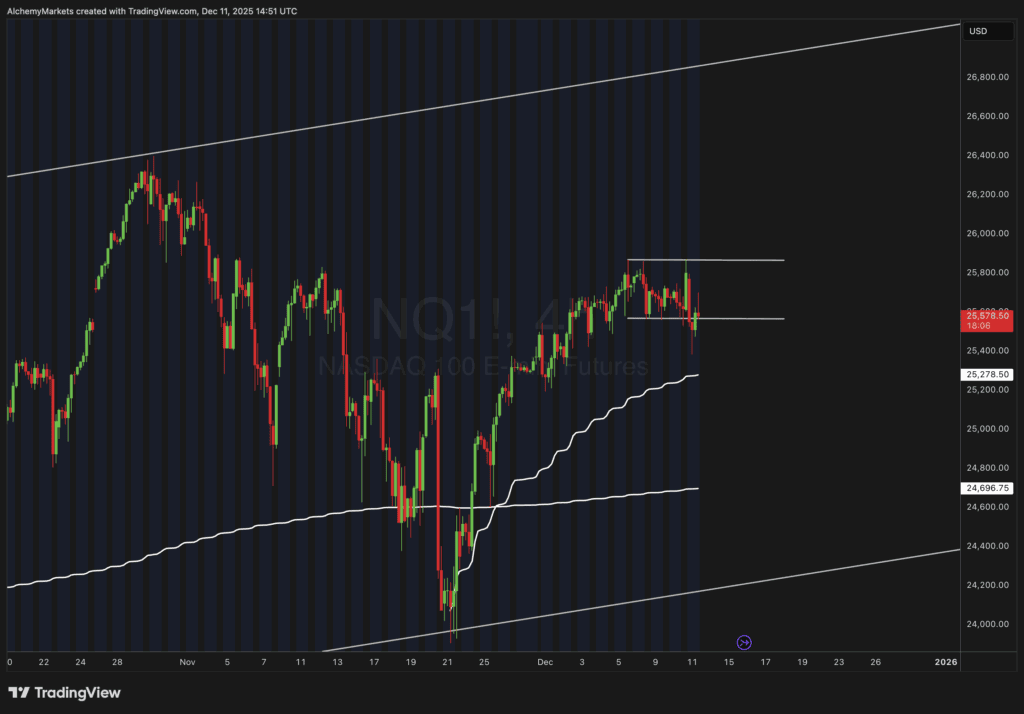
The Nasdaq’s weakness makes sense both fundamentally and technically.
“The cut helped sentiment, but the guidance forced a valuation rethink in growth.”
The Nasdaq 100 futures (NQ1!) currently trade around 25,600, sitting between short-term support near 25,400–25,450and resistance around 25,800–25,900.
In short:
The Nasdaq is at a technical crossroads — either it starts a mild correction from here, or squeezes once more toward 26,000 before turning lower within its broader channel.
The setup suggests that a near-term cooling in tech valuations is increasingly likely.
Why? Because the Nasdaq doesn’t respond to the rate cut itself, but to the path of future cuts. And right now, the Fed is signaling that policy will stay restrictive longer.
This environment — rising long yields and crowded positioning — could spark a controlled correction or sector rotation, not a crash. AI, semiconductors, and software names are most vulnerable, while cash-rich megacaps may act as stabilizers.
Expect volatility clusters and valuation compression as positioning resets into year-end.
Institutional flows are already adjusting to this new regime:
| Potential Winners | Why They Benefit |
|---|---|
| Financials | Steeper yield curve supports margins |
| Industrials | Aligned with real growth and capex |
| Materials | Reflation exposure |
| Consumer Discretionary (select) | Benefiting from wage strength |
| Energy | Supported by resilient global demand |
| Likely Underperformers | Why They Lag |
|---|---|
| Long-Duration Tech | Valuation pressure |
| Expensive Software | Limited earnings leverage |
| Unprofitable Growth | Higher cost of capital |
| Utilities & Staples | Bond-proxy drag |
Rotation toward value and cyclicals is consistent with a hawkish-cut macro environment and a steepening yield curve.
The December Fed meeting marked a subtle but meaningful shift.
The Fed cut rates, but its hawkish guidance reshaped equity leadership.
Markets are recalibrating around:
The Nasdaq 100 remains the most sensitive barometer of this change. Technically, it’s hovering at a decision point — either confirming a mild correction or staging a final test of resistance near 26,000 before a likely fade.
Either way, the message is the same:
This isn’t a liquidity-fueled bull phase — it’s a selective rotation phase.
Alchemy Markets is a multi-asset brokerage providing retail traders with the same elite trading conditions, tools, and transparency typically reserved for institutions.

Select the categories and companies you wish to follow directly to your person rss feed.
Create Custom RSS FeedSign up and join over 5,000 professional members who receive personalized news alerts, curated professional connections, and more for free!
Multi-asset trading broker AvaTrade has agreed to acquire the majority of FXCM Group’s business and brand, in a transaction that would bring a longstanding retail FX franchise into the AvaTrade Group.
LSEG and CMC Markets have signed a multi-year strategic data agreement expanding CMC's access to LSEG's real-time and delayed pricing, reference and corporate actions data, news and analytics, plus AI-ready content, to support new products, entry into new markets and the growth of CMC's institutional and B2B partnerships.
The Tel Aviv Stock Exchange is considering a bid for the Cyprus Stock Exchange, with Israeli media citing its EU licence, trading platform and clearing house. Euronext’s Athens exchange and India’s National Stock Exchange are also seen as contenders, and Cyprus aims to sign a sale agreement by the end of this year.
CME Group will launch baseball futures on 12 October, pending regulatory review, tracking CME FutureSports Performance Indexes built on Official League Data. Standard and micro contracts will start with the 2026 Postseason and the four clubs in the League Championship Series, trading around the clock.
ESMA has published an opinion stating that MiCA-authorised crypto-asset service providers should cease services tied to non-MiCA-compliant stablecoins for EU clients across MiCA crypto-asset services. National authorities should require remediation of existing exposures within three months, by early January 2027.
Nasdaq Ventures has made a strategic investment in Amsterdam-based derivatives and crypto exchange One Trading, with both firms to explore 24/7 trading of equity futures. The undisclosed investment follows Nasdaq's US$100 million investment in Payward, the parent of Kraken, and CME Group's move to 24/7 trading.
cTrader has opened multi-platform plugins to brokers and prop firms, which can pre-install their own tools for clients or list them in cTrader Store. The plugins run across Mobile, Web, Windows and Mac, and can be built and launched independently of core-platform releases, including trading journals and calculators.
Institutional brokerage and financial infrastructure provider Clear Street has joined TradingView’s broker network, allowing its clients to trade US stocks, exchange-traded funds and options directly through the charting and analysis platform.
Learn how to improve trading psychology, manage fear and greed, avoid revenge trading, and follow your trading strategy with discipline and a trading journal.
GTC Prime has announced a strategic partnership with Centroid Solutions to manage and distribute its liquidity through CS 360 Bridge, Centroid's multi-asset connectivity and execution engine, giving brokers and institutional clients access to tailor-made pricing, low-latency execution and real-time risk management.