just now


Liquidity Finder Ltd is incorporated in England and Wales, company number 10610740, registered address 167-169 Great Portland Street, Fifth Floor, London W1W 5PF, United Kingdom.
Published: just now


Consumer spending refers to the money spent on goods and services. This includes everyday purchases such as food, clothing, etc. Household spending is also a major part of economic activity, the changes in consumer spending can provide traders and investors that identify the strength and direction of an economy.
Here’s the basic idea made simple: when consumers spend more, businesses may generate more sales. When consumers cut back , businesses may face weaker demand. These changes can influence economic growth, inflation, expectation on interest-rate, and its financial markets.
Consumer spending measures what people purchase for their own use. These include both essential and discretionary spending.
Essential spending is spending people generally need, such as transportation, food and utilities, While discretionary spending includes consumer purchases that can delay or reduce, such as restaurant meals, entertainment, and some luxury goods.
Economists and policymakers monitor consumer spending because it provides insight into consumer demand and economic activity. Personal Consumption Expenditures, or PCE, this is one of the major measures or as a metric we use to track or monitor consumer spending and covers goods and services purchased by or on behalf of households.
Markets are straight forward. Traders not only react to what is happening now, they also analyze and gather information that would show signs for future economic growth, company earnings, inflation, and interest rates.
Consumer spending helps indicate household confidence, when people continue to buy or purchase goods and services. Higher spending might increase business revenue and support economic growth. But weak spending can signal that households are becoming more cautious and can potentially put pressure on sales and growth expectations.
But be careful, traders should not assume that strong consumer spending is always positive for every asset. Markets also respond to several factors, and the same goes for economic reports that can affect stocks, currencies, commodities, and indices differently.
When consumers have a high increase in their spending, companies may increase their expected sales and earnings. Some investors may view this positively, especially when consumer spending is stronger than expected.
While, weaker consumer demand can lead investors to lower their expectations for a company’s revenue and profits. This can put pressure on certain stocks, particularly businesses that rely heavily on discretionary spending.
Another important factor to consider is inflation. A strong consumer demand can indicate a higher contribution to prices when supply is unable to keep up. If inflation remains high, some traders may view this an increase to interest rates especially if it takes longer. This can also affect stock valuations and overall investor sentiment.
Consumer spending can also influence the foreign exchange market through expectations about economic growth and monetary policy.
Suppose consumer demand remains strong while an economy is growing steadily. Traders may expect its central bank to maintain or tighten monetary policy especially if inflation remains a concern. Those expectations sometimes influence interest-rate forecasts and its currency prices.
If consumer spending weakens significantly, markets may instead consider slower growth and the possibility of easier monetary policy.
Because forex (foreign exchange) involves trading one currency against another, traders also need to compare economic conditions between countries. A positive consumer spending report in one economy does not automatically mean its currency will rise.
Consumer demand can also influence commodity markets. Stronger economic activity can increase demand for energy, industrial materials, and other resources used by consumers and businesses.
For example, the increase in transportation activity can also affect energy demand, while stronger construction or manufacturing activity can influence demand for industrial commodities.
However, these commodity prices are also heavily affected by supply factors such as production, inventories, weather, geopolitical events, and supply disruptions. Consumer spending is therefore only one part of the overall market picture.
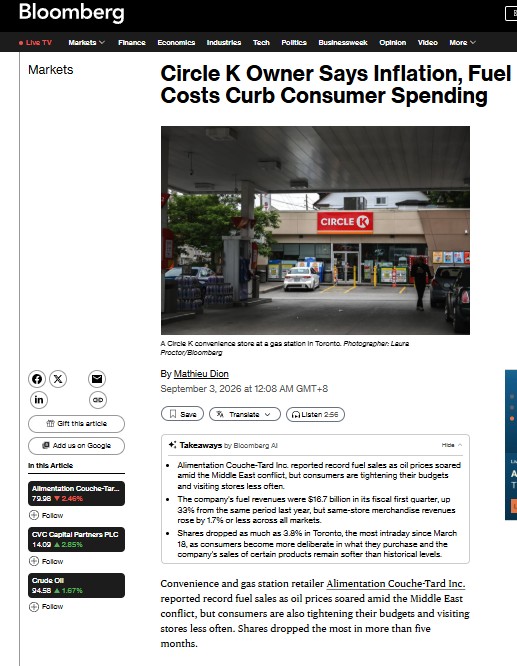
Article below as an example stating high inflation and rising fuel costs are forcing consumers to tighten their budgets, visit stores less frequently, and become much more selective with their purchases.
Source: Bloomberg
Broad market indices represent companies, so consumer spending can also influence them through expectations for overall corporate earnings and economic growth.
When investors believe consumers remain financially healthy, sentiment toward the broader economy may improve. If spending falls sharply, concerns about weaker growth can increase.
Indices can rise even when consumer spending is weak or fall when spending is strong.
Traders do not need to follow every economic statistic. A few important indicators can provide a useful starting point.
Retail sales offer a relatively direct view of consumer purchases through retailers. Traders use this to compare the recent result vs. with the previous reading and market expectations.
Consumer confidence or sentiment might provide hint or indication on how households feel about their finances. Confidence can also explain whether consumers are likely to increase or reduce their discretionary spending.
Personal Consumption Expenditures or (PCE) provides a broader measure on household spendings. Traders analyze PCE price index, which helps them measure changes in the prices consumers pay for goods and services. The core of PCE price index excludes food and energy which help provide a clearer view of inflation markup which should be monitored closely when assessing monetary policy.
One of the most important lessons is to avoid looking at an economic release in isolation.
For example, when market expectations that consumer spending is about to increase by 0.5%, but the actual result is only 0.2%. This shows that the spending value increased, but the end result is weaker than the expected value. Some traders may interpret this as a sign that consumer demand is losing its momentum.
Now imagine if the consumer spending rises by 0.8% instead of the expected market of 0.5%. This result could change expectations for economic growth, inflation and interest rates.
The market reaction will depend on the broader context. Traders will consider the actual figure, the previous data, recent forecasts, revisions, and other economic indicators before deciding what the report could mean.
Long-term investors may use consumer spending data to understand the health of the economy and the potential earnings environment for businesses. Short-term traders may focus more on how an economic release changes market expectations and creates price volatility.
Neither approach makes consumer spending a guaranteed trading signal. It is better viewed as one piece of evidence that can help form a broader market view.
Disclaimer: This content may have been written by a third party. ACY makes no representation or warranty and assumes no liability as to the accuracy or completeness of the information provided, nor any loss arising from any investment based on a recommendation, forecast or other information supplies by any third-party. This content is information only, and does not constitute financial, investment or other advice on which you can rely.
ACY Securities is one of Australia's fastest growing multi-asset online trading providers, offering ultra-low-cost trading, rock-solid execution, technologically superior account management and premium market analysis.

Select the categories and companies you wish to follow directly to your person rss feed.
Create Custom RSS FeedSign up and join over 5,000 professional members who receive personalized news alerts, curated professional connections, and more for free!
Multi-asset trading broker AvaTrade has agreed to acquire the majority of FXCM Group’s business and brand, in a transaction that would bring a longstanding retail FX franchise into the AvaTrade Group.
LSEG and CMC Markets have signed a multi-year strategic data agreement expanding CMC's access to LSEG's real-time and delayed pricing, reference and corporate actions data, news and analytics, plus AI-ready content, to support new products, entry into new markets and the growth of CMC's institutional and B2B partnerships.
The Tel Aviv Stock Exchange is considering a bid for the Cyprus Stock Exchange, with Israeli media citing its EU licence, trading platform and clearing house. Euronext’s Athens exchange and India’s National Stock Exchange are also seen as contenders, and Cyprus aims to sign a sale agreement by the end of this year.
CME Group will launch baseball futures on 12 October, pending regulatory review, tracking CME FutureSports Performance Indexes built on Official League Data. Standard and micro contracts will start with the 2026 Postseason and the four clubs in the League Championship Series, trading around the clock.
ESMA has published an opinion stating that MiCA-authorised crypto-asset service providers should cease services tied to non-MiCA-compliant stablecoins for EU clients across MiCA crypto-asset services. National authorities should require remediation of existing exposures within three months, by early January 2027.
Nasdaq Ventures has made a strategic investment in Amsterdam-based derivatives and crypto exchange One Trading, with both firms to explore 24/7 trading of equity futures. The undisclosed investment follows Nasdaq's US$100 million investment in Payward, the parent of Kraken, and CME Group's move to 24/7 trading.
cTrader has opened multi-platform plugins to brokers and prop firms, which can pre-install their own tools for clients or list them in cTrader Store. The plugins run across Mobile, Web, Windows and Mac, and can be built and launched independently of core-platform releases, including trading journals and calculators.
Institutional brokerage and financial infrastructure provider Clear Street has joined TradingView’s broker network, allowing its clients to trade US stocks, exchange-traded funds and options directly through the charting and analysis platform.
Learn how to improve trading psychology, manage fear and greed, avoid revenge trading, and follow your trading strategy with discipline and a trading journal.
GTC Prime has announced a strategic partnership with Centroid Solutions to manage and distribute its liquidity through CS 360 Bridge, Centroid's multi-asset connectivity and execution engine, giving brokers and institutional clients access to tailor-made pricing, low-latency execution and real-time risk management.