just now


Liquidity Finder Ltd is incorporated in England and Wales, company number 10610740, registered address 167-169 Great Portland Street, Fifth Floor, London W1W 5PF, United Kingdom.
Published: just now

This trading week is firmly an American bank story, and the message from earnings has been consistent across the sector.
While several major banks managed to beat EPS expectations, most missed on revenue, reinforcing the idea that profits are being protected through efficiency rather than expansion.
Below is how that story is unfolding on the charts.
Earnings recap:
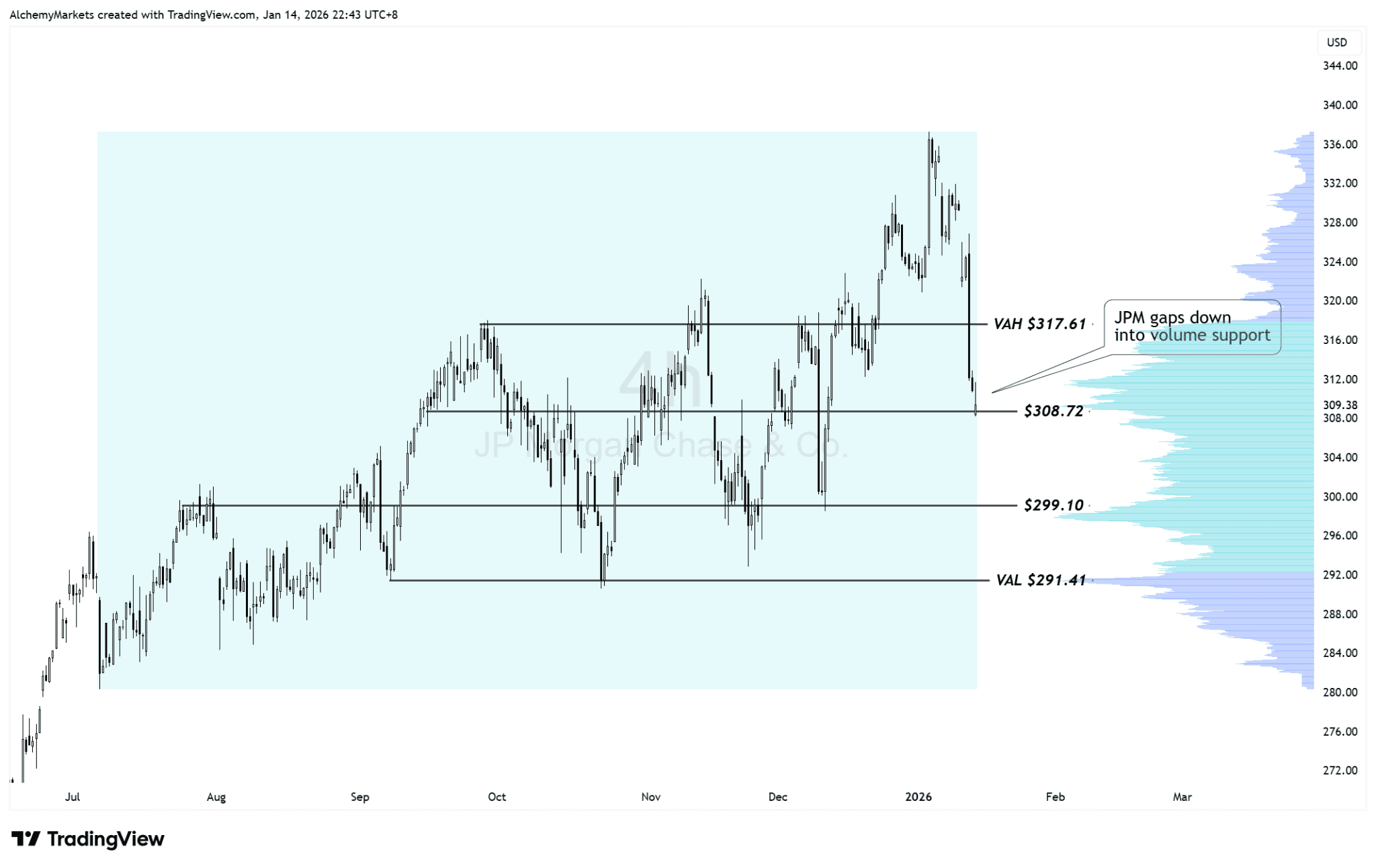
JPMorgan missed on both headline revenue and EPS, setting a cautious tone for the sector.
Technical view (4H, Anchored Volume Profile):
JPM has gapped down into a high-volume support zone, rotating back into its prior fair-value range. The key level to watch is the Value Area High near $317.61. As long as price remains below this level, the earnings gap acts as overhead supply, keeping rallies capped.
On the downside, $308.72 is the first important support. Holding this level would suggest the move is controlled profit-taking rather than panic selling. However, a loss of $299.10 would likely open the door to a deeper rotation toward the Value Area Low near $291.41.
Market takeaway:
JPM is the sector’s anchor. If it holds volume support, the broader market can remain stable. If it breaks lower and accepts below value, bank weakness tends to spill into wider risk sentiment.
Earnings recap:
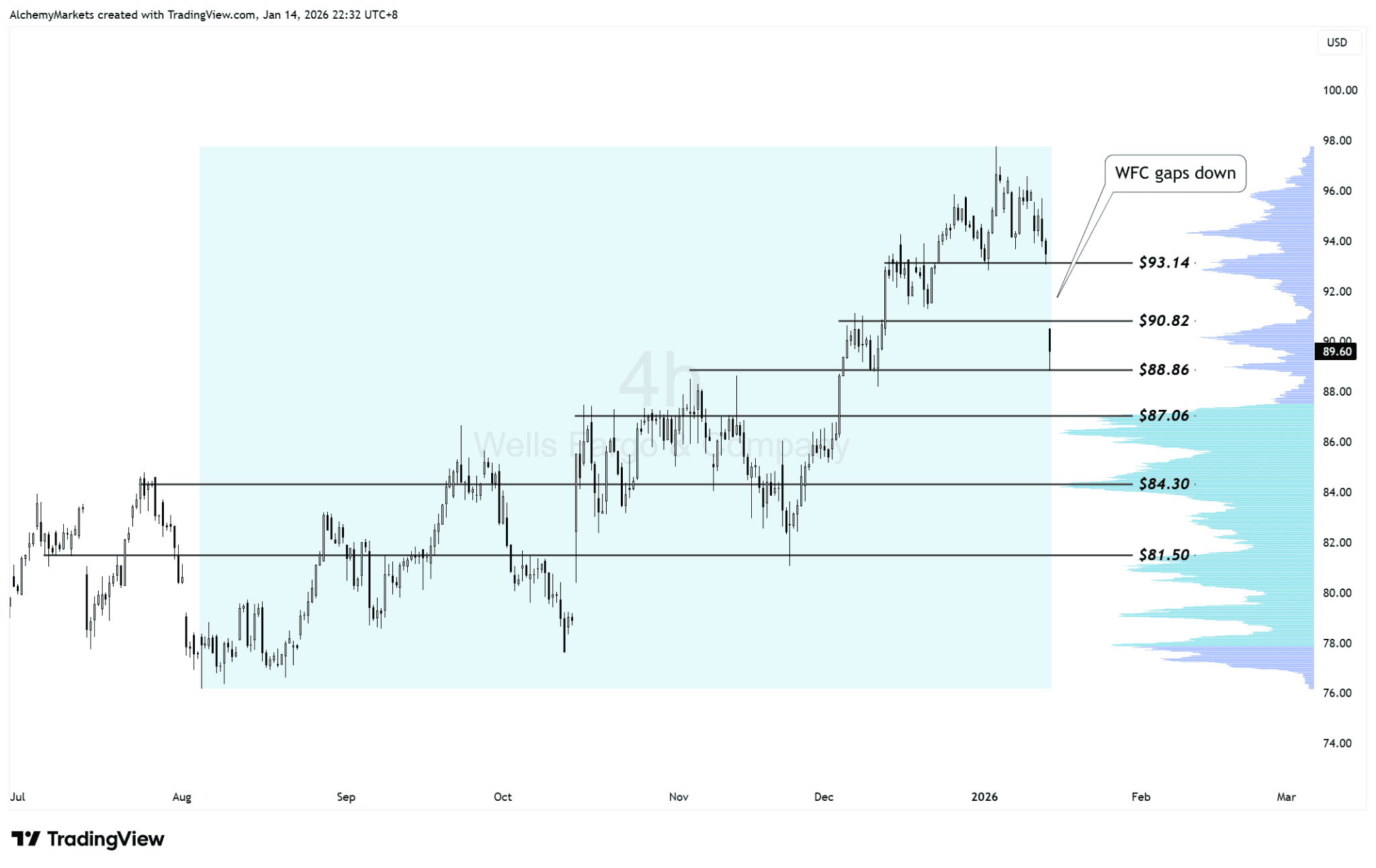
Wells Fargo beat EPS expectations but missed on revenue, highlighting slower consumer-driven activity despite solid cost control.
Technical view (4H, Anchored Volume Profile):
WFC has gapped below a key support level, which is short-term bearish. This move reflects the market repricing the bank after earnings, rather than chasing the EPS beat.
The immediate focus is whether price can reclaim the broken support. A close back above it would soften the bearish signal and suggest acceptance back into value. Failure to do so increases the probability of rotation toward the next high-volume node below.
Market takeaway:
As a consumer-facing bank, sustained weakness in WFC would reinforce concerns around household demand and make broader equity rallies harder to sustain.
Earnings recap:
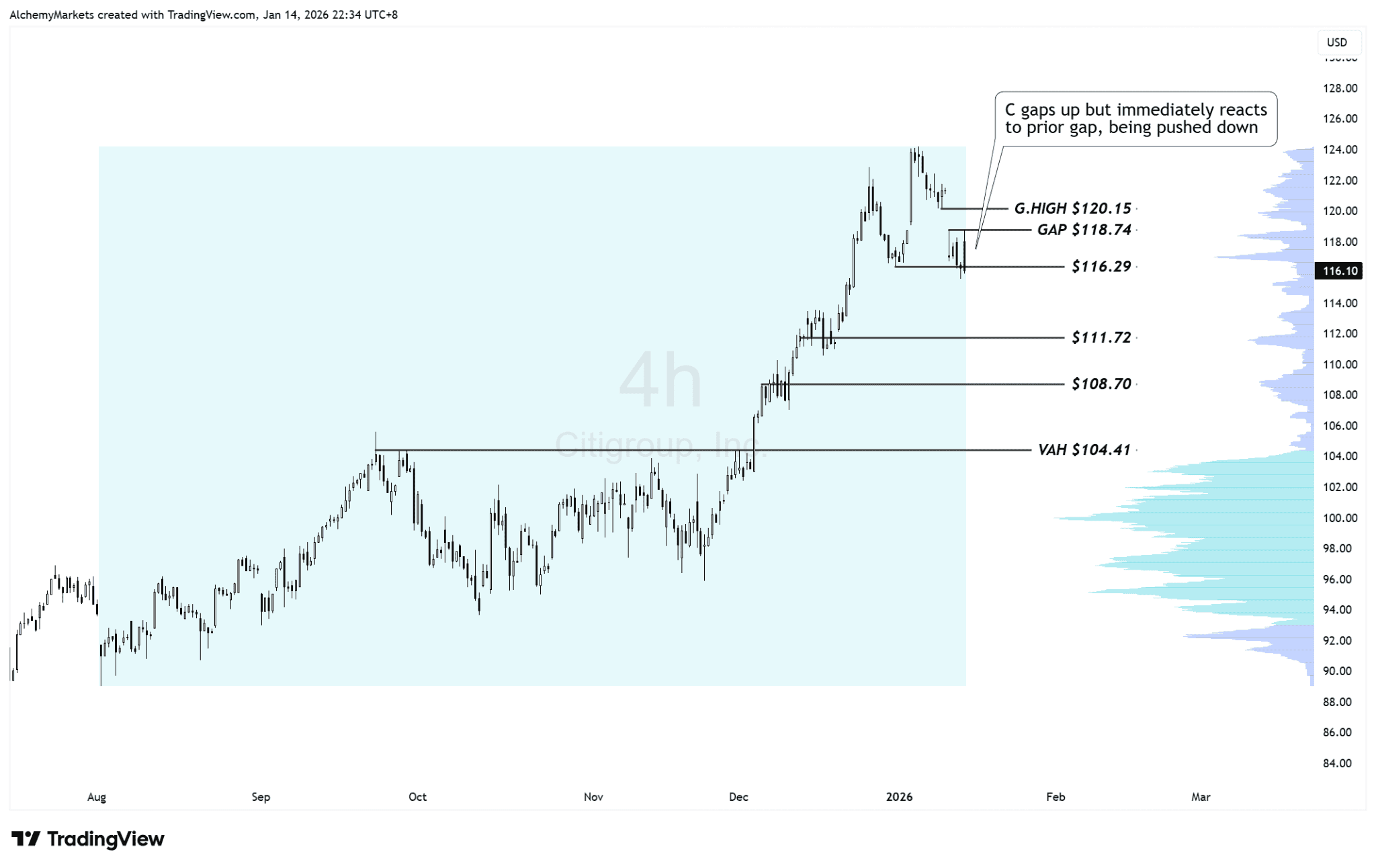
Citigroup beat EPS on an adjusted basis but missed revenue, reflecting ongoing restructuring success rather than stronger global demand.
Technical view (4H):
Citi is set to gap higher, but price is immediately reacting to a prior gap zone above, which often acts as resistance. This area represents trapped supply, where sellers from previous sessions look to exit.
If price fails at this upper gap, the move risks turning into a fade, consistent with a defensive earnings interpretation. Acceptance above the gap, however, would suggest stronger follow-through demand and improve the tone for global banks.
Market takeaway:
Citi’s reaction will help determine whether this earnings move is positioning-driven or the start of a more durable recovery in global financials.
Earnings recap:
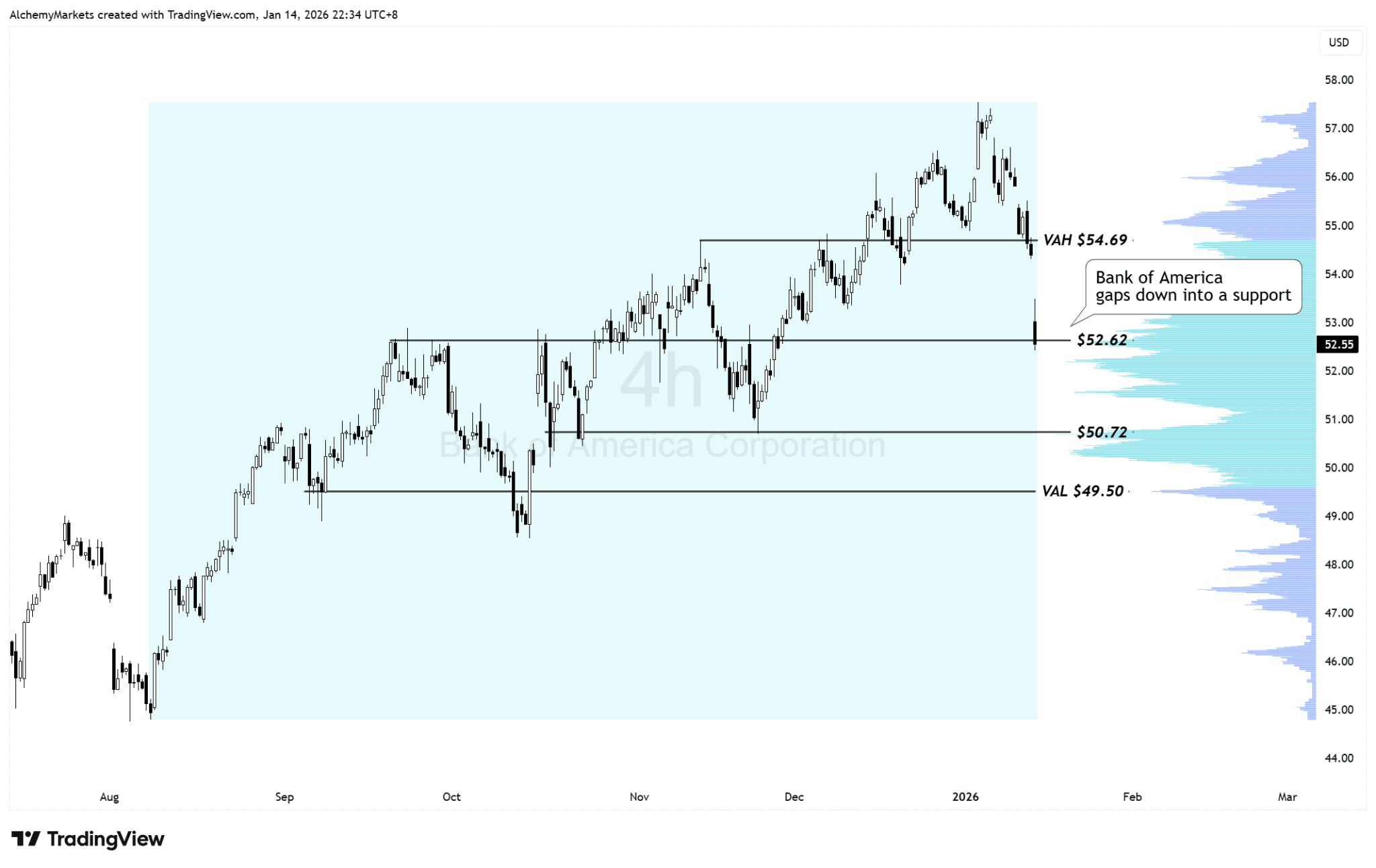
Bank of America beat both EPS and revenue expectations, but remains the most rate-sensitive of the major banks.
Technical view (4H, Anchored Volume Profile):
BAC has gapped down into support but importantly has rotated back into the Value Area High near $54.69. This places the stock back inside its fair trading range, where the market must now decide direction.
Holding above VAH keeps the broader uptrend intact. Losing acceptance would likely trigger a rotation toward $52.62, then $50.72, with the Value Area Low near $49.50 acting as a deeper support target.
Market takeaway:
BAC is the cleanest technical setup. Its ability to hold value will be a key tell for whether the market remains constructive or shifts more defensively.
Across JPMorgan, Wells Fargo, and Citigroup, the pattern is clear:
Earnings are being defended, not grown.
EPS beats driven by cost control — alongside revenue misses — signal late-cycle behaviour, where management teams prioritise margins and balance-sheet protection over expansion.
That doesn’t imply an immediate downturn, but it does mean markets are more sensitive to downside risk.
From here:
Bottom line: US banks are telling us this is a market about defence, not acceleration — and price action should be traded with that mindset.
DISCLAIMER: For educational purposes only. Trading comes with substantial risk, leading to possible loss of your capital. Traders are advised to do their own due diligence before investing.
You may also be interested in:
US CPI Data Holds Steady at 2.7% — What It Means for the Dollar and Stocks
Alchemy Markets is a multi-asset brokerage providing retail traders with the same elite trading conditions, tools, and transparency typically reserved for institutions.

Select the categories and companies you wish to follow directly to your person rss feed.
Create Custom RSS FeedSign up and join over 5,000 professional members who receive personalized news alerts, curated professional connections, and more for free!
Americans vote on November 3 for all 435 seats in the House of Representatives and a third of the Senate. The presidency is not on the ballot, which means any new Congress will still need the President's signature to turn bills into law. Markets care about the midterms less for the laws that follow and more for what changes in oversight, budgets and the regulatory mood of Washington.
The Australian Securities and Investments Commission has said it is not currently convinced that prediction markets for retail clients are in the public interest. ASIC Chair Sarah Court said prediction market contracts have all the features of a bet, likening them to binary options, which are banned for retail clients.
Binance has confirmed a security incident with an estimated total impact of around $6.3 billion, linked by its initial investigation to a compromised DevOps engineer's laptop. Around $3 billion has been frozen on-chain, and the exchange says it will cover all losses from its SAFU fund and company funds.
US crypto exchange Coinbase has reported net income of $719 million for the third quarter of 2026, up 66% from $432.6 million a year earlier. Prediction markets passed $200 million in annualised revenue, and paid Coinbase One subscribers reached an all-time high.
Webull Securities Co., Ltd., the Japanese subsidiary of Webull Corporation, has started handling US Treasury bonds, giving customers access to about 20,000 bonds as of 30 October 2026. The service lets users trade market-traded bonds like stocks, with real-time prices and yields, from $100.
Intercontinental Exchange and Trade[XYZ] have agreed to bring Trade[XYZ]’s perpetual markets onshore in the US through a new regulated market and clearing structure for round-the-clock retail trading built on Hyperliquid, operated separately from ICE’s institutional futures franchise, subject to regulatory approvals.
The Utah Attorney General's Office has filed 14 criminal charges against KalshiEX, LLC, the operator of US prediction market Kalshi, in a case that names co-founders Tarek Mansour, Chief Executive Officer, and Luana Lopes Lara, Chief Operating Officer, as co-defendants.
US blockchain payments company Ripple and US crypto exchange Coinbase have partnered to make Ripple's US dollar stablecoin, Ripple USD (RLUSD), available across Coinbase's platforms
The UK Financial Conduct Authority (FCA) has secured High Court undertakings to ensure that global crypto exchange HTX, formerly known as Huobi, will not knowingly promote cryptoasset services unlawfully to UK consumers.
US post-trade market infrastructure provider DTCC has launched its DTCC Tokenization Service (DTS) through its subsidiary The Depository Trust Company.