
just now


Liquidity Finder Ltd is incorporated in England and Wales, company number 10610740, registered address 167-169 Great Portland Street, Fifth Floor, London W1W 5PF, United Kingdom.
Published: just now

The precious metals complex enters the new week bruised but not broken. Gold and silver have both suffered sharp pullbacks after a powerful multi-month run, catching many participants off guard. What makes this moment particularly important is that fundamentals, macro events, and technicals are all converging at once.
This article brings those strands together into a weekly outlook calendar, framed as a short, easy-to-follow market story. We begin with the fundamentals behind the recent selloff, move through the key economic events that could define the week ahead, and finish with a technical deep dive into the gold-to-silver ratio, which is now testing a critical level.
The recent drop in gold and silver was not driven by one single factor, but by a cluster of shifts in narrative and positioning.
First, markets reacted to renewed uncertainty around the future direction of U.S. monetary policy. Speculation surrounding the next Federal Reserve Chair reintroduced the idea that policy could remain tighter—or at least less predictable—than markets had grown comfortable with. Gold and silver, which thrive when real rates are falling and policy is clearly easing, tend to struggle when that clarity disappears.
Second, the U.S. dollar strengthened. Because gold and silver are priced in dollars, a stronger dollar acts like gravity: it makes metals more expensive for global buyers and often triggers short-term selling. Even modest dollar strength can have an outsized impact when positioning is crowded.
Third, this move was amplified by profit-taking. Both gold and especially silver had rallied aggressively. Silver, in particular, had shown signs of speculative excess. When markets get stretched, they don’t need bad news—just “less good” news—to spark sharp corrections.
Finally, silver assumed its usual role as the volatile cousin. Silver is both a precious metal and an industrial input, which makes it more sensitive to shifts in growth expectations and risk appetite. When confidence wobbles, silver often falls faster than gold.
In simple terms: this was not a collapse in the long-term metals story, but a reset driven by dollar strength, policy uncertainty, and crowded positioning—with silver exaggerating the move.
The week opens with the ISM reports, offering an early read on growth momentum.
Wednesday: Eurozone inflation
Inflation has remained anchored near the ECB’s 2% target, with core inflation easing steadily. A modest uptick due to energy prices would not be shocking.
Thursday: ECB rate decision
No policy change is expected, but the tone will matter—especially with the euro having strengthened recently.
The Bank of England is expected to hold rates, likely with a 7–2 vote split.
This is the defining moment of the week.
Despite the Fed’s more optimistic tone on employment, the labour market remains fragile beneath the surface. Hiring outside of government and a few service sectors has been weak, and markets remain unconvinced that the jobs picture is truly robust.
Canadian data is secondary but still relevant for broader risk sentiment and commodity-linked currencies.
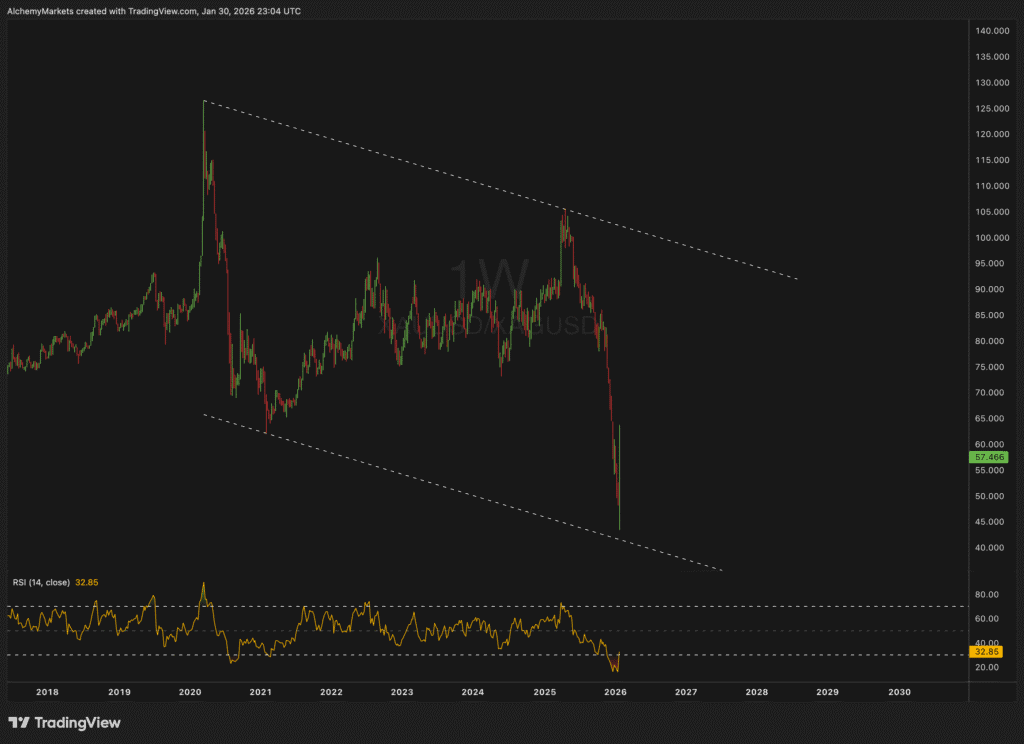
The gold-to-silver ratio offers a powerful lens through which to view the current environment.
This is exactly the type of area where markets often pause—and sometimes reverse.
If the ratio holds the lower bound and begins to rise, it would suggest:
In practical terms, this would signal a shift back toward defensive leadership, with gold once again outperforming.
If the ratio breaks cleanly below the channel:
This makes the current level a clear decision point.
This week is about confirmation.
If macro data disappoints and the dollar softens, the conditions are in place for a ratio bounce and renewed gold leadership. If data surprises to the upside, metals may remain under pressure—but even then, the ratio will tell us whether silver’s dominance is fading.
In short: the metals market isn’t just reacting anymore—it’s choosing a direction.
Alchemy Markets is a multi-asset brokerage providing retail traders with the same elite trading conditions, tools, and transparency typically reserved for institutions.

Select the categories and companies you wish to follow directly to your person rss feed.
Create Custom RSS FeedSign up and join over 5,000 professional members who receive personalized news alerts, curated professional connections, and more for free!
Theorem has integrated Symbiotic’s Liquid Lane RFQ network, letting holders of tokenised real-world assets trade against on-chain pool liquidity and market-maker quotes. The integration is live on Ethereum, with Midas’s yield-bearing mHYPER fund as the first supported asset. Holders can trade for the USDC stablecoin.
US equities were volatile with technology selloff erasing much of the earlier rebound.
FM Summit London 2026 returns to Old Billingsgate on 24 November for its 15th edition, with LMAX Group, Plus500 and oneZero among confirmed exhibitors. The one-day event adds Business Connect meetings and roundtables, and opens with a networking evening at The Folly on 23 November.
Finance Magnates Summit London returns to Old Billingsgate on 24 November 2026 for its 15th edition. The one-day event brings together brokers, liquidity providers, institutional firms, trading technology vendors, payments businesses and digital asset firms.
iSAM Securities Apex has integrated with Match-Prime, giving brokers access to liquidity across more than 2,000 instruments, with tailored pricing and up to 10 levels of market depth.
propfunding.com's free-entry instant funding changes the order of prop funding. Start trading first. Its free-entry instant funding model offers two qualification attempts without an upfront activation fee.
US stocks closed higher on Wednesday, with the Nasdaq gaining 1%, the S&P 500 rising 0.6%, and the Dow advancing 0.7%, as renewed enthusiasm for AI-related stocks lifted market sentiment.
SpaceX went public in June as a rocket company. On October 20 it reported as something else entirely: an AI infrastructure business, financed by a satellite broadband network, with a launch division attached. Rockets generated 12% of third quarter revenue and lost money. The AI segment generated 52% of revenue and consumed 84% of capital expenditure. Starlink generated 85% of operating profit.
Standard Chartered has signed definitive agreements to acquire 100% of Zodia Custody UK Limited, folding its regulated digital asset custody business into Securities Services. Zodia Solutions will be set up under SC Ventures with bank investors including Northern Trust, NAB Ventures, Emirates NBD and Investcorp.
Bybit Fintech FZE has secured a Virtual Asset Service Provider licence from Dubai’s Virtual Assets Regulatory Authority for Exchange Services, covering spot trading. Bybit’s Peter Loo said the firm hopes to add derivatives, subject to regulatory approvals. Its international Dubai headquarters opened in 2022.