just now

Liquidity Finder Ltd is incorporated in England and Wales, company number 10610740, registered address 167-169 Great Portland Street, Fifth Floor, London W1W 5PF, United Kingdom.
Published: just now

Gold spent the first half of 2026 doing something it rarely does: falling, and falling hard. From a February peak above 5,600, the metal shed more than 1,500 dollars in five months, a slow bleed that turned every "safe haven" pitch on its head. The catalyst was never really about gold. It was about the dollar getting its confidence back under a hawkish Warsh Fed, a Middle East ceasefire draining the fear premium, and oil sliding back to pre-conflict levels. When the world stops panicking, the panic trade gets sold.
But look at where price has come to rest. Gold has slid all the way back to 4,000, the exact shelf that stopped every dip from October through December last year. That old accumulation zone is now being retested from above, and for the first time since the sell-off began, buyers are showing up. This week price pushed back through its 20-day moving average, the first time it has managed that since the trend rolled over in the spring. It is a small technical event with an outsized message: the one-way selling has paused, and the market is asking whether 4,000 is a floor or a trapdoor.
Which makes the timing almost too neat. Next week's economic calendar is thin, arguably the quietest of the summer. There is no Fed meeting, no CPI, no payrolls to hijack the tape. When the macro goes quiet, price action stops taking orders from the headlines and starts trading its own structure. That is exactly the kind of week where a level like 4,000 gets tested properly, on its own merits, without a data print to blame. So this week we let the chart do the talking.
The week is light on tier-one risk, but three releases are worth having on your radar. The standout for us is Monday's ISM Services print, where our in-house read sits meaningfully below consensus.
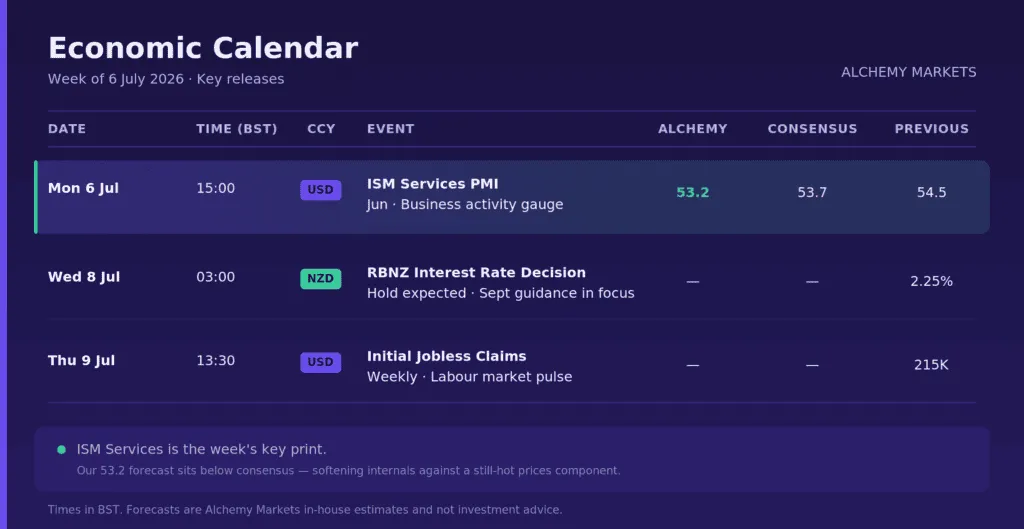
ISM Services (Monday) is the one to watch. May's 54.5 was the strongest reading in three months, and we think it overstated the underlying momentum. Our forecast of 53.2 sits below the 53.7 consensus because the internals are turning: manufacturing already cooled in June, new orders look stretched after May's jump, and the employment component has been contracting for three straight months. The catch is prices, which have been running at their hottest since 2022. A softer-activity, sticky-prices print is the combination that keeps the Warsh Fed exactly where it is, patient, data-dependent, and in no hurry to signal anything. Watch the dollar for the immediate reaction, and gold by extension.
RBNZ (Wednesday) is widely expected to leave rates unchanged, so the decision itself is unlikely to be the story. What matters is the tone. A US-Iran de-escalation has pulled oil sharply lower and cooled the case for an early move, but the market is listening closely for what the central bank signals about the months ahead. This is a statement-driven event for the Kiwi rather than a decision-driven one, and how hawkish or cautious that signal reads will do more to move NZD than the rate line itself.
Initial Jobless Claims (Thursday) is normally background noise, but in a quiet week with a cooling labour market fresh in mind after June's soft payrolls, any upside surprise gets more attention than usual. It is a low-ceiling release that can still nudge a directionless tape.
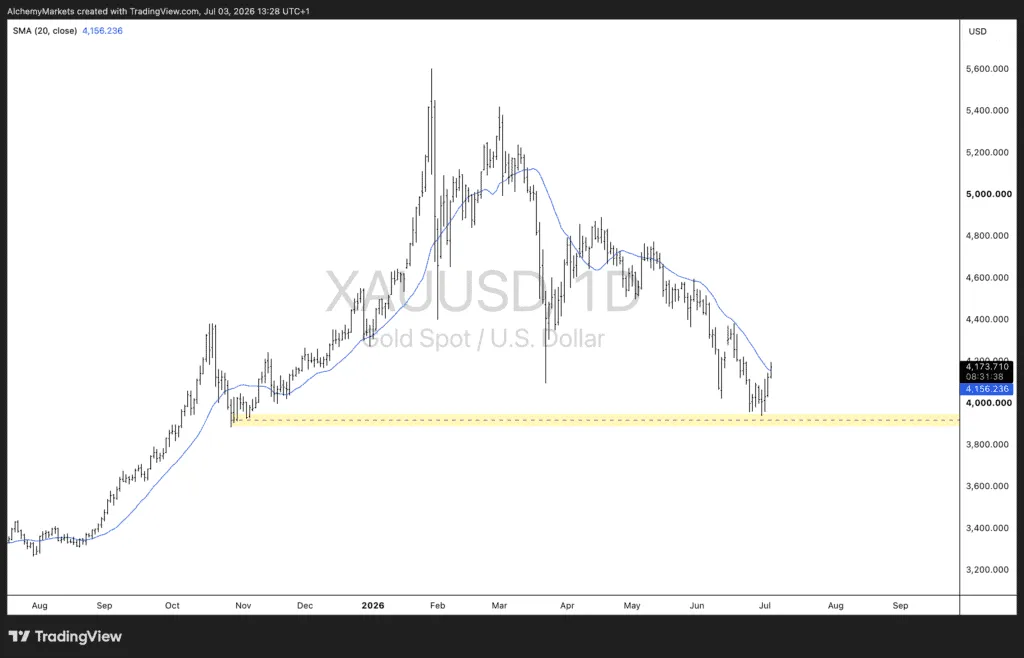
This is the setup the quiet week is built around.
Gold has retraced the entire post-February decline back into the 4,000 zone, and this is not a random number. That shelf acted as a launchpad from October through December 2025, the base the metal spent three months building before its explosive run to 5,600. Price has now returned to that exact level from above, turning old support into a live test. The yellow band on the chart marks the zone that matters.
Two technical signals are worth flagging. First, the reaction off 4,000 has been immediate. Rather than slicing through, price has stalled and started to curl back up, the early signature of buyers defending a level they remember. Second, and more telling, gold has reclaimed its 20-day moving average for the first time since May. Through the entire second-quarter decline, that average capped every bounce. Trading back above it does not confirm a trend change on its own, but it is the first crack in the bearish structure that has governed price for two months.
The picture is a market that has fallen a long way, arrived at a level with genuine history, and started to show its first signs of life. What we are watching for is whether this becomes a base or a pause. A daily close that holds above the 20-day average and defends the 4,000 shelf would suggest the sellers are finally losing their grip. A decisive break back below the yellow zone would say the retest failed, and the path of least resistance is lower toward the next area of interest. In a week without a major catalyst to force the issue, the level itself becomes the story, and how price behaves around 4,000 will tell us more than any single data point could.
Alchemy Markets is a multi-asset brokerage providing retail traders with the same elite trading conditions, tools, and transparency typically reserved for institutions.
Select the categories and companies you wish to follow directly to your person rss feed.
Create Custom RSS FeedSign up and join over 5,000 professional members who receive personalized news alerts, curated professional connections, and more for free!
Multi-asset trading broker AvaTrade has agreed to acquire the majority of FXCM Group’s business and brand, in a transaction that would bring a longstanding retail FX franchise into the AvaTrade Group.
LSEG and CMC Markets have signed a multi-year strategic data agreement expanding CMC's access to LSEG's real-time and delayed pricing, reference and corporate actions data, news and analytics, plus AI-ready content, to support new products, entry into new markets and the growth of CMC's institutional and B2B partnerships.
The Tel Aviv Stock Exchange is considering a bid for the Cyprus Stock Exchange, with Israeli media citing its EU licence, trading platform and clearing house. Euronext’s Athens exchange and India’s National Stock Exchange are also seen as contenders, and Cyprus aims to sign a sale agreement by the end of this year.
CME Group will launch baseball futures on 12 October, pending regulatory review, tracking CME FutureSports Performance Indexes built on Official League Data. Standard and micro contracts will start with the 2026 Postseason and the four clubs in the League Championship Series, trading around the clock.
ESMA has published an opinion stating that MiCA-authorised crypto-asset service providers should cease services tied to non-MiCA-compliant stablecoins for EU clients across MiCA crypto-asset services. National authorities should require remediation of existing exposures within three months, by early January 2027.
Nasdaq Ventures has made a strategic investment in Amsterdam-based derivatives and crypto exchange One Trading, with both firms to explore 24/7 trading of equity futures. The undisclosed investment follows Nasdaq's US$100 million investment in Payward, the parent of Kraken, and CME Group's move to 24/7 trading.
cTrader has opened multi-platform plugins to brokers and prop firms, which can pre-install their own tools for clients or list them in cTrader Store. The plugins run across Mobile, Web, Windows and Mac, and can be built and launched independently of core-platform releases, including trading journals and calculators.
Institutional brokerage and financial infrastructure provider Clear Street has joined TradingView’s broker network, allowing its clients to trade US stocks, exchange-traded funds and options directly through the charting and analysis platform.
Learn how to improve trading psychology, manage fear and greed, avoid revenge trading, and follow your trading strategy with discipline and a trading journal.
GTC Prime has announced a strategic partnership with Centroid Solutions to manage and distribute its liquidity through CS 360 Bridge, Centroid's multi-asset connectivity and execution engine, giving brokers and institutional clients access to tailor-made pricing, low-latency execution and real-time risk management.