just now

Liquidity Finder Ltd is incorporated in England and Wales, company number 10610740, registered address 167-169 Great Portland Street, Fifth Floor, London W1W 5PF, United Kingdom.
Published: just now
New data from trade-flow analytics firm Tapaas (@Tapaas ) tracks how traders across ten markets, grouped into five regions, were buying and selling two of the world's most closely watched assets, WTI crude oil and gold, over the four weeks to 16 June.
The data shows what happened during the war between the United States and Iran, which began in February and pushed oil prices up with the closure of the Strait of Hormuz. For weeks, a US naval blockade and the threat of closure kept a fear premium in the oil price and helped support gold as a safe place to hold money.
On 14 June, Donald Trump and Iran announced a 'deal' to end the fighting and reopen the strait, with Trump saying "let the oil flow" and ordering the blockade removed. If the deal holds, the supply fear that drove much of this trading could fade quickly, and the strong bullish view on oil that Europe in particular had built up may start to unwind. But this is only a first-stage agreement. Several important issues are still open, and continued Israeli strikes in Lebanon have already put it under pressure. In short, the regional split shown here is a snapshot of how the world traded the war, taken just as the war may be ending.
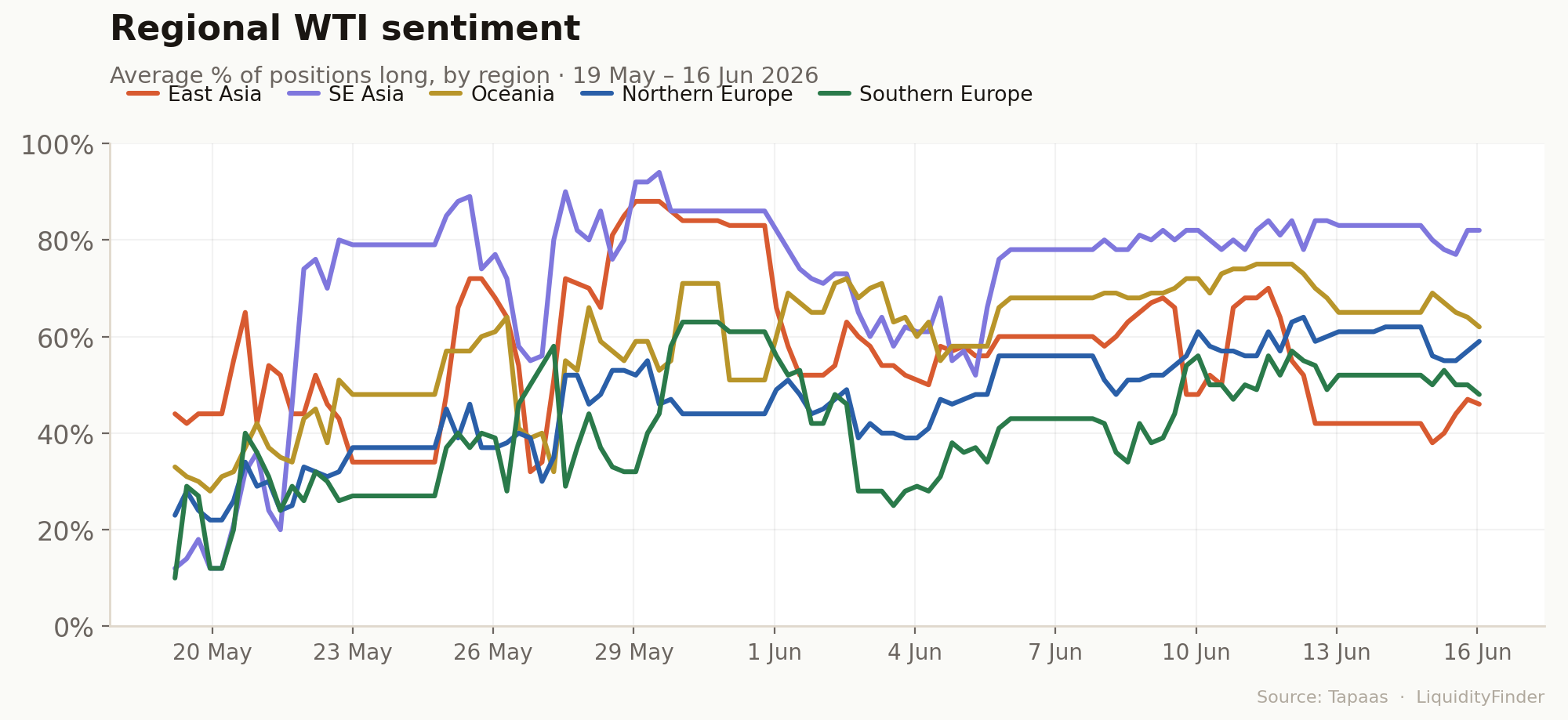
What it reveals is a striking lack of agreement. Faced with the same run of news, the regions moved in different and often opposite directions: some treated oil and gold as safe havens to buy together, others picked one over the other, and a few that had been trading as a bloc broke apart and stopped agreeing among themselves. Rather than one global trade, the data shows five regional ones, which makes where a trade is coming from as telling right now as what is being traded.
The dataset looks at retail CFD positioning covering ten markets in five regions. It measures how many traders were betting that prices would rise, counted both by number of trades and by volume.
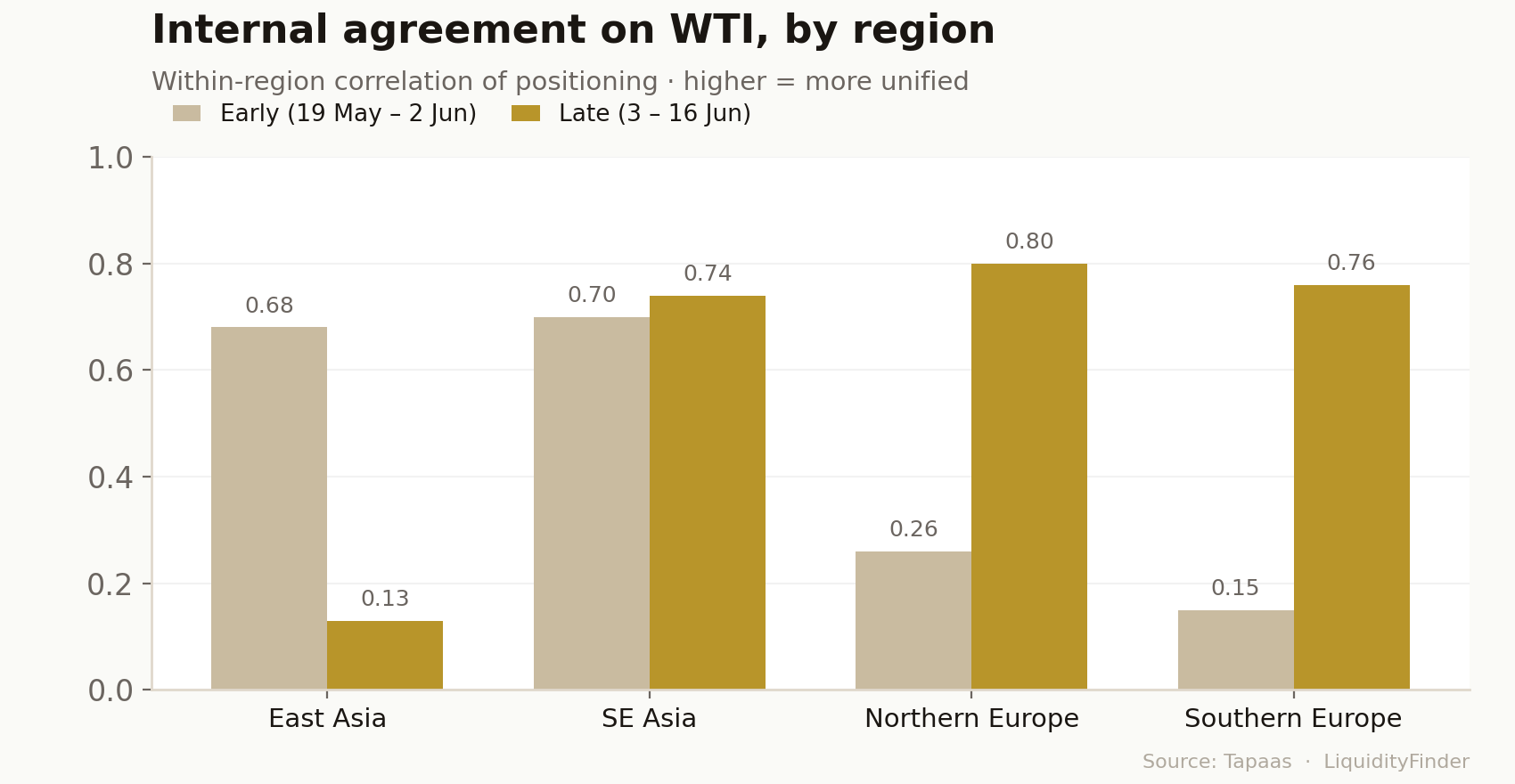
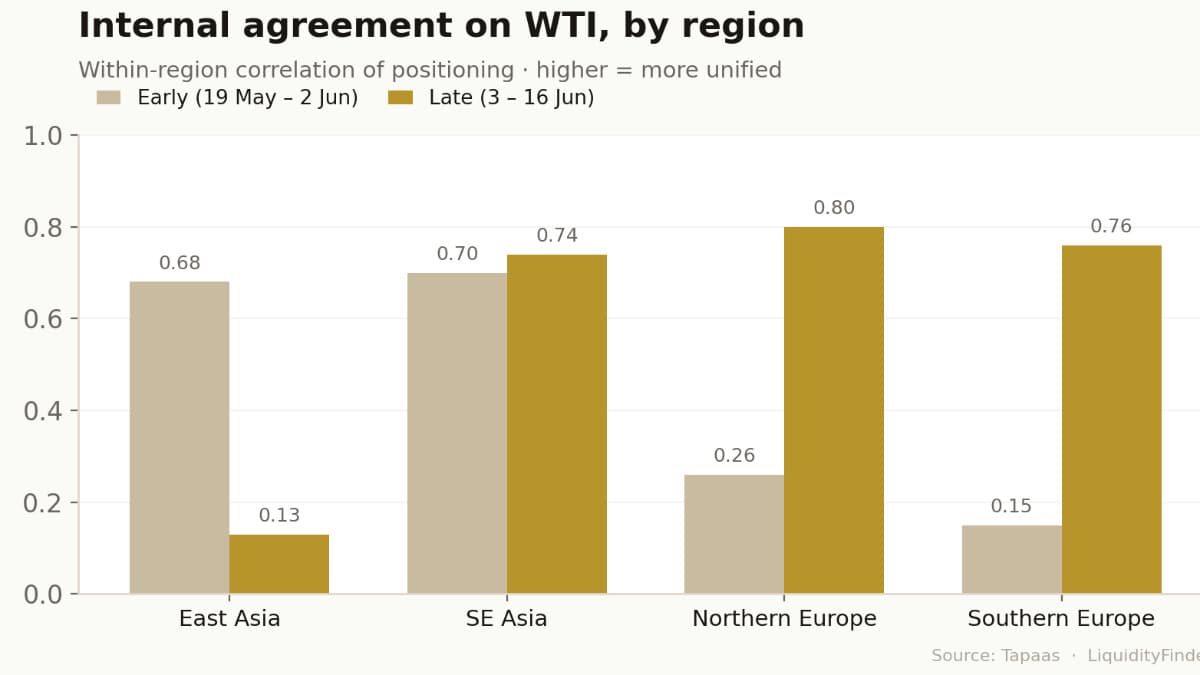
At the start of the past month, China and Hong Kong traded oil in a very similar way. Their agreement was strong, with a score of 0.68, where 1.0 means full agreement and 0 means none. By June that agreement had almost gone, down to 0.13. The same thing happened with gold, where their score fell from 0.51 to 0.14. Hong Kong sold its oil positions while China kept them. The two stopped trading as one.
Northern and Southern Europe started far apart on oil, with scores of 0.26 and 0.15. By mid-June they were close together, at 0.80 and 0.76. Spain, Germany, Poland, Italy and the United Kingdom ended up with the same view: they expected the oil price to rise. So while Asia split apart, Europe came together.
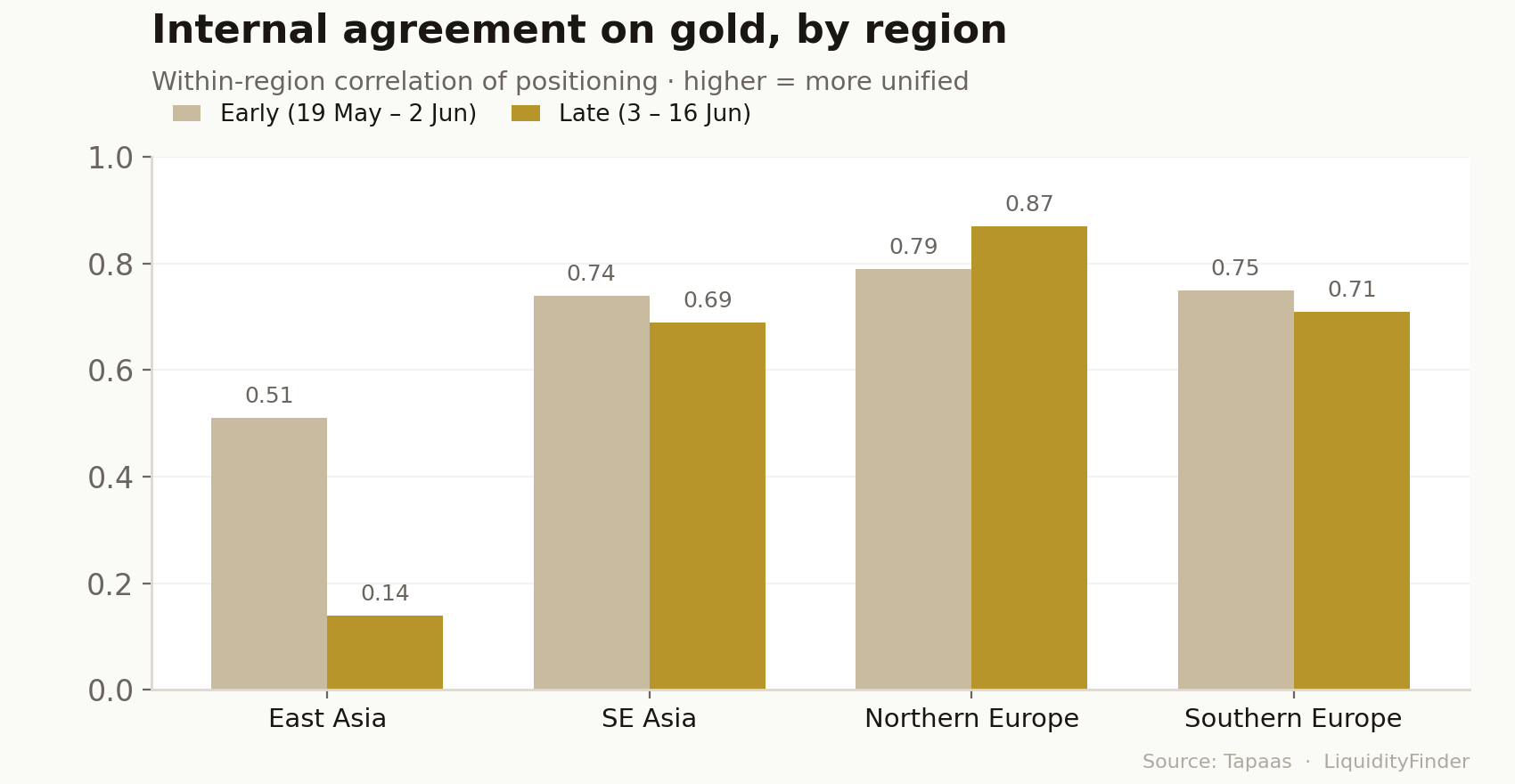
Gold moved less than oil, but the data still tells us something. Northern Europe agreed on gold throughout the period, and agreed even more strongly by the end, with its score rising from 0.79 to 0.87. At the same time, Germany, Poland and the UK steadily bought more gold, which suggests they treat it as a safe place to hold money when there is risk.
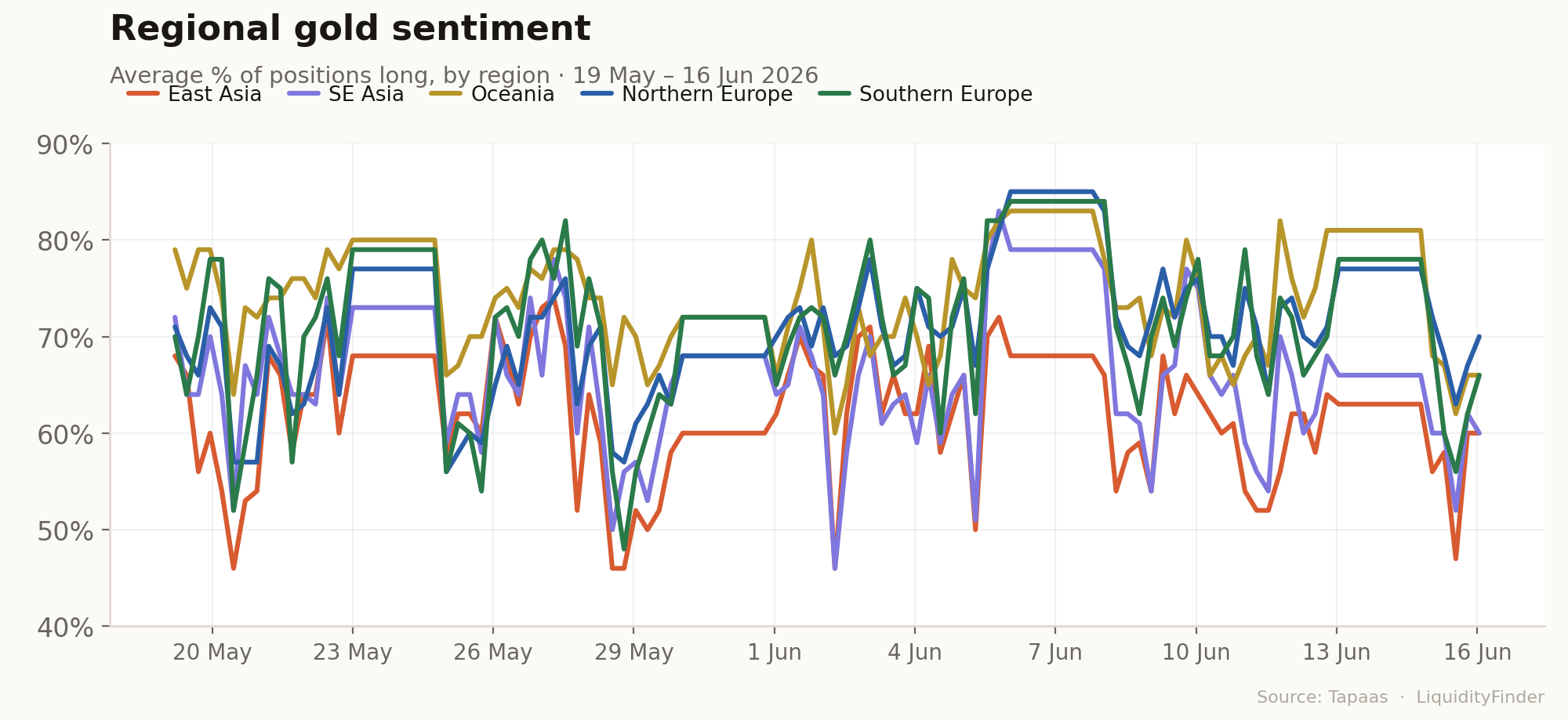
The two Asian regions did not follow. South East Asia and East Asia held roughly flat on gold while Europe bought more, so by mid-June they were the least keen on it. South East Asia is still worth noting for one reason: Singapore and Thailand kept trading gold in step with each other the whole way through, even as they fell behind the rest of the world.
A useful question is whether each region treated oil and gold as the same trade, or as opposites. If a region buys both at the same time, it is protecting itself against risk. If it buys one and sells the other, it is choosing between them.
Northern Europe is the clearest case. Early on, its oil trades and gold trades had little to do with each other. From around 5 June, they moved together strongly, with a score of up to 0.84. Germany, Poland and the UK bought oil and gold at the same time. This is a sign that they expected higher prices and more risk, so they protected themselves on both sides.
Australia did the opposite. In June, it began to buy one and sell the other. East Asia did much the same throughout the period, treating oil and gold as a short-term trade rather than as protection. South East Asia slowly began to buy both together from early June. This suggests that Singapore and Thailand expected the supply problem to last.
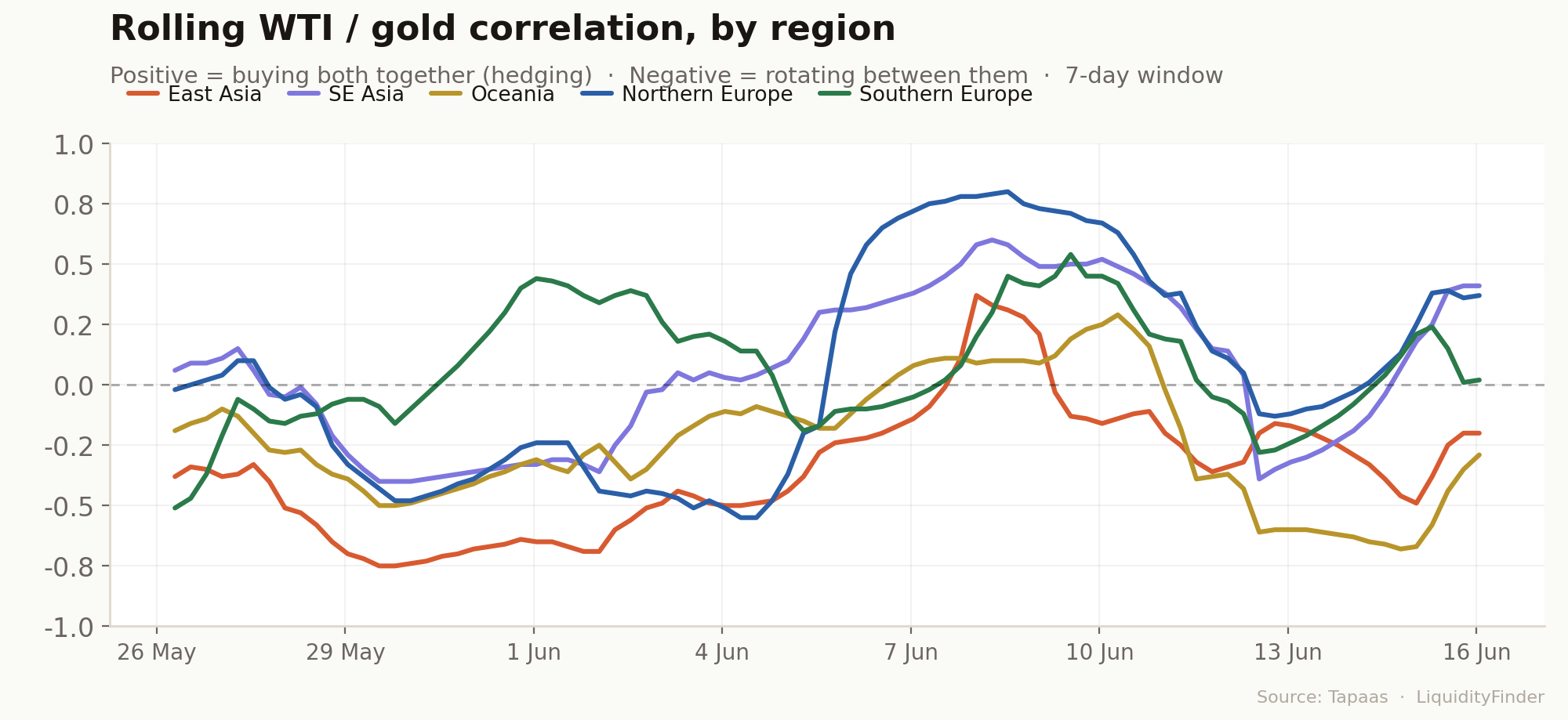
For LiquidityFinder readers managing risk, the theme is regional dispersion. A single macro shock that might be expected to push global positioning the same way has instead had a different effect on different region, and the split is not random. Europe is hedging, Oceania is rotating, East Asia is trading, and South East Asia is quietly accumulating. For anyone pricing flow, managing risk across regional books, or building a view of where the next wave of demand sits, it might be best to look at these asset classes regionally rather than globally.
Found this interesting? Become a member of LiquidityFinder, join the community and join the discussion - join here.
We're the largest marketplace to connect with brokers, Fintech companies & digital asset firms. Want to partner? Let's get in touch.

Select the categories and companies you wish to follow directly to your person rss feed.
Create Custom RSS FeedSign up and join over 5,000 professional members who receive personalized news alerts, curated professional connections, and more for free!
Multi-asset trading broker AvaTrade has agreed to acquire the majority of FXCM Group’s business and brand, in a transaction that would bring a longstanding retail FX franchise into the AvaTrade Group.
LSEG and CMC Markets have signed a multi-year strategic data agreement expanding CMC's access to LSEG's real-time and delayed pricing, reference and corporate actions data, news and analytics, plus AI-ready content, to support new products, entry into new markets and the growth of CMC's institutional and B2B partnerships.
The Tel Aviv Stock Exchange is considering a bid for the Cyprus Stock Exchange, with Israeli media citing its EU licence, trading platform and clearing house. Euronext’s Athens exchange and India’s National Stock Exchange are also seen as contenders, and Cyprus aims to sign a sale agreement by the end of this year.
CME Group will launch baseball futures on 12 October, pending regulatory review, tracking CME FutureSports Performance Indexes built on Official League Data. Standard and micro contracts will start with the 2026 Postseason and the four clubs in the League Championship Series, trading around the clock.
ESMA has published an opinion stating that MiCA-authorised crypto-asset service providers should cease services tied to non-MiCA-compliant stablecoins for EU clients across MiCA crypto-asset services. National authorities should require remediation of existing exposures within three months, by early January 2027.
Nasdaq Ventures has made a strategic investment in Amsterdam-based derivatives and crypto exchange One Trading, with both firms to explore 24/7 trading of equity futures. The undisclosed investment follows Nasdaq's US$100 million investment in Payward, the parent of Kraken, and CME Group's move to 24/7 trading.
cTrader has opened multi-platform plugins to brokers and prop firms, which can pre-install their own tools for clients or list them in cTrader Store. The plugins run across Mobile, Web, Windows and Mac, and can be built and launched independently of core-platform releases, including trading journals and calculators.
Institutional brokerage and financial infrastructure provider Clear Street has joined TradingView’s broker network, allowing its clients to trade US stocks, exchange-traded funds and options directly through the charting and analysis platform.
Learn how to improve trading psychology, manage fear and greed, avoid revenge trading, and follow your trading strategy with discipline and a trading journal.
GTC Prime has announced a strategic partnership with Centroid Solutions to manage and distribute its liquidity through CS 360 Bridge, Centroid's multi-asset connectivity and execution engine, giving brokers and institutional clients access to tailor-made pricing, low-latency execution and real-time risk management.