just now

Liquidity Finder Ltd is incorporated in England and Wales, company number 10610740, registered address 167-169 Great Portland Street, Fifth Floor, London W1W 5PF, United Kingdom.
Published: just now

The gold-to-silver ratio measures how many ounces of silver it takes to buy one ounce of gold. It’s a long-standing barometer of relative strength between the two precious metals — and by extension, a useful lens into macro risk sentiment.
When the ratio rises, it means gold is outperforming silver. That typically happens when investors grow more cautious, preferring the relative safety of gold over the higher-beta behavior of silver.
When the ratio falls, silver is outperforming gold, which tends to coincide with periods of improving growth expectations and stronger risk appetite across markets.
In other words, the ratio functions less as a mean-reversion trade and more as a regime indicator — a reflection of the market’s underlying tone between defensive and cyclical positioning.
The recent collapse in the gold/silver ratio reflects a combination of macro tailwinds for silver and a broader rotation toward risk-on sentiment. Several overlapping drivers likely explain the move.
Silver’s industrial component — spanning solar panels, electronics, and electric vehicles — makes it far more sensitive to the global manufacturing cycle than gold.
Recent signs of stabilization in China’s PMIs and improving industrial sentiment in Europe and the U.S. have likely encouraged investors to reprice growth expectations higher.
As a result, silver has been the higher-beta beneficiary, while gold, though still firm, has lagged on a relative basis.
Throughout late 2025, markets have shown evidence of easing liquidity stress and narrowing credit spreads, signaling improved funding conditions.
When investors grow more comfortable with liquidity, they tend to rotate out of defensive assets like gold and into higher-beta plays such as silver.
This dynamic has historically been one of the most consistent contributors to a falling gold/silver ratio.
Real yields — the inflation-adjusted return on U.S. Treasuries — have moderated in recent months as Fed policy expectations have turned less restrictive.
Since both metals are non-yielding, falling real yields tend to be supportive. But silver, with its cyclical profile, often reacts more positively to the perception that policy is shifting toward growth support.
This has given silver additional tailwinds during the ratio’s recent leg lower.
A weaker USD typically supports both gold and silver, but silver tends to respond more strongly. The dollar’s drift lower into late 2025, partly on softer U.S. data and policy repricing, has amplified silver’s outperformance and driven the ratio sharply lower.
Silver’s volatility cuts both ways. Earlier in the year, speculative short covering and fresh long exposure added fuel to the upside, compressing the ratio rapidly.
While this move may have overshot in the short term, it underscores the leverage and momentum sensitivity inherent in silver — traits that make the ratio both powerful and risky as a signal.
The recent collapse has taken the ratio deep into oversold territory. While there’s room for continued silver outperformance, several macro catalysts could trigger a turn higher over the next 2–8 weeks:
If the recent stabilisation in global manufacturing fades — especially if China’s PMIs weaken again — silver’s industrial leverage could turn from tailwind to headwind.
A growth scare or renewed slowdown would likely push investors back toward gold, lifting the ratio.
Any widening in credit spreads, renewed funding stress, or spike in volatility indices (e.g., VIX) could flip market tone to defensive.
In that environment, gold historically outperforms, and the gold/silver ratio tends to rise sharply.
If the USD stages a recovery — perhaps due to a hawkish Fed repricing or stronger inflation data lifting real yields — both metals could come under pressure.
Silver, being the higher-beta asset, would likely fall faster, causing the ratio to rebound.
Speculative longs in silver futures have grown crowded after the recent rally.
A volatility-driven shakeout or profit-taking episode could see silver drop quickly, even if gold remains relatively stable — a classic driver of a short-term ratio bounce.
A continued decline would reinforce the pro-cyclical narrative: silver outperforming as investors lean into industrial and risk-sensitive assets.
Gold could still rise in absolute terms — particularly if real yields remain contained — but its relative performancewould likely remain muted.
A rebound would signal a shift back toward defensiveness.
That scenario often sees gold holding up better, benefiting from safe-haven flows and macro caution, while silver lags or consolidates due to its higher beta and cyclical exposure.
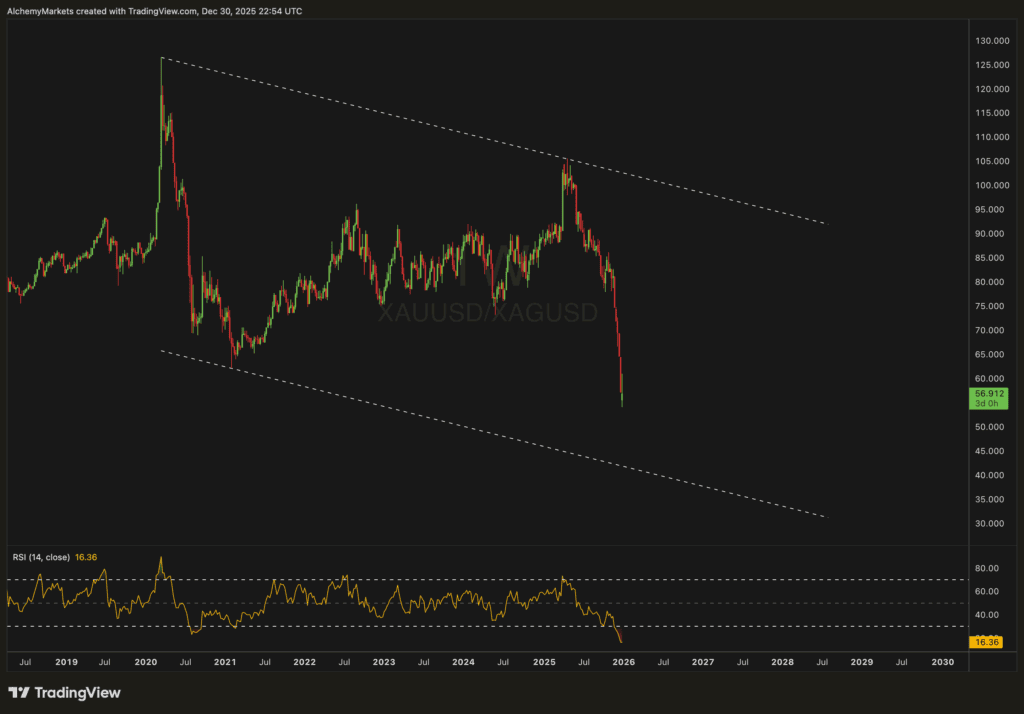
The weekly chart shows the gold/silver ratio still trending lower within a well-defined descending channel.
There remains some room to the downside, potentially carrying into the next quarter as the ratio approaches the lower bound of that channel.
However, the RSI is deeply oversold (currently near 16), suggesting momentum may begin to flatten or turn choppy.
This setup supports the idea of volatile, two-way trading — continued downside in the short term but with rising risks of a technical rebound once exhaustion sets in.
The gold/silver ratio isn’t just a metals chart — it’s a macro thermometer.
Its sharp decline reflects a market tilting away from defensiveness toward cyclical optimism.
But with positioning stretched and sentiment bullish on silver, the setup looks increasingly asymmetric: further downside is possible, yet the probability of a rebound is building as macro and technical conditions converge.
Alchemy Markets is a multi-asset brokerage providing retail traders with the same elite trading conditions, tools, and transparency typically reserved for institutions.

Select the categories and companies you wish to follow directly to your person rss feed.
Create Custom RSS Feed
just now
Sign up and join over 5,000 professional members who receive personalized news alerts, curated professional connections, and more for free!
CMC Markets, a FTSE 250 multi-asset financial services firm, has launched a read-only ChatGPT integration for UK CFD clients, giving access to balances, positions, orders, pricing and historical market data through conversational prompts, as part of its ongoing investment in AI and cloud technology.
DXtrade, the multi-asset trading platform from Devexperts, has integrated Notofin's trading performance intelligence solution, adding behaviour-first analysis, structured journaling and pattern recognition tools. Brokers licensing DXtrade can now offer Notofin's services to clients as part of the platform's open integration framework.
KYC is essential for building trust, preventing fraud, and meeting regulatory requirements. A centralized system like ATARIA CRM helps compliance teams manage KYC requests, track pending documents, monitor approvals and rejections, and keep the entire verification process organized. By quickly identifying pending issues, businesses can reduce delays and provide customers with a smoother path from “Pending” to “Approved.”
Build better trading habits with a trading journal. Learn how a trading memory bank helps you review mistakes, manage emotions, and develop confidence.
GBP/USD has fallen to 3-month lows near 1.3200 due to strong US economic data and weakening UK consumer demand, though technical indicators like an RSI of 25.18 suggest the pair is now in oversold territory near key support at 1.3150.
In Remembrance of H.H. Sheikh Ahmed bin Rashid Al Maktoum (1950–2026)
Blueberry Financial Consultation has secured a Category 5 licence from the UAE Capital Markets Authority and opened a new office in Dubai, forming a regional hub covering the UAE, Saudi Arabia and Egypt. Head of Category Giscard Abi El Hessen said the move supports the firm's long-term MENA growth strategy.
ATARIA CRM’s **Payment Gateways** feature centralizes multiple payment methods—**PSPs, bank payments, and crypto**—into one workflow. This helps brokerages manage payment activities more efficiently, reduce operational complexity, and provide clients with flexible funding options from a single platform.
Bring native groups from different connected trading servers together under one virtual structure and manage future routing changes from one place.