just now


Liquidity Finder Ltd is incorporated in England and Wales, company number 10610740, registered address 167-169 Great Portland Street, Fifth Floor, London W1W 5PF, United Kingdom.
Published: just now
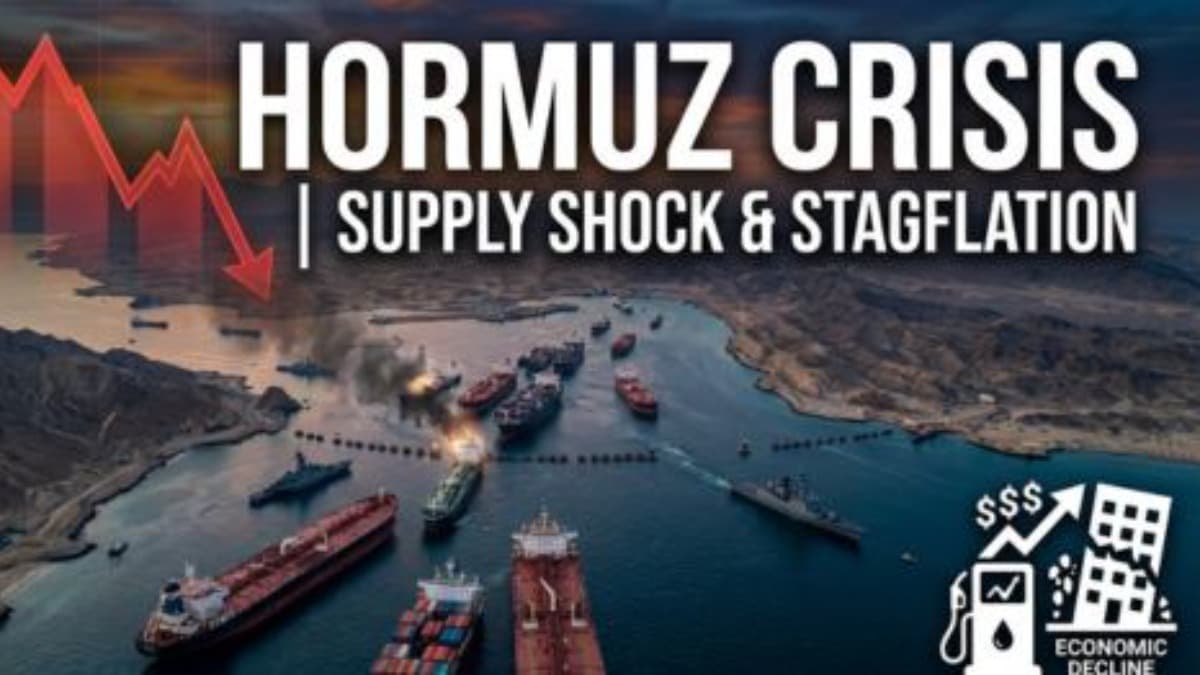

An Energy Supply Shock happens when the resources that powers the world such as oil, natural gas, or electricity suddenly becomes harder to obtain or significantly more expensive.
And because every business in the world requires amount of energy to run, when the price of energy surge, it is like a brake or pause on the whole economy.
Energy is the hidden element in everything the global economy produces. Be it in manufacturing goods, powering data centers, or moving cargo across the ocean, energy is a fundamental value. When the cost of that energy doubles overnight, the cost of production spikes instantly. Crucially, this doesn't make the product higher quality or more efficient; it simply makes the same product much more expensive to bring to market.
A shock is defined by its speed and magnitude. It is not a gradual market shift that executives can hedge against, it is an emergency like the current closure of the Strait of Hormuz. Since it is both instant and crucial, businesses are rejected the time to adapt their supply chains or pivot to alternative energy sources. It forces an entire global industrial complex to react to a crisis rather than execute a strategy.
When energy costs jump, the global economy hits a wall. Businesses, faced with weakening profit margins, are forced into a defensive posture they must either increase prices and pass it onto consumers (which fuels inflation) or cut back on their operations as affecting the operating costs, investments, and hiring to stay solvent. When firms across the globe simultaneously pull back on expenditures and production, the entire economy experiences a contraction a sharp slowdown in growth that ripples through every sector. The Research and Development (R&D) is as example is affected by an energy shock situation, a classic example of what occurs during the retrenchment period and this is the fact that Research and Development is a long-term, discretionary investment, companies may give importance on the immediate survival by slashing innovation costs to preserve essential cash flow or CF as this extensive withdrawal from the research and development creating an innovation gap that heavily delays long-term economic productivity and future growth.
Baseline Equilibrium
Under normal conditions, a logistics firm balances input costs against revenue to maintain standard profit margins.
The Exogenous Shock
A disruption to global energy chokepoints causes an immediate, severe spike in operational costs. For example, if fuel expenses rise from $100 to $300, the firm’s operating margin collapses into a net loss.
The impact
Macroeconomic Synthesis
Energy shocks act as an inflationary brake, forcing prices up while slowing growth. This creates a Central Bank Trap policies intended to curb inflation inevitably worsen the contractionary pressure. We monitor this very carefully because central banks cannot simultaneously verify price stability and stimulate growth in a supply-constrained environment.
Example of impact for each asset class
The Equities or Stocks
Energy costs are a major expense for businesses. When these costs spike, companies are stuck if they raise prices, customers stop buying; if they don’t, their profits vanish.
Example (Airlines) Fuel is a huge cost for airlines. If fuel prices double, airlines lose money. If they raise ticket prices, fewer people fly. Either way, the stock price usually drops.
The Fixed Income or Bonds
Bonds pay a fixed amount of interest. If energy costs cause high inflation, that fixed payment doesn't buy as much as it used to. In addition, if the central banks decide to hike interest rates to fight inflation, older bonds become less valuable.
Example on U.S. Treasuries. In year 1970s, the oil prices and inflation both surged, bondholders lost money due to their fixed interest payments couldn't keep up with the increasing cost of living.
The Commodities
When the world faces a shortage of energy, the energy itself becomes the most valuable asset. Prices for oil and gas go up, making these commodities the primary place to store value during a crisis.
Example with Oil Futures. If a major supply passage like the Strait of Hormuz is closed or blocked, we expect that oil prices will spike immediately. This result to some investors may take advantage to buy oil and energy stocks to profit from higher prices, which helps offset losses elsewhere.
The Currencies
Energy shocks shift wealth from countries that need to buy energy to countries that sell it. The currencies of energy-exporting countries tend to get boosted the while energy-importing countries see their currencies decline.
Example on Norway vs. Eurozone. Norway is an oil producer country. When the oil prices suddenly jump, the world needs more of the Norwegian local currency as a payment for that oil, resulting to making the Norwegian Krone stronger compared to the Eurodollar as used by countries that rely on energy imports, since this makes the demand for that specific resource becomes higher as it supports the currency as well.
How this affects the movement of US Dollar?
The Safe-Haven Effect when we see investors shift to the U.S. dollar as a security when geopolitical crises causing a global market panic.
Taking advantage on the Interest Rates as higher inflation usually leading to force the Federal Reserve to maintain elevated interest rates as this makes the dollar more attractive to investors seeking better returns or higher value.
The U.S. Energy Independence since the U.S. is a net energy exporter, it remains economically stronger than energy-importing nations, whose currencies weaken as they struggle to pay for expensive fuel. That is why we see during the first week we saw an immediate spike on USD index.
Example with the WTI or West Texas Intermediate
During an energy supply shock, WTI Crude stops following normal chart rules and enters a Liquidity-Void, where prices move too fast for standard patterns to work.
Breakouts No Re-test
In normal markets, prices re-test old resistance levels to confirm new support. During a shock, prices gap upward and keep moving because there is no sell-side liquidity to bridge the gap.
Analysis. The asset has undergone a structural re-pricing due to a fundamental supply collapse, rendering historical support levels irrelevant in the new price regime.
Indicators Relative Strength Index Pinning
Generally, the investors sell when this index goes above 70 which signals an overbought market. During this shock, the RSI can pin at 90+ for weeks.
Analysis. An extreme RSI reading during a crisis is not a signal of mean reversion, but a diagnostic of extreme physical scarcity, reflecting the desperate inelastic demand of buyers seeking to secure supply at any cost.
Analysis. Relying on moving averages assumes a stable equilibrium, however, the velocity of the shock makes the historical mean obsolete, necessitating the use of Fibonacci projections to model the new, higher-level price discovery.
Example WTI Crude Shock
The Setup. West Texas Intermediate is trading calmly between $75 and $80.
The Catalyst or Primary Driver. A major supply route like the Strait of Hormuz closes.
The Movement
The Gap. Price instantly jumps to $88.00, skipping everything in between.
The Volume. A massive spike in On-Balance Volume (OBV) confirms institutional accumulation of physical contracts.
The Projection. Since $80 is now irrelevant, you use a 1.618 Fibonacci extension from the old range to set your new target at $88.10.
The Result.The price holds $88.00 as a new support, leaving the old 20-day EMA ($78.00) far below.
1-Hour (H1) charts capture the acute volatility and liquidity voids following the April 18 closure announcement.
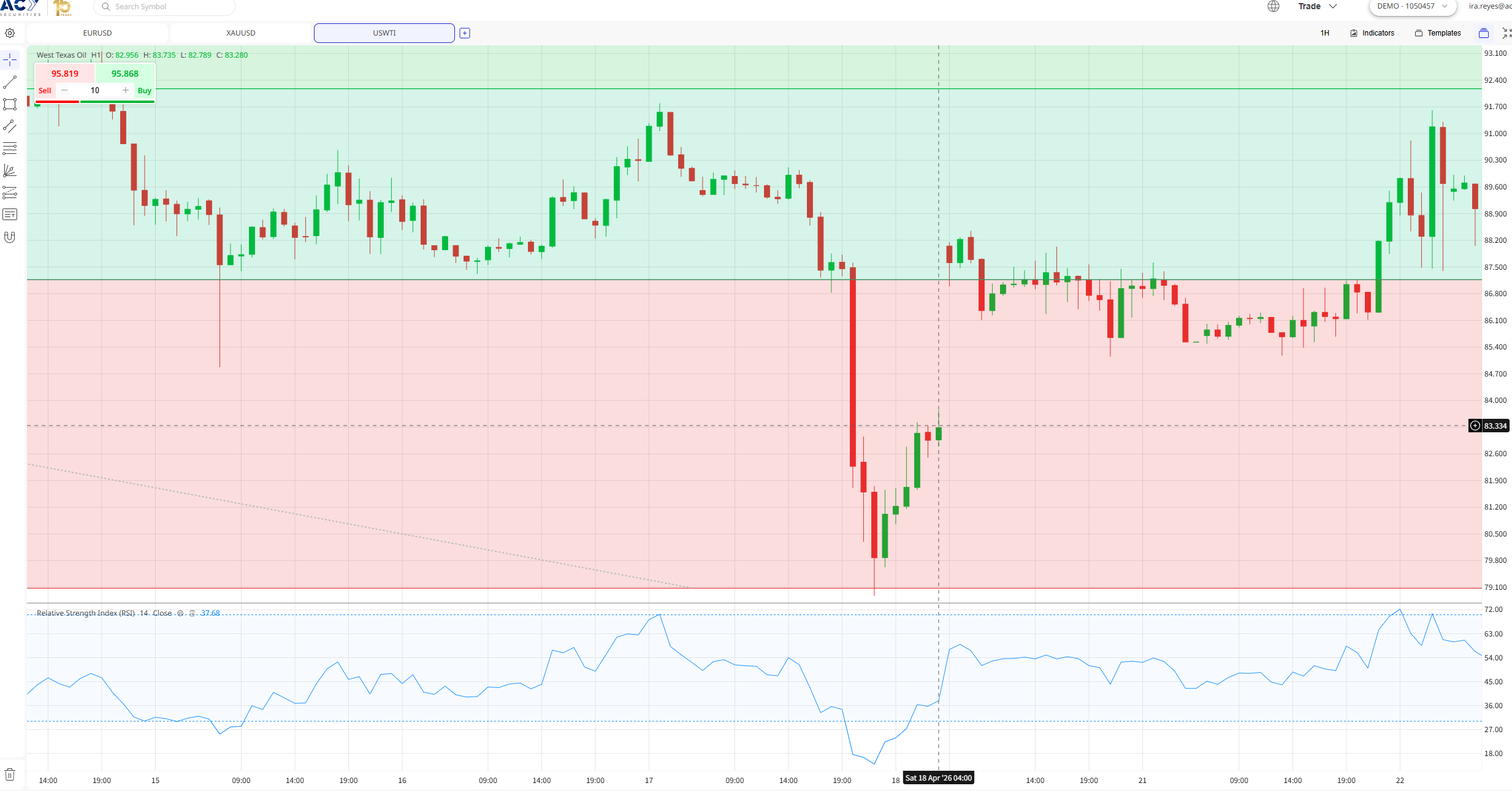
The Gap Catalyst. Look at the candles around April 17–20, 2026. You will observe a significant Breakaway Gap upward, as markets reacted to the failure of the April ceasefire and the subsequent Iranian blockade.
Moving Average Detachment. During the surge following the April 18 re-closure, the price of WTI decoupled from its 20-day and 50-day EMAs. This vertical fan phase is the technical signature of a market transitioning from price-based trading to scarcity-based re-pricing.
RSI Extremes. If you pull up the RSI for the weeks following April 18, you will see it remain pinned in the 80–90 range, which serves as your diagnostic indicator of inelastic physical demand rather than standard momentum.
Since mid-April, WTI has been driven primarily by a persistent Geopolitical Risk Premium. We are tracking two critical support levels the 50-day SMA near $93.00 as our primary trend floor, and the $85.00–$88.00 'gap zone' as our structural liquidity floor. Maintaining levels above this gap confirms that the market is still pricing in significant supply disruption risk.
Inflation is when consumer and business costs a sudden surge since the energy is a fundamental input for almost everything produced and being transported.
Gross Domestic Product Growth is when the economy slows down or shrinks as businesses cut production, investment, and hiring to offset rising energy bills.
Interest rates is when central banks face a difficult dilemma, often trapped between raising rates to fight inflation or cutting them to support a struggling economy.
Currency values of Forex when the currencies of energy-exporting countries typically gain strength, while those of energy-importing nations weaken as they struggle to pay for expensive fuel.
For the Disposable income, it is when the households have less cash or money to spend on discretionary goods because a larger portion of their budget is consumed by higher energy and fuel prices.
Explore my portfolio for further insights:
The Gas Gap: Why LNG Benchmarks are the New Engine for Equity Returns
WTI at the Crossroads: Supply Deficits vs. the 100 Psychological Floor
XAU/USD: Gold at the Crossroads: Geopolitical Shield or Technical Trap?
EURUSD: Trading EUR/USD Through High Oil and Rate Volatility
NASDAQ100: Breakout or Breakdown for the Nasdaq?
WTI: Is WTI Headed for a Price Collapse or a Supply Spike?
XAUUSD Outlook: Safe-Haven vs. Strong Dollar: The Battle for Gold’s Next Big Trend
EURUSD Outlook: Interest Rate Pair to Energy Security Pair
EURUSD: Why Beating the Forecast No Longer Supports the Euro?
GBPUSD: Retail Recovery or Energy Trap?
EURUSD: Is the Euro Heading for a Breakdown as German Manufacturing Fades and Energy Risks Rise?
Industrial Core vs. Energy Cost: Who wins the Battle for the DAX?
EURUSD: Will the Sentiment support a lifeline amid growing stagflation fear across the region?
WTI: Is the war premium dormant?
Disclaimer: This content may have been written by a third party. ACY makes no representation or warranty and assumes no liability as to the accuracy or completeness of the information provided, nor any loss arising from any investment based on a recommendation, forecast or other information supplies by any third-party. This content is information only, and does not constitute financial, investment or other advice on which you can rely.
ACY Securities is one of Australia's fastest growing multi-asset online trading providers, offering ultra-low-cost trading, rock-solid execution, technologically superior account management and premium market analysis.

Select the categories and companies you wish to follow directly to your person rss feed.
Create Custom RSS FeedSign up and join over 5,000 professional members who receive personalized news alerts, curated professional connections, and more for free!
FM Summit London 2026 returns to Old Billingsgate on 24 November for its 15th edition, with LMAX Group, Plus500 and oneZero among confirmed exhibitors. The one-day event adds Business Connect meetings and roundtables, and opens with a networking evening at The Folly on 23 November.
Finance Magnates Summit London returns to Old Billingsgate on 24 November 2026 for its 15th edition. The one-day event brings together brokers, liquidity providers, institutional firms, trading technology vendors, payments businesses and digital asset firms.
iSAM Securities Apex has integrated with Match-Prime, giving brokers access to liquidity across more than 2,000 instruments, with tailored pricing and up to 10 levels of market depth.
propfunding.com's free-entry instant funding changes the order of prop funding. Start trading first. Its free-entry instant funding model offers two qualification attempts without an upfront activation fee.
US stocks closed higher on Wednesday, with the Nasdaq gaining 1%, the S&P 500 rising 0.6%, and the Dow advancing 0.7%, as renewed enthusiasm for AI-related stocks lifted market sentiment.
SpaceX went public in June as a rocket company. On October 20 it reported as something else entirely: an AI infrastructure business, financed by a satellite broadband network, with a launch division attached. Rockets generated 12% of third quarter revenue and lost money. The AI segment generated 52% of revenue and consumed 84% of capital expenditure. Starlink generated 85% of operating profit.
Standard Chartered has signed definitive agreements to acquire 100% of Zodia Custody UK Limited, folding its regulated digital asset custody business into Securities Services. Zodia Solutions will be set up under SC Ventures with bank investors including Northern Trust, NAB Ventures, Emirates NBD and Investcorp.
Bybit Fintech FZE has secured a Virtual Asset Service Provider licence from Dubai’s Virtual Assets Regulatory Authority for Exchange Services, covering spot trading. Bybit’s Peter Loo said the firm hopes to add derivatives, subject to regulatory approvals. Its international Dubai headquarters opened in 2022.
ATFX Connect has released its Q4 2026 Institutional Edge, examining the geopolitical, monetary policy and fiscal pressures shaping global financial markets in the final quarter of the year.
The Nasdaq 100 is trading at 29,382. After reaching a recent high of 29,957, the index reversed sharply and has been recording a series of lower highs and lower lows.