just now


Liquidity Finder Ltd is incorporated in England and Wales, company number 10610740, registered address 167-169 Great Portland Street, Fifth Floor, London W1W 5PF, United Kingdom.
Published: just now
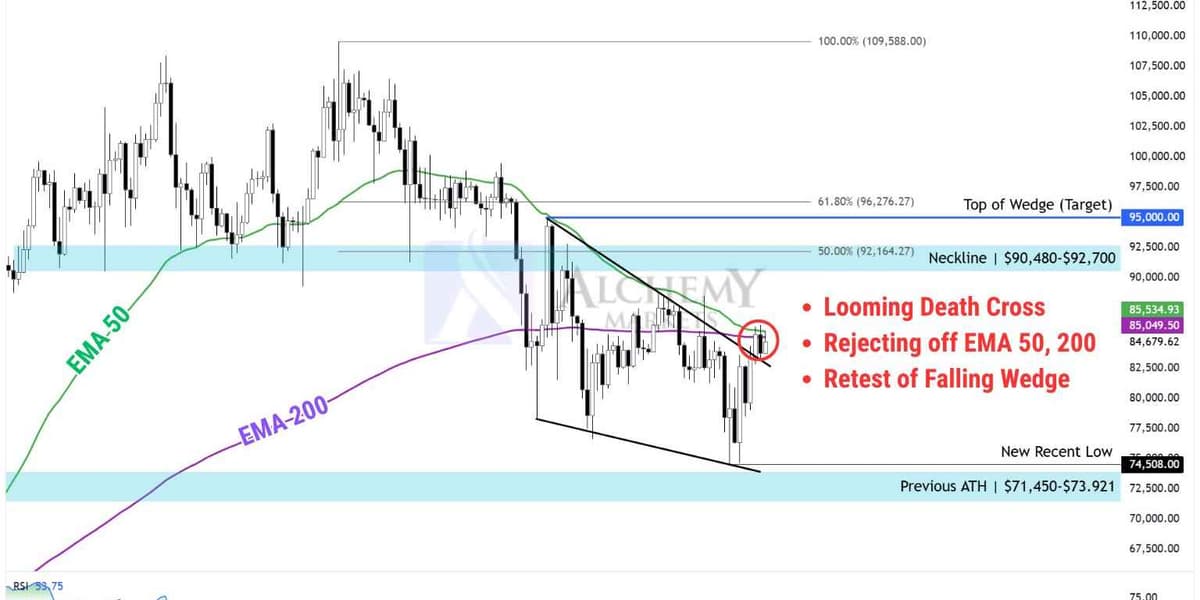
Bitcoin’s breaking out of a falling wedge and retesting structure highs — ha, a classic reversal setup.
But let’s not sugarcoat it: there’s a looming Death Cross on the daily, and that’s a red flag worth watching. Historically, these crosses (50 EMA slicing below the 200) get billed as bearish — but in crypto’s twisted logic, they often mark bottoms, not breakdowns.
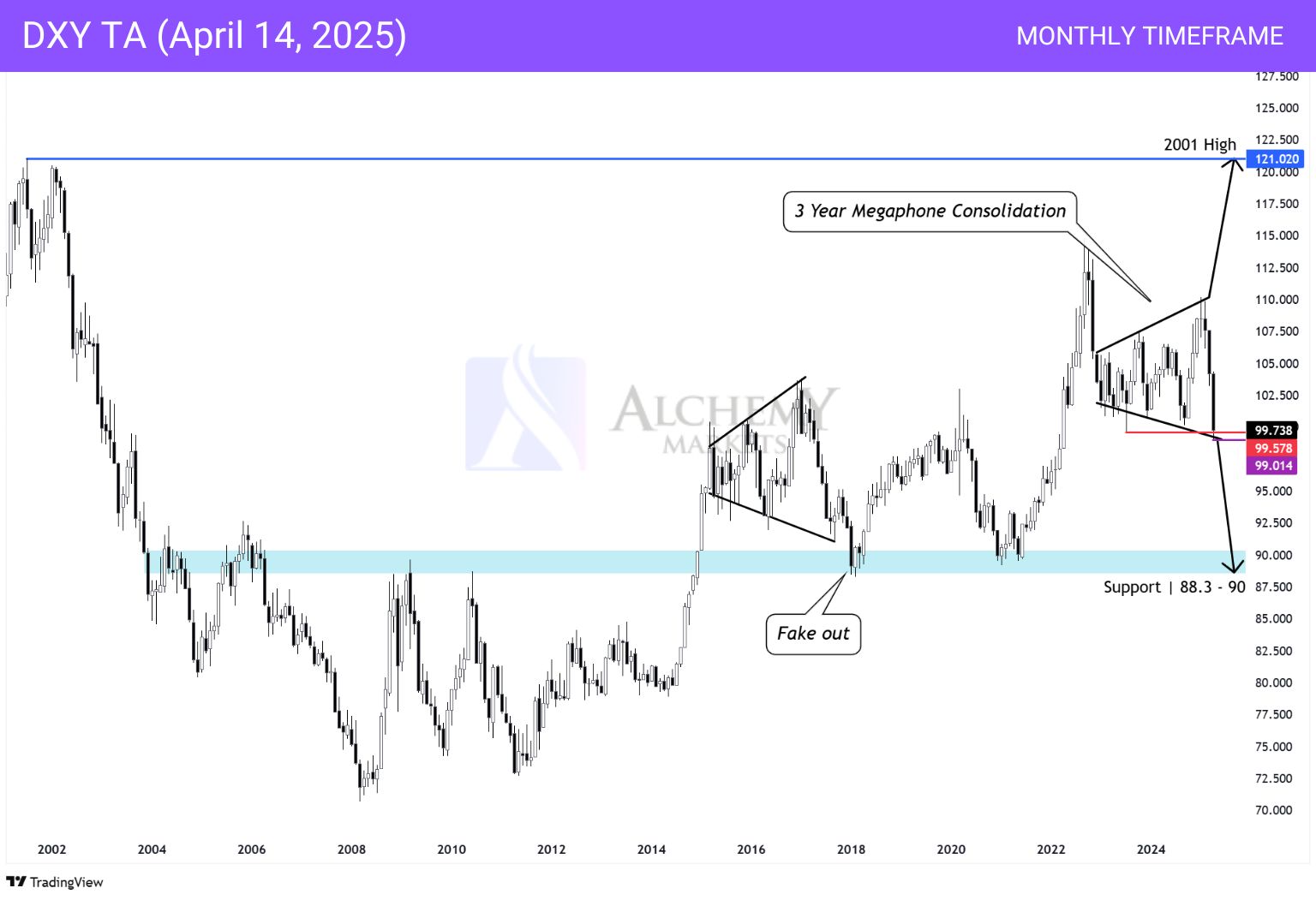
Meanwhile, with China ramping up its tariffs on the US in retaliation, the US dollar is seeing pressure to the downside. The Dollar has hit its lowest point in three years, wicking to ~99.04, while many were expecting 100 to hold.
So when we stitch this together, what’s the playbook for Bitcoin and the DXY from here?
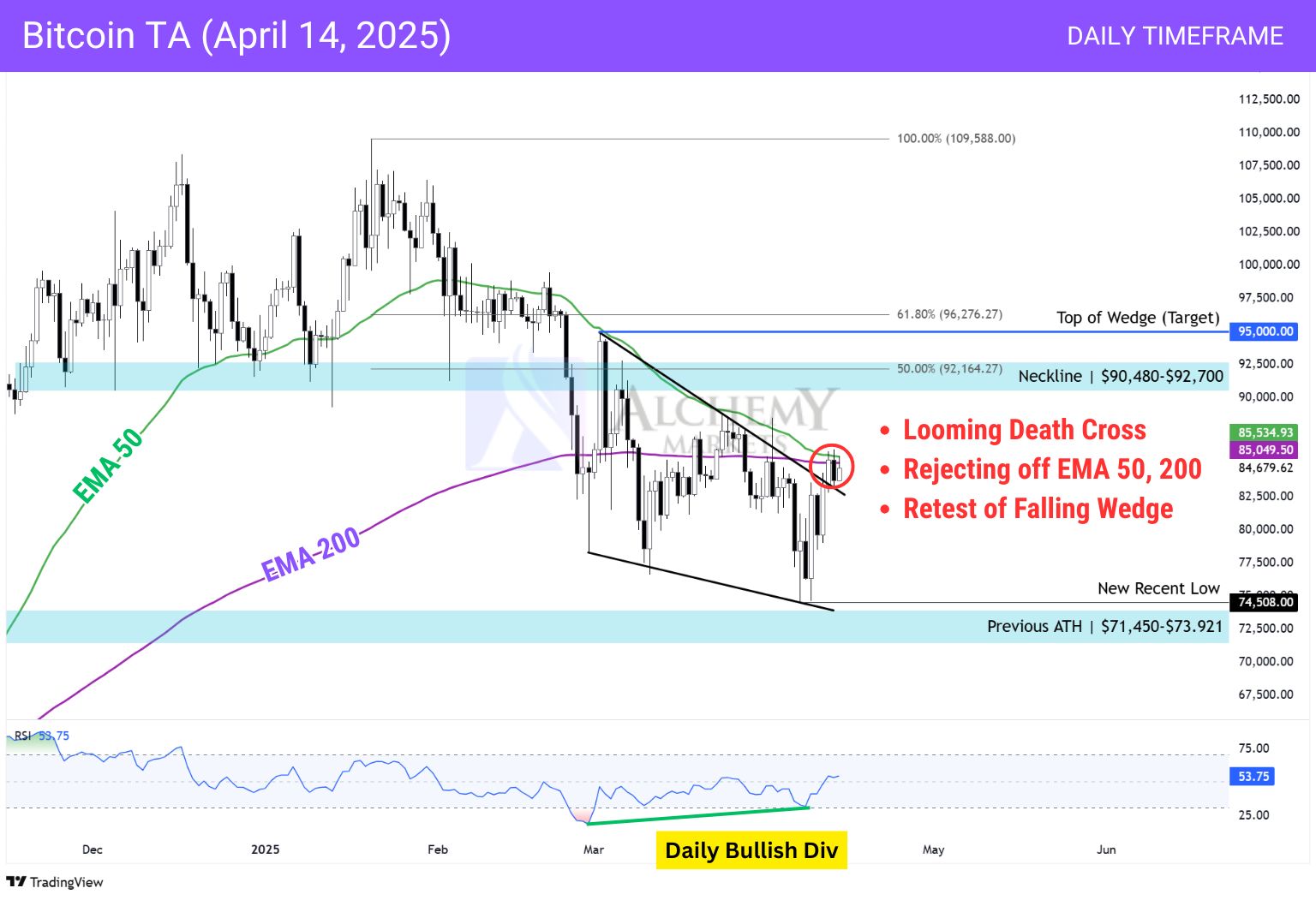
Bitcoin has been known to bottom whenever a death cross—the Daily EMA 50 crossing below the 200—flashes on the price chart. Though this has not yet come to fruition, there have been moments where a looming Death Cross in itself has signalled the bottom, such as in September 2024.
Does this mean that Bitcoin’s bottom is currently in? No.
Currently, the price is being rejected by the 50 and 200 exponential moving averages, so there’s still a possibility we can re-enter the falling wedge’s range. If this happens, a rejection from here down to $71,450 is possible.
If Bitcoin can break above the daily 50 and 200 EMAs, a rise to these prices are on the cards:
In short: keep your eyes on the EMAs. We’re at a technical fork.
Over in FX land, the dollar’s under the gun. DXY just wicked down to 99.04 — the lowest print in three years — as trade tensions between the U.S. and China pick up steam. Markets were expecting 100 to hold. It didn’t.
On the monthly chart, DXY’s carved out a megaphone (expanding triangle) structure — and that sets up a broad range. Breakout targets point either toward the 2001 highs or 2018 lows, depending on which edge gives first.
But geopolitics will drive the next leg. China’s tariff retaliation throws another wrench into the mix. Traders should keep a close eye on recent developments.
The current market setup may be hinting at the early stages of a Yen carry trade unwind—but we’re not there yet.
For context, the carry trade works like this: investors borrow Yen at near-zero rates, convert to USD, and funnel that into higher-yielding US assets like equities or bonds. It’s a core engine of global liquidity. But that engine may soon sputter.

Bottom line?
We’re in a pre-unwind positioning phase. For now, the dollar's weakness and crypto strength suggest the carry trade is still intact, but traders are watching closely for the inflection point.
You may also be interested in:
Tariff Turmoil & Market Mayhem: 7 Wild Days That Left Everything the Same
Alchemy Markets is a multi-asset brokerage providing retail traders with the same elite trading conditions, tools, and transparency typically reserved for institutions.

Select the categories and companies you wish to follow directly to your person rss feed.
Create Custom RSS FeedSign up and join over 5,000 professional members who receive personalized news alerts, curated professional connections, and more for free!
Americans vote on November 3 for all 435 seats in the House of Representatives and a third of the Senate. The presidency is not on the ballot, which means any new Congress will still need the President's signature to turn bills into law. Markets care about the midterms less for the laws that follow and more for what changes in oversight, budgets and the regulatory mood of Washington.
The Australian Securities and Investments Commission has said it is not currently convinced that prediction markets for retail clients are in the public interest. ASIC Chair Sarah Court said prediction market contracts have all the features of a bet, likening them to binary options, which are banned for retail clients.
Binance has confirmed a security incident with an estimated total impact of around $6.3 billion, linked by its initial investigation to a compromised DevOps engineer's laptop. Around $3 billion has been frozen on-chain, and the exchange says it will cover all losses from its SAFU fund and company funds.
US crypto exchange Coinbase has reported net income of $719 million for the third quarter of 2026, up 66% from $432.6 million a year earlier. Prediction markets passed $200 million in annualised revenue, and paid Coinbase One subscribers reached an all-time high.
Webull Securities Co., Ltd., the Japanese subsidiary of Webull Corporation, has started handling US Treasury bonds, giving customers access to about 20,000 bonds as of 30 October 2026. The service lets users trade market-traded bonds like stocks, with real-time prices and yields, from $100.
Intercontinental Exchange and Trade[XYZ] have agreed to bring Trade[XYZ]’s perpetual markets onshore in the US through a new regulated market and clearing structure for round-the-clock retail trading built on Hyperliquid, operated separately from ICE’s institutional futures franchise, subject to regulatory approvals.
The Utah Attorney General's Office has filed 14 criminal charges against KalshiEX, LLC, the operator of US prediction market Kalshi, in a case that names co-founders Tarek Mansour, Chief Executive Officer, and Luana Lopes Lara, Chief Operating Officer, as co-defendants.
US blockchain payments company Ripple and US crypto exchange Coinbase have partnered to make Ripple's US dollar stablecoin, Ripple USD (RLUSD), available across Coinbase's platforms
The UK Financial Conduct Authority (FCA) has secured High Court undertakings to ensure that global crypto exchange HTX, formerly known as Huobi, will not knowingly promote cryptoasset services unlawfully to UK consumers.
US post-trade market infrastructure provider DTCC has launched its DTCC Tokenization Service (DTS) through its subsidiary The Depository Trust Company.