just now


Liquidity Finder Ltd is incorporated in England and Wales, company number 10610740, registered address 167-169 Great Portland Street, Fifth Floor, London W1W 5PF, United Kingdom.
Published: just now
The Purchasing Managers’ Index is a survey-based economic indicator designed to track changes in business conditions.
Each month, companies are surveyed about whether selected aspects of their business have improved, remained unchanged or deteriorated compared with the previous month.
The questions can cover areas such as:
The exact questions and methodology depend on the PMI provider and the sector being surveyed.
The information is then converted into diffusion indexes, which provide a numerical measure of the direction and scope of change. S&P Global, for example, calculates diffusion indexes using the share of companies reporting an increase and a portion of those reporting no change.
This makes PMI different from many traditional economic statistics. Rather than waiting for companies to report completed sales, production or employment data through official statistical processes, PMI gathers information directly from businesses about current conditions.
That speed is one of the reasons PMI is closely followed by financial markets.
PMI is designed to capture changes in important areas of business activity.
For manufacturing companies, the survey can provide information about production, new orders, employment, purchasing activity, inventories and supplier delivery times.
For service businesses, the focus can include business activity, new business, employment, prices and outstanding work.
This means PMI can provide more than a single headline number. Its individual components can also help to understand why some business conditions are changing.
Example, if a company reports stronger new orders but weaker employment. Another month may show strong production but increasing input costs. We use this information to get an accurate picture rather than focusing only on the headline PMI.
PMI is calculated by asking businesses if things are getting better, getting worse, or staying the same compared with the month before.
Example below from the Economic Calendar PMI readings.
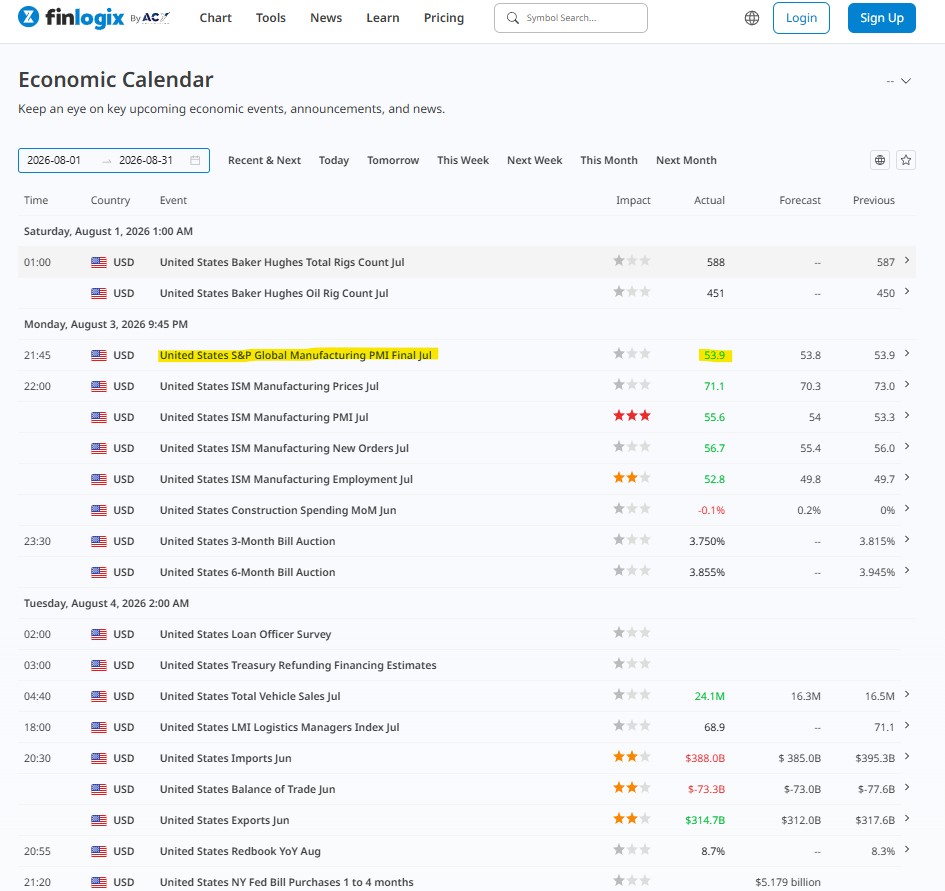
Source: Finlogix
Businesses may be asked about things like that help calculate PMI like: new orders, production, jobs, and deliveries. Their answers are then combined to create a PMI score between 0 and 100.
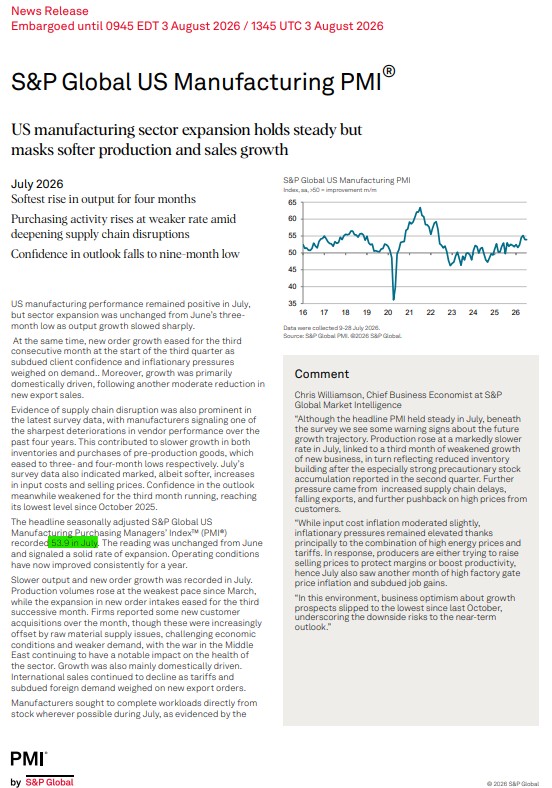
Source: S&P Global
A higher PMI means more businesses are seeing better conditions. A lower PMI means more businesses are seeing worse conditions.
PMI is useful because it helps show whether business activity is growing or slowing down.
However, not all PMI reports are calculated in exactly the same way. Different groups may use different businesses, questions, and methods to calculate their PMI.
PMI data are available for different sectors, allowing investors to look at specific areas of the economy.
Manufacturing PMI focuses on businesses involved in producing physical goods.
It can provide information about production, new orders, employment, inventories, purchasing activity and supplier deliveries.
Manufacturing PMI can be particularly relevant to investors following industrial companies, exporters, commodities and economies with significant manufacturing sectors.
Services PMI focuses on businesses operating in service industries.
These can include areas such as finance, transportation, information technology, professional services, real estate, hospitality and other business services.
Services are an important part of many economies, making services PMI a useful indicator of broader private-sector activity.
Composite PMI combines information from manufacturing and services to provide a broader view of private-sector business activity.
For investors, this can be useful when manufacturing and services are moving in different directions.
For example, manufacturing activity could weaken while services remain strong. Looking only at manufacturing PMI might therefore give an incomplete picture of overall business conditions.
Construction PMI focuses on activity in the construction industry.
Depending on the provider, surveys can cover construction activity, new orders, employment, purchasing and input costs across areas such as residential, commercial and civil-engineering projects.
S&P Global is one of the major international providers of PMI data.
Its PMI surveys cover more than 40 economies and provide information on manufacturing, services and other areas of business activity. The data are derived from surveys of senior executives at private-sector companies.
One of the most important features of S&P Global's PMI releases for traders is the Flash PMI.
Flash PMI provides an early indication of business conditions before the final monthly data are released. S&P Global says its flash estimates are typically based on approximately 80%–90% of the eventual total survey responses.
This timing can be important for financial markets.
Markets react when they get new information. An early PMI report can give investors an early idea of how businesses are doing.
This information can affect what people expect about business growth, prices, jobs, and interest rates before other economic reports come out.
S&P Global's international coverage is another important feature. Investors can use its PMI data to compare business conditions across major economies and regions using a broadly consistent framework.
The Institute for Supply Management (ISM) collects information about businesses in the United States. And this information helps to create PMI reports that show how the economy is doing.
ISM releases two main reports: the Manufacturing PMI and the Services PMI.
The ISM Manufacturing PMI indicator tracks five key or important areas of manufacturing and by looking at these areas, we can get an idea of whether factories are growing, slowing down, or staying about the same.
The ISM Services PMI uses four major components:
ISM's surveys therefore provide a detailed look at how U.S. businesses are experiencing changes in demand, production or activity, employment and supply conditions.
For market participants, the importance of ISM goes beyond the headline PMI. Individual components can sometimes provide more useful information about the underlying economic environment.
For example, a strong services PMI accompanied by strong new orders but weaker employment could tell a different story from a report in which both activity and employment are improving.
PMI is valuable because it provides a relatively timely view of business conditions.
Investors can use PMI data to monitor trends in:
For traders, the surprise relative to expectations can be particularly important.
Consider a simple example.
Let’s say experts think the PMI will be 52 but the actual number is 55. Since 55 is higher than expected it may be a sign that businesses are doing better than people thought. Investors may see this as news and change their plans.
Now suppose experts expect the PMI to be 55 but the actual number is 52. The economy may still be growing. It is not growing as much as expected. Investors may see this as bad or disappointing news.
That is why investors look at both the PMI result and what they expected it to be. A PMI number can have a different effect on the market depending on whether it is better or worse than expected.
This is why market participants often look at three things:
The relationship between those three can help explain why financial markets sometimes react strongly to what appears to be a relatively small change in PMI.
Last month (August 2026) the J.P. Morgan Global Composite PMI increased from 52.7 in July to 53.5. This meant that business activity across the world was increasing faster than it had in than two years. A lot of this increase came from service businesses.
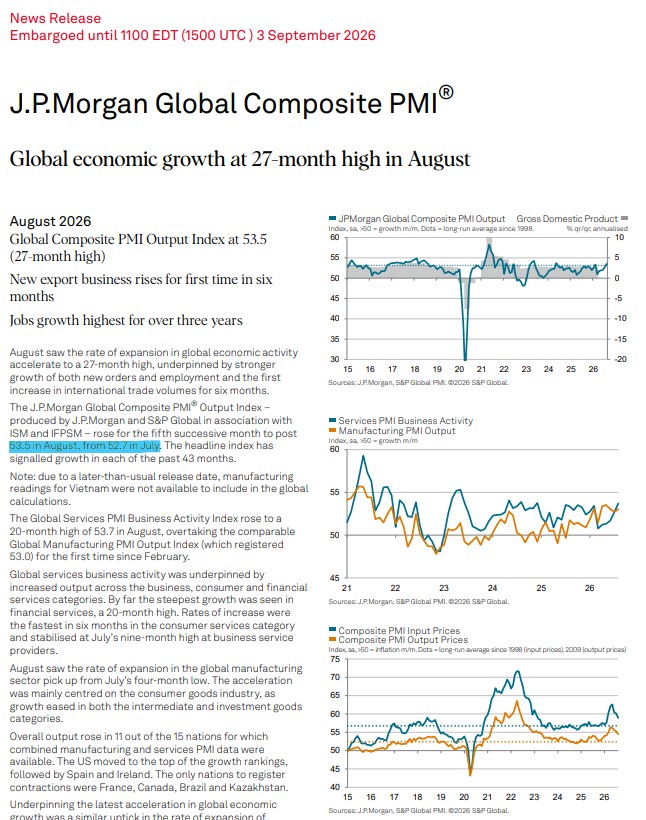
Source: S&P Global
Manufacturing also kept growing. In the United States the ISM Services PMI rose from 54.1 in July to 55.4 in August. Business Activity was 61.7. New Orders were 60.9. The Employment Index was 47.8, which was less, than 50. This showed that employment was still going down. ISM data shown below.
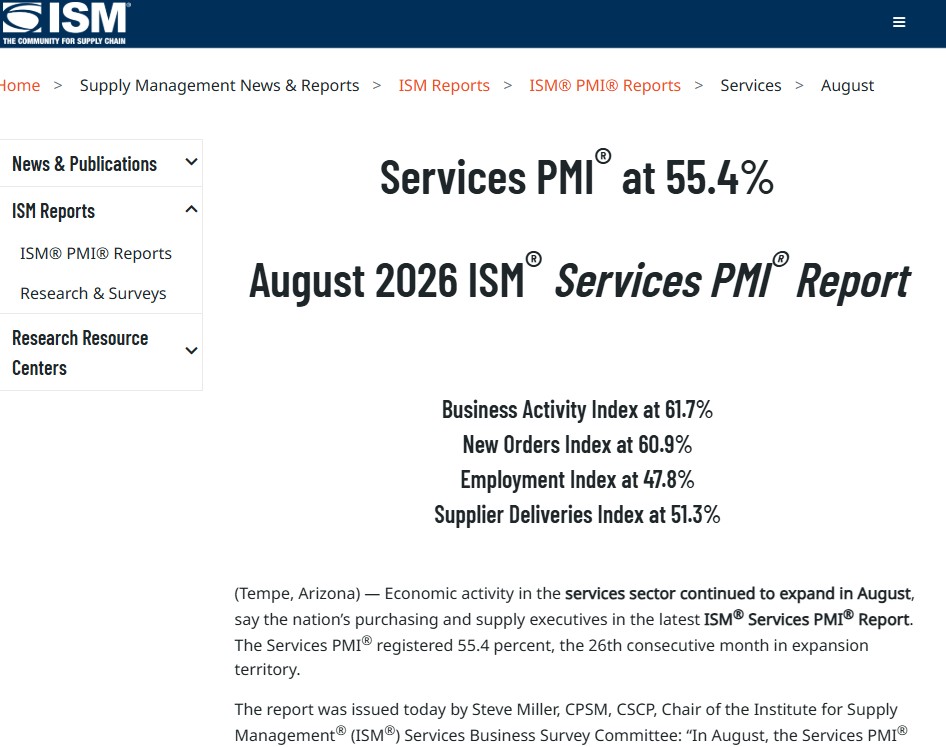
Source: ISM
This example shows why it is important to look beyond the main PMI number. The headline PMI tells us whether business activity is growing or slowing, while the smaller parts of the report can show us what is driving the change.
Although PMI is widely followed it should not be treated as a measure of economic conditions.
For investors and traders, PMI is therefore most useful when considered alongside other economic and financial-market information.
The Purchasing Managers' Index provides investors with a timely way to monitor changes in business conditions across manufacturing, services and other sectors.
Its value comes not only from the headline figure but also from the information contained in its individual components.
For global investors, S&P Global PMI provides extensive international coverage and early Flash PMI releases. For those focused on the United States, ISM PMI is an important source of manufacturing and services data.
Understanding the difference between the two is essential when interpreting economic headlines.
The Purchasing Managers' Index (PMI) is best viewed as a snapshot of changing business conditions.
For investors and traders, that snapshot can provide useful clues about demand, employment, prices and business momentum and help put other market-moving economic data into context.
Disclaimer: This content may have been written by a third party. ACY makes no representation or warranty and assumes no liability as to the accuracy or completeness of the information provided, nor any loss arising from any investment based on a recommendation, forecast or other information supplies by any third-party. This content is information only, and does not constitute financial, investment or other advice on which you can rely.
ACY Securities is one of Australia's fastest growing multi-asset online trading providers, offering ultra-low-cost trading, rock-solid execution, technologically superior account management and premium market analysis.

Select the categories and companies you wish to follow directly to your person rss feed.
Create Custom RSS FeedSign up and join over 5,000 professional members who receive personalized news alerts, curated professional connections, and more for free!
Multi-asset trading broker AvaTrade has agreed to acquire the majority of FXCM Group’s business and brand, in a transaction that would bring a longstanding retail FX franchise into the AvaTrade Group.
LSEG and CMC Markets have signed a multi-year strategic data agreement expanding CMC's access to LSEG's real-time and delayed pricing, reference and corporate actions data, news and analytics, plus AI-ready content, to support new products, entry into new markets and the growth of CMC's institutional and B2B partnerships.
The Tel Aviv Stock Exchange is considering a bid for the Cyprus Stock Exchange, with Israeli media citing its EU licence, trading platform and clearing house. Euronext’s Athens exchange and India’s National Stock Exchange are also seen as contenders, and Cyprus aims to sign a sale agreement by the end of this year.
CME Group will launch baseball futures on 12 October, pending regulatory review, tracking CME FutureSports Performance Indexes built on Official League Data. Standard and micro contracts will start with the 2026 Postseason and the four clubs in the League Championship Series, trading around the clock.
ESMA has published an opinion stating that MiCA-authorised crypto-asset service providers should cease services tied to non-MiCA-compliant stablecoins for EU clients across MiCA crypto-asset services. National authorities should require remediation of existing exposures within three months, by early January 2027.
Nasdaq Ventures has made a strategic investment in Amsterdam-based derivatives and crypto exchange One Trading, with both firms to explore 24/7 trading of equity futures. The undisclosed investment follows Nasdaq's US$100 million investment in Payward, the parent of Kraken, and CME Group's move to 24/7 trading.
cTrader has opened multi-platform plugins to brokers and prop firms, which can pre-install their own tools for clients or list them in cTrader Store. The plugins run across Mobile, Web, Windows and Mac, and can be built and launched independently of core-platform releases, including trading journals and calculators.
Institutional brokerage and financial infrastructure provider Clear Street has joined TradingView’s broker network, allowing its clients to trade US stocks, exchange-traded funds and options directly through the charting and analysis platform.
Learn how to improve trading psychology, manage fear and greed, avoid revenge trading, and follow your trading strategy with discipline and a trading journal.
GTC Prime has announced a strategic partnership with Centroid Solutions to manage and distribute its liquidity through CS 360 Bridge, Centroid's multi-asset connectivity and execution engine, giving brokers and institutional clients access to tailor-made pricing, low-latency execution and real-time risk management.