just now


Liquidity Finder Ltd is incorporated in England and Wales, company number 10610740, registered address 167-169 Great Portland Street, Fifth Floor, London W1W 5PF, United Kingdom.
Published: just now

March 16, 2023 - The Federal Reserve has announced that its groundbreaking 'FedNow' Service will start operating in July and has provided details on preparations for launch.
From the official press release yesterday, the Fed announced, "In the first week of April, the Federal Reserve will begin the formal certification of participants for launch of the service. Early adopters will complete a customer testing and certification program, informed by feedback from the FedNow Pilot Program, to prepare for sending live transactions through the system.
Certification encompasses a comprehensive testing curriculum with defined expectations for operational readiness and network experience. In June, the Federal Reserve and certified participants will conduct production validation activities to confirm readiness for the July launch.
"We couldn't be more excited about the forthcoming FedNow launch, which will enable every participating financial institution, the smallest to the largest and from all corners of the country, to offer a modern instant payment solution," said Ken Montgomery, first vice president of the Federal Reserve Bank of Boston and FedNow program executive. "With the launch drawing near, we urge financial institutions and their industry partners to move full steam ahead with preparations to join the FedNow Service."
Many early adopters have declared their intent to begin using the service in July, including a diverse mix of financial institutions of all sizes, the largest processors, and the U.S. Treasury.
In addition to preparing early adopters for the July launch, the Federal Reserve continues to engage a range of financial institutions and service providers to complete the testing and certification program and implement the service throughout 2023 and beyond. Montgomery noted that availability of the service is just the beginning, and growing the network of participating financial institutions will be key to increasing the availability of instant payments for consumers and businesses across the country.
The FedNow Service will launch with a robust set of core clearing and settlement functionality and value-added features. More features and enhancements will be added in future releases to continue supporting safety, resiliency and innovation in the industry as the FedNow network expands in the coming years.
"With the FedNow Service, the Federal Reserve is creating a leading-edge payments system that is resilient, adaptive, and accessible," said Tom Barkin, president of the Federal Reserve Bank of Richmond and FedNow Program executive sponsor. "The launch reflects an important milestone in the journey to help financial institutions serve customer needs for instant payments to better support nearly every aspect of our economy."
You could be forgiven for thinking that FedNow is a new innovation from PayPal, based on the similarity, (in colour at least) of their logos:

Fintech apps like PayPal, CashApp, and Venmo, already transfer money from one party to another instantly. The current Fed system has been too slow compared to these fintechs and has been working to speed up the time it takes to process money through the banking system. The Fed is playing catch-up.
The big difference between the payment fintechs and the what the Fed is aiming at is that currently the fintech apps can instantly transfer between apps, but not into a user's bank account.
The FedNow service, which was announced in 2019, offers instantaneous payments to individuals and businesses bank accounts. It is a real-time gross settlement (RTGS) system, developed by the Federal Reserve, designed to facilitate instant and continuous payment services, enabling banks and other financial institutions to offer round-the-clock fund transfers to customers. The platform supports real-time, interbank settlement of individual payments, providing a more efficient and secure alternative to existing methods.
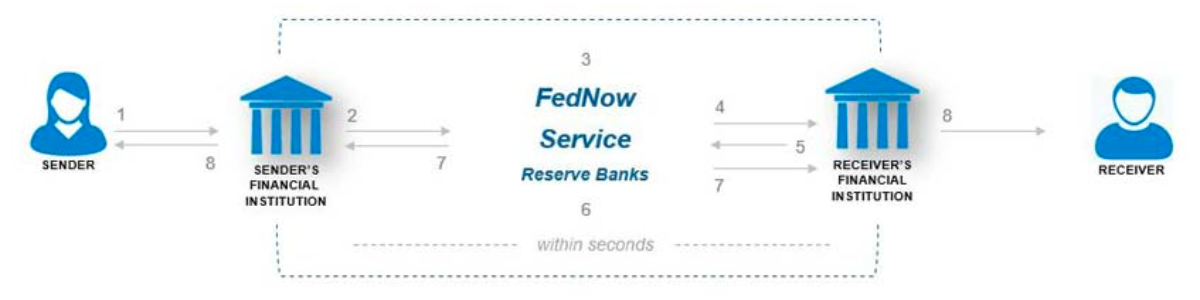
FedNow will operate on a 24x7x365 basis, allowing financial institutions to process and settle transactions at any time. When a user initiates a transaction, the sending bank submits a payment message to FedNow. The system then verifies the details of the transaction, including the recipient's account information, and immediately settles the funds between the sender's and recipient's banks. Once settlement is complete, the recipient's bank sends a notification to the recipient, confirming the deposit of funds.
The figure below illustrates a completed payment over the FedNow Service in its simplest form.
(Source: https://www.frbservices.org/financial-services/fednow/about.html)
The introduction of the FedNow Service could have a significant impact on the financial industry, some of which could be:
Increased Competition: FedNow has the potential to introduce a new level of competition in the real-time payments market, which was previously dominated by private-sector players like The Clearing House (TCH). This competition should lead to improved services and lower costs for both consumers and businesses.
Enhanced Customer Experience: FedNow has been designed to revolutionise the way individuals and businesses make payments, enabling them to transfer funds instantly, securely, and conveniently. This enhanced customer experience should raise the bar for payment services across the board.
Opportunities for Innovation: FedNow's real-time settlement capabilities should open the door for financial institutions to develop new products and services that leverage the benefits of instant payments and could include new lending products, cash management services, and fraud prevention tools.
Financial Inclusion: The FedNow Service may promote financial inclusion by providing affordable and accessible payment options to unbanked and underbanked populations. By offering low-cost, real-time payment services, financial institutions could reach a broader customer base, including those who may have been excluded from traditional banking services.
As the service matures and evolves, it is also crucial to consider the potential challenges that may arise. Key areas of focus will be maintaining the platform's security and resilience, ensuring the interoperability of various payment systems, and addressing potential privacy concerns. In addition, regulators and policymakers will need to ensure a fair and competitive landscape while safeguarding the interests of consumers and businesses.
Despite some early rumours amongst crypto-enthusiasts, especially in the Ripple (XRP) community, FedNow is not based on any blockchain or distributed ledger technology. There are several reasons for this:
As crypto services mature and become more widely adopted, it is possible that the Fed may consider exploring partnerships or integrations with blockchain/DLT-based services. However, this would depend on such things as regulatory and compliance requirements, technology maturity, and the potential benefits that such integrations would bring to the overall financial system. These collaborations could be established by developing APIs or integration layers that allow blockchain-based systems to interact with the FedNow Service, enabling a hybrid approach that combines the strengths of both centralised and decentralised systems, the best of both worlds.
FedNow have published the charges for using the system (https://www.frbservices.org/resources/fees/fedcomplete-2023) but is not a given that it will be able to compete with entrenched services with critical mass such as Visa.
Recommened reading: https://www.paymentsdive.com/news/Visa-CFO-Fednow-realtime-payments-competition-credit-legislation/631047/
We're the largest marketplace to connect with brokers, Fintech companies & digital asset firms. Want to partner? Let's get in touch.
Select the categories and companies you wish to follow directly to your person rss feed.
Create Custom RSS FeedSign up and join over 5,000 professional members who receive personalized news alerts, curated professional connections, and more for free!
Multi-asset trading broker AvaTrade has agreed to acquire the majority of FXCM Group’s business and brand, in a transaction that would bring a longstanding retail FX franchise into the AvaTrade Group.
LSEG and CMC Markets have signed a multi-year strategic data agreement expanding CMC's access to LSEG's real-time and delayed pricing, reference and corporate actions data, news and analytics, plus AI-ready content, to support new products, entry into new markets and the growth of CMC's institutional and B2B partnerships.
The Tel Aviv Stock Exchange is considering a bid for the Cyprus Stock Exchange, with Israeli media citing its EU licence, trading platform and clearing house. Euronext’s Athens exchange and India’s National Stock Exchange are also seen as contenders, and Cyprus aims to sign a sale agreement by the end of this year.
CME Group will launch baseball futures on 12 October, pending regulatory review, tracking CME FutureSports Performance Indexes built on Official League Data. Standard and micro contracts will start with the 2026 Postseason and the four clubs in the League Championship Series, trading around the clock.
ESMA has published an opinion stating that MiCA-authorised crypto-asset service providers should cease services tied to non-MiCA-compliant stablecoins for EU clients across MiCA crypto-asset services. National authorities should require remediation of existing exposures within three months, by early January 2027.
Nasdaq Ventures has made a strategic investment in Amsterdam-based derivatives and crypto exchange One Trading, with both firms to explore 24/7 trading of equity futures. The undisclosed investment follows Nasdaq's US$100 million investment in Payward, the parent of Kraken, and CME Group's move to 24/7 trading.
cTrader has opened multi-platform plugins to brokers and prop firms, which can pre-install their own tools for clients or list them in cTrader Store. The plugins run across Mobile, Web, Windows and Mac, and can be built and launched independently of core-platform releases, including trading journals and calculators.
Institutional brokerage and financial infrastructure provider Clear Street has joined TradingView’s broker network, allowing its clients to trade US stocks, exchange-traded funds and options directly through the charting and analysis platform.
Learn how to improve trading psychology, manage fear and greed, avoid revenge trading, and follow your trading strategy with discipline and a trading journal.
GTC Prime has announced a strategic partnership with Centroid Solutions to manage and distribute its liquidity through CS 360 Bridge, Centroid's multi-asset connectivity and execution engine, giving brokers and institutional clients access to tailor-made pricing, low-latency execution and real-time risk management.