just now


Liquidity Finder Ltd is incorporated in England and Wales, company number 10610740, registered address 167-169 Great Portland Street, Fifth Floor, London W1W 5PF, United Kingdom.
Published: just now

NVIDIA just announced a partnership with Goldman Sachs, Blackstone, and KKR to make up to $500 billion in private credit available to customers who want to purchase NVIDIA GPUs. SpaceX is promising 10 gigawatts of capacity for its Colossus data centers by the end of 2027. CoreWeave doubled revenue to $2.58 billion and quadrupled losses to $626 million. Nebius grew revenue 454% while narrowing its adjusted loss to $33 million.
These are not separate stories. They are four data points describing the same phenomenon: the AI infrastructure buildout has entered its gold rush phase, where capital is abundant, demand is real, and the difference between the companies that survive and the companies that don't comes down to unit economics, not revenue growth.
The NVIDIA Credit Facility: Selling Shovels and Financing the Picks
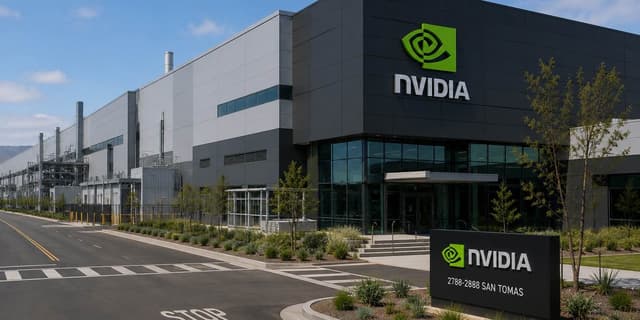
NVIDIA has done something that no semiconductor company has ever done before. It has partnered with three of the largest private credit providers in the world to create a financing mechanism for its own products. Goldman Sachs, Blackstone, and KKR will make up to $500 billion available to companies that want to buy NVIDIA GPUs for compute infrastructure, whether for renting out capacity to AI labs or for internal use.
The immediate effect is to remove the capital constraint from the GPU supply chain. A neocloud operator that previously couldn't afford 50,000 H200s at $30,000 each can now finance them through a Goldman credit facility. NVIDIA gets the hardware revenue regardless of whether the buyer can operate profitably. Goldman gets the interest income. The buyer gets the GPUs.
The medium-term effect is more consequential. When capital is abundant and available to any operator with a business plan and a power contract, the supply of available compute explodes. Every operator who can fog a mirror gets access to GPUs. More GPUs enter the rental market. Spot rental rates compress because supply grows faster than demand. The companies with the best unit economics (lowest power costs, highest utilization, longest-duration customer contracts) survive the compression. The companies that financed their GPU fleet at double-digit interest rates and are renting those GPUs at declining spot rates get squeezed between fixed debt service and falling revenue per unit.
This is the shale oil cycle applied to compute. In 2012-2014, cheap private credit flooded into US shale producers. Everyone could drill. Capital was unlimited. Production surged. Oil prices collapsed in 2014-2016. The operators with the lowest breakeven costs survived. The operators who drilled at $70 per barrel breakeven with leveraged balance sheets went bankrupt. The banks and PE firms who financed them took losses. The cycle took five years to shake out.
The NVIDIA credit facility is the equivalent of Wall Street financing shale drilling. It guarantees demand for NVIDIA's product in the near term. It also guarantees an oversupply of compute in the medium term that will compress returns for the most leveraged, least differentiated operators. NVIDIA wins regardless of who goes bust, just as the equipment manufacturers won during shale regardless of which driller went bankrupt. The risk is transferred entirely to the operators and their lenders.
CoreWeave: The Case Study in Leverage Risk
CoreWeave's Q2 2026 earnings are a masterclass in why revenue growth without profitable unit economics is not a business. It is a treadmill.
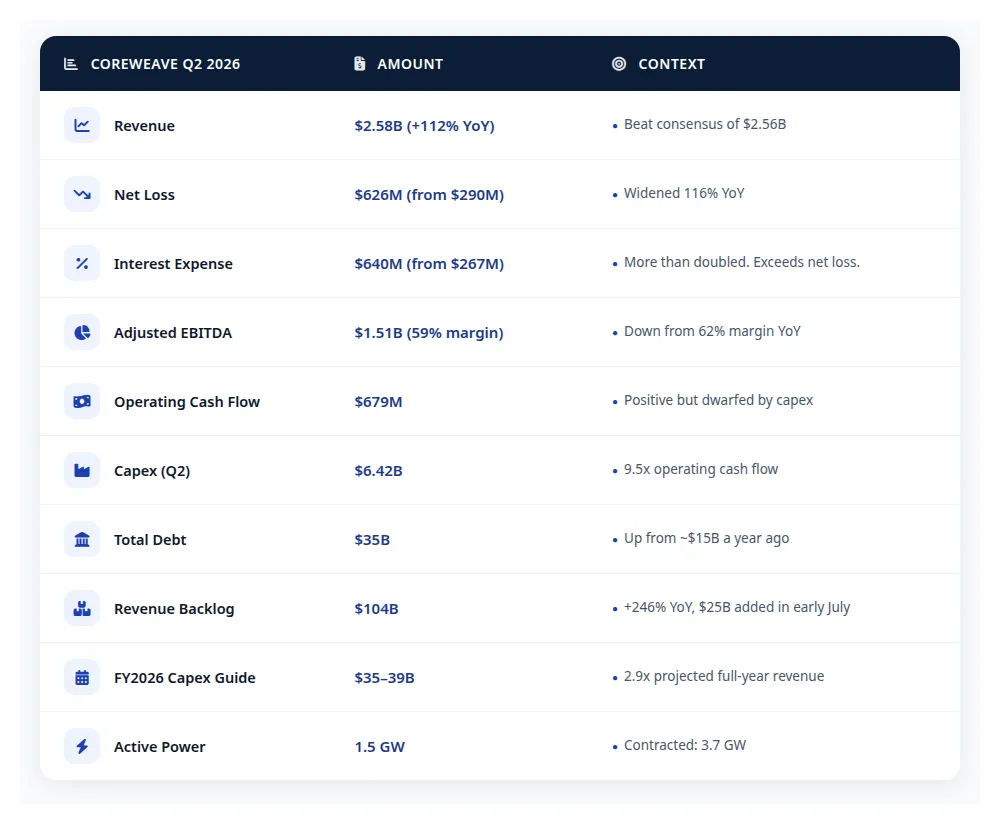
The numbers tell a stark story. CoreWeave generated $679 million in operating cash flow during the quarter. It spent $6.42 billion on capital expenditure. The gap was funded by raising $13.46 billion in gross debt, offset by $3.88 billion in repayments, for net financing inflows of $10.07 billion. The company borrowed more than $10 billion in a single quarter to fund infrastructure that its operating cash flow cannot support.
The most revealing number is interest expense: $640 million. CoreWeave's interest expense now exceeds its net loss. This means the company is operationally profitable at the adjusted EBITDA level ($1.51 billion, 59% margin) but the debt service consumes the entire operating surplus and then some. Without the debt, CoreWeave would be profitable. But without the debt, CoreWeave would not have the GPUs. The debt IS the business model.
The question is whether the model is self-sustaining or self-consuming. CoreWeave's capex guidance for 2026 is $35-39 billion against projected revenue of $12.4-13.2 billion. That is a capex-to-revenue ratio of approximately 2.9x. For comparison, Microsoft's ratio is roughly 1.5x and Amazon's is approximately 1.1x. CoreWeave is spending nearly three dollars on infrastructure for every dollar of revenue it generates.
The backlog of $104 billion provides long-term revenue visibility. The Meta contract ($21 billion through 2032) and Anthropic agreement are anchor commitments. But backlog is not revenue. It is a contractual promise that depends on CoreWeave building the infrastructure to fulfil it, maintaining the GPU fleet to deliver the contracted capacity, and doing so at a cost that the contracted revenue can service. If GPU rental rates decline (and they are declining on legacy hardware), or if interest rates on refinanced debt increase, or if utilization falls below the level assumed in the financial plan, the backlog becomes a liability rather than an asset: a commitment to deliver capacity at rates that may not cover the cost of providing it.
One analysis has put CoreWeave's probability of default at 50%. Whether that specific number is correct is debatable. What is not debatable is that a company with $35 billion in debt, $640 million in quarterly interest expense, and negative free cash flow is operating with a margin of error that approaches zero. Any adverse change in GPU pricing, customer demand, or financing conditions cascades through the entire financial structure.
Nebius: A Different Model, A Different Risk Profile
Nebius reported Q2 2026 on the same day as CoreWeave, and the contrast is instructive.
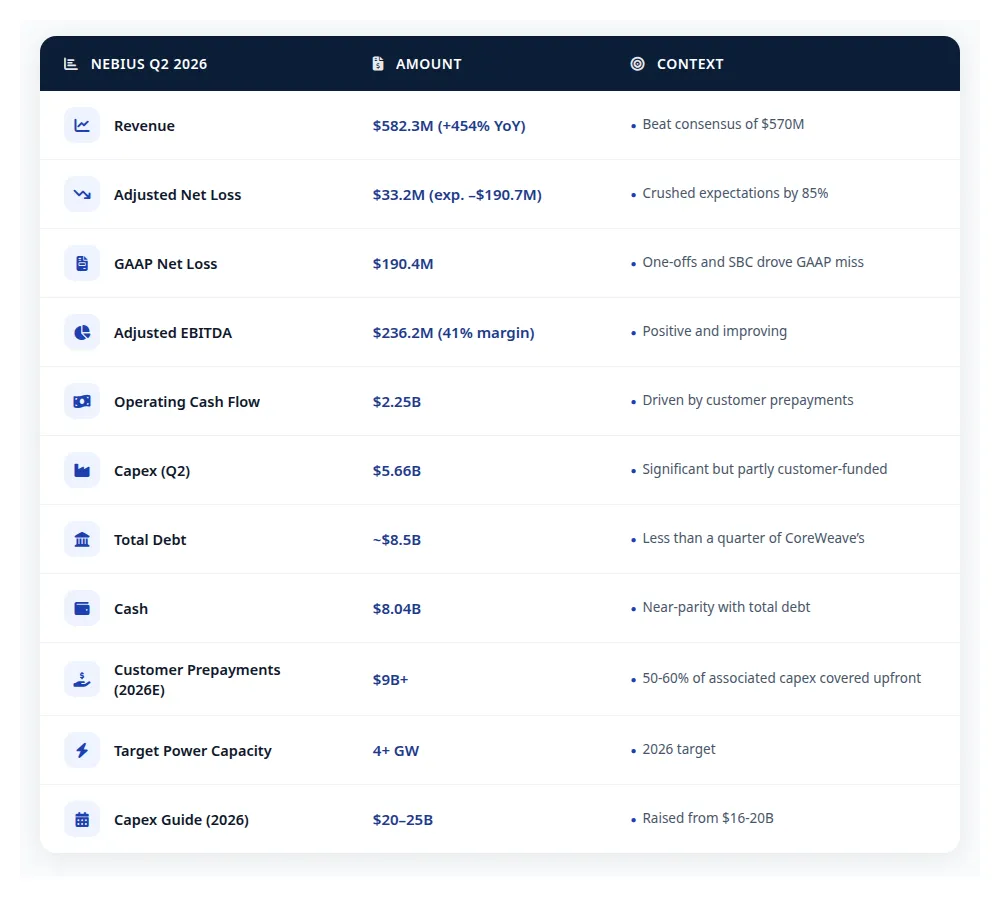
Nebius is smaller than CoreWeave (one-quarter the revenue) but has a fundamentally different capital structure. The critical difference is the customer prepayment model. Approximately 70% of Nebius's closed deals include upfront payments covering 50-60% of the associated capital expenditure. Total deferred revenue reached $6 billion, up from $4.8 billion at the end of Q1. Management expects customer prepayments to contribute more than $9 billion of upfront funding in 2026.
This means Nebius's customers are funding the infrastructure buildout directly. The company does not need to borrow at double-digit rates to buy GPUs and then hope that rental income covers the debt service. The customer pays upfront for the capacity they have contracted. Nebius builds the capacity with the customer's money. The risk of a mismatch between debt service and rental income is dramatically reduced because the capital comes from the customer, not from a credit facility.
The result shows in the financials. Nebius has $8.04 billion in cash against $8.5 billion in total debt, near parity. CoreWeave has $5.5 billion in cash against $35 billion in debt. Nebius's adjusted net loss was $33 million. CoreWeave's was $626 million. Nebius's interest expense, while growing, is a fraction of CoreWeave's because the debt load is a fraction of CoreWeave's.
Nebius also benefits from NVIDIA's strategic investment (9.3% stake), which provides preferential access to GPU supply. This is a meaningful advantage in a supply-constrained environment: if NVIDIA is allocating scarce chips, its equity investee is likely to receive priority.
The risk for Nebius is different from CoreWeave's. It is execution risk, not balance sheet risk. The company needs to convert $20-25 billion in annual capex into operational data center capacity on schedule, in multiple geographies, while managing construction, permitting, and power interconnection simultaneously. If capacity deployment falls behind schedule, the customer prepayments sit as deferred revenue while the contracted capacity is not yet generating utilization-based income.
The Quality Filter
The NVIDIA credit facility, CoreWeave's leverage, and Nebius's prepayment model collectively illustrate a framework for evaluating every company in the neocloud space.
The question is not whether a company can access capital. Capital is now abundant. NVIDIA and Wall Street have ensured that any operator with a plausible business plan can borrow to buy GPUs. Access to capital is no longer a differentiator. It is table stakes.
The question is what the capital costs and how it is repaid. CoreWeave funds its GPU fleet through debt at market interest rates. Every GPU it deploys carries a financing cost that must be covered by rental income before the company earns a single dollar of profit. When rental rates decline (and they are declining on legacy hardware while premium pricing holds only on the newest generation), the spread between financing cost and rental income compresses. If it inverts, the company is paying more to carry the GPU than the GPU earns.
Nebius funds a substantial portion of its fleet through customer prepayments. The financing cost is zero because the customer is providing the capital. The GPU earns revenue from its first day of operation without needing to clear a debt service hurdle. The margin structure is fundamentally different even if the hardware and the workloads are identical.
The question is whether the business can survive a downturn in GPU rental rates. Spot rental prices for H100 GPUs have declined from $8 per hour at launch to approximately $2-3 per hour on peer-to-peer platforms. B200 and newer chips command $4.50-7 per hour, but the premium is temporary. Each GPU generation depreciates as the next generation launches. A fleet financed at $30,000 per GPU with a 5-year useful life needs to generate $6,000 per year in net revenue per unit just to break even on the hardware cost, before interest, power, cooling, and staffing. At $2.50 per hour and 80% utilization, a single H100 generates approximately $17,500 per year in gross revenue. Subtract power, cooling, staffing, and depreciation, and the net margin per GPU depends entirely on the financing cost. A company with zero financing cost (customer-funded) earns the full margin. A company with 10% annual financing cost on a $30,000 GPU loses $3,000 per unit before operational costs.
The question is what happens when the $500 billion credit facility creates oversupply. More capital means more GPUs deployed means more compute available for rent means lower rental rates means lower revenue per GPU means lower margins for every operator. The companies with the lowest cost structure survive. The companies with the highest debt loads do not. This is not speculation. It is the inevitable consequence of flooding a market with capital-backed supply.
Conclusion
The demand for AI compute is real, growing, and far from saturated. The hyperscalers' capex commitments, the ARR growth at the application layer, and the backlog data from both CoreWeave ($104 billion) and Nebius ($6 billion deferred revenue) all confirm that customers are willing to pay for capacity.
But demand being real does not mean every supplier will profit from it. The gold rush analogy is precise: the people who got rich during the California gold rush were the ones who sold shovels, not the ones who dug for gold. NVIDIA is selling shovels. Goldman, Blackstone, and KKR are financing the shovels. The neoclouds are digging.
Some diggers will strike gold. Nebius, with its customer-funded capital model, lower leverage, NVIDIA backing, and improving adjusted economics, is positioned to be among them. CoreWeave, with $35 billion in debt, interest expense that exceeds its net loss, and a capex-to-revenue ratio of 2.9x, is digging with borrowed shovels in a field where the gold is getting cheaper by the quarter.
The NVIDIA credit facility makes capital available to everyone. Unit economics determine who survives. The time-tested rule of business applies in AI infrastructure exactly as it applies everywhere else: revenue growth without profitable unit economics is not a business model. It is a countdown.
Sources: CoreWeave Q2 2026 earnings release (August 11, 2026), Nebius Group Q2 2026 earnings release (August 12, 2026), NVIDIA press release (August 2026), CNBC, Yahoo Finance, Reuters, Blockspace, TechTimes.
This report does not constitute investment advice. Past performance is not indicative of future results.
BitDelta Limited is a Limited Company with Investment Dealer (Full-Service Dealer excluding Underwriting) under License No. GB24202926 and is authorized and regulated by the Financial Services Commission (FSC) in Mauritius.
Institutional multi-asset market access across MT5 Ultency, CQG, Iress Pro and BitDelta Terminal, with transparent execution standards and global market coverage.

Select the categories and companies you wish to follow directly to your person rss feed.
Create Custom RSS Feed
just now

just now
Sign up and join over 5,000 professional members who receive personalized news alerts, curated professional connections, and more for free!
Thunes and Coinbase have announced a strategic collaboration at Money20/20 USA. Coinbase will integrate Thunes’ Direct Global Network for payouts to local clearing systems, while Coinbase will power Thunes’ stablecoin infrastructure, supporting enterprise supplier payments, gig worker payouts and global remittances.
Hantec Group's prop firm brand Hantec Trader began operating as RZR Funded on 19 October.
Online investment platform Webull (NASDAQ: BULL) will offer perpetual futures to eligible US customers from November. The first contracts will be on Bitcoin and other crypto assets.
Market data and financial technology provider dxFeed has launched dxFeed ZeroDTE, a quantitative analytics solution for the zero-days-to-expiration (0DTE) options market.
US stock futures edged higher this morning after Wall Street rebounded on Monday, with the S&P 500 rising 0.4% and the Nasdaq Composite gaining over 1%, led by technology stocks such as Nvidia, Tesla, and Alphabet.
Gold is trading at $4,128. Following its recent high of $4,198, the precious metal has entered a clear downward move, with successive lower highs and lower lows.
Was the recent AI infrastructure sell-off a warning sign, or a market overreaction? As earnings season takes centre stage, investors are looking beyond market volatility to assess the strength of corporate spending, financial resilience and future growth. With major technology, semiconductor and defence companies set to report, this week's results could offer important clues about where market confidence stands. In this Weekly Outlook, we examine the key developments and earnings signals that could shape market sentiment. Read the full article for our latest analysis. BitDelta Securities Financial Services LLC, regulated by the Capital Market Authority under Category 5 (Introduction Only), acts solely as an introducer and does not provide trading, execution, dealing, advisory, portfolio management, or custody services. All trading, execution, and investment-related services are provided by BitDelta Limited, Mauritius, a licensed Investment Dealer. All trading and investments involve risk. The value of investments may fluctuate, and you may receive less than your initial investment.
Nasdaq 100 turns bearish after breaking weekly support. Watch 29,800–30,400 resistance for a potential rejection toward the 29,000 target.
Tradeweb Markets Inc. has agreed to acquire electronic credit trading platform Trumid Holdings, LLC for about $1.97 billion, combining credit protocols and extending its reach into new issue and grey market trading. The deal is targeted to close in the first half of 2027, subject to regulatory approvals.
The Cboe has launched pre-market and post-market trading sessions for select single stock and exchange-traded fund (ETF) options on its Cboe Options Exchange (C1). Trading began today with options on 24 single stocks and 5 ETFs.