just now


Liquidity Finder Ltd is incorporated in England and Wales, company number 10610740, registered address 167-169 Great Portland Street, Fifth Floor, London W1W 5PF, United Kingdom.
Published: just now
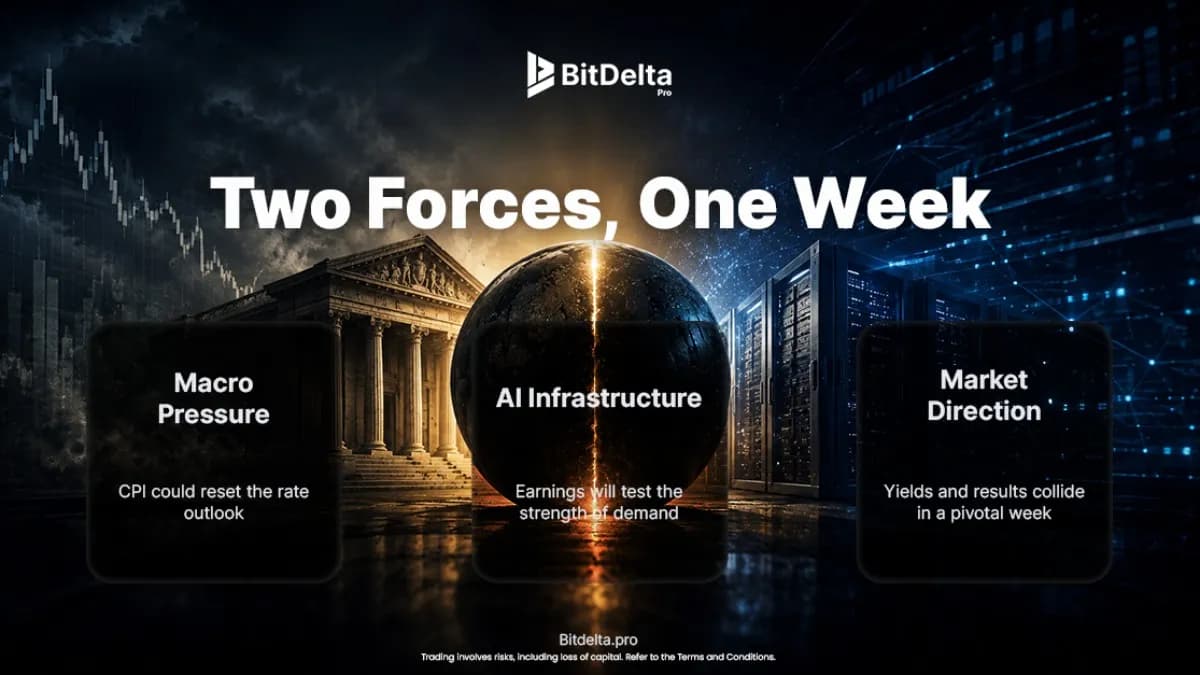
CPI on Tuesday. Applied Materials, CoreWeave, Coherent, and Lumentum by Friday. This week is a collision between a bearish macro catalyst and a bullish earnings catalyst, and the market's direction will be determined by which force overwhelms the other.
The setup is tense. Treasury yields are elevated, with the 30-year above 5.20% and the 10-year approaching 4.70%. The CME FedWatch tool is pricing a 45.9% probability of a 25 basis point hike to 3.75-4.00%, the highest hike probability since Warsh took the chair. The Middle East defence pact and the Houthi attack on Saudi Aramco have pushed geopolitical risk premiums back into the bond market. The yield curve is steeper than last month. The lack of guidance from the Fed on the short end is compounding the confusion.
Against this backdrop, the AI infrastructure earnings wave continues, and the companies reporting this week will tell us whether the demand thesis is broadening, peaking, or something in between.
CPI: The Bearish Catalyst
June CPI came in at 3.8%, down from 4.2% in May. The decline was driven almost entirely by energy: fuel oil fell 9.2% month-over-month, gasoline dropped 9.7%. Stripping energy out, the remaining components were mildly inflationary. Shelter decelerated slowly. Services remained sticky. Core readings stayed above the Fed's comfort zone.
The July print, due Tuesday morning, will determine whether the disinflation trend has legs beyond energy.
There are reasons to expect the print to be less friendly. Oil has bounced from the June lows on the Iran re-escalation and the Houthi attacks on Saudi infrastructure. The energy tailwind that drove the June decline is no longer present. If energy prices are flat or rising month-over-month, the headline number loses its primary source of improvement. Core CPI then becomes the entire story, and core has been stubbornly resistant to meaningful deceleration.
The market's reaction function is asymmetric. A cooler-than-expected print reduces hike probability and provides relief across rate-sensitive assets. A hotter-than-expected print, particularly in core, pushes hike probability above 50% and triggers a repricing in bonds, small caps, regional banks, and housing. With the 10-year already at 4.70%, there is less room to absorb a hawkish surprise without material price action.
The broader context matters. The Fed's preferred inflation measure, core PCE, ran at 4.4% annualized in Q1 2026. CPI and PCE have been telling divergent stories for months. Even if CPI improves on Tuesday, the Fed is watching a different number. The gap between what the market trades (CPI) and what the Fed targets (PCE) remains the primary source of rate repricing risk.
Employment: Productivity Is the Story
Last week's employment data was mixed on the headline but contained one number that matters more than the others.
The economy lost 23,000 jobs. The unemployment rate held at 4.1%. These are unremarkable numbers that largely reflect seasonal effects as summer and World Cup-related temporary employment wound down. No signal of either strength or weakness.
The number that matters is productivity. The Bureau of Labor Statistics reported that non-farm business productivity increased 2.1% on an annualized basis in Q2 2026. Output grew 2.5% while hours worked declined 0.4%. This is the AI productivity thesis showing up in the national economic data. Companies are producing more output with fewer labor hours. The implication is deflationary in the medium term: if firms can grow output without growing headcount, unit labor costs decline, which reduces cost-push inflation.
The decline in hours worked is already visible in wage growth, which has decelerated. This is the trade-off the labor market is making: higher productivity per worker but fewer total hours demanded, which translates to lower aggregate wage growth. For the Fed, this is constructive: easing wage pressures reduce the risk of a wage-price spiral, which is one of the conditions that would force Warsh into a hike he does not want to make.
Manufacturing tells the reshoring story. Manufacturing output increased 4.6% in Q2 2026, with hours worked rising 2.6%, producing a productivity gain of approximately 1.9%. ISM Manufacturing PMI has been expansionary for 8-9 consecutive quarters. This is not a data blip. It is evidence that the reshoring and reindustrialization thesis, driven by CHIPS Act incentives, defense procurement, and AI infrastructure buildout, is translating into measurable production growth. The investment in domestic manufacturing capacity that showed up as 17.2% equipment spending growth in Q1 GDP is now appearing in the output data as well.
For industrials investors, this is the confirmation signal. Revenue and earnings growth follow output growth with a lag of 1-2 quarters. The companies supplying equipment, materials, and services to the domestic manufacturing expansion are entering a multi-quarter earnings acceleration.
Earnings: Testing the AI Infrastructure Thesis
This week's earnings calendar is dense with names that sit at critical nodes in the AI infrastructure supply chain.
Applied Materials (AMAT). The most important semicap report of the week. AMAT makes the deposition, etch, and inspection tools that build the fabs and packaging lines powering the AI buildout. Their revenue is a direct function of how much TSMC, Intel, Samsung, and GlobalFoundries are investing in new capacity. If AMAT guides up, it confirms that the hyperscaler capex commitments (Microsoft's $120B, Amazon's $200B, Google's $175-185B) are flowing through to equipment orders. If guidance is cautious, the market will question the pace of capex-to-order conversion. AMAT's commentary on advanced packaging tool demand is particularly important given the capacity constraints at TSMC's CoWoS line and Intel's EMIB-T ramp.
CoreWeave (CRWV). This is the neocloud stress test. CoreWeave is the most leveraged name in the AI infrastructure space, with a balance sheet that requires sustained high GPU utilization and favorable rental pricing to service its debt. The company's earnings will reveal whether the GPU-as-a-service model works at scale or whether the unit economics are deteriorating as rental prices compress on legacy hardware. CoreWeave is the company we have identified as the tail risk in the hyperscaler ecosystem: if the economics don't work for the most aggressive neocloud, the entire category faces a credibility problem.
Nebius (NBIS). A better-positioned neocloud than CoreWeave but still operating without the diversified revenue base that protects the hyperscalers during capex-to-revenue lag periods. Nebius has NVIDIA backing and a cleaner balance sheet, but the fundamental question is the same: can a pure-play GPU cloud provider generate sustainable returns in a market where the hyperscalers are building their own capacity and GPU rental rates on legacy hardware are declining?
Coherent (COHR) and Lumentum (LITE). The optical networking plays. Both companies provide the photonic components that connect GPUs within data centers and link data centers to each other. Optical interconnects have been identified as the next bottleneck after HBM and advanced packaging. If these companies report strong demand and guide higher, it confirms that data center buildout is reaching the networking layer. If demand is softer than expected, it suggests the buildout is still concentrated in compute and hasn't fully reached the interconnect stage.
Cerebras (CBRS). Second earnings report since the May IPO. The first report showed 92% revenue growth but margin compression guidance and 86% customer concentration. The market will watch for any improvement in customer diversification and whether the $20 billion OpenAI agreement is translating into revenue recognition. The wafer-scale architecture remains technologically interesting but commercially unproven as a NVIDIA alternative at scale.
Super Micro Computer (SMCI). AI server integration. SMCI assembles the rack-level infrastructure that houses the GPUs, memory, and networking equipment. Revenue is directly tied to data center build velocity. The company has had accounting and governance concerns that weigh on the stock independent of demand fundamentals. Earnings quality and transparency will be scrutinized alongside the revenue numbers.
Cisco (CSCO). Enterprise networking. Less directly tied to the AI hyperscale buildout than the other names but provides a read on broader enterprise IT spending. Cisco's AI-related networking revenue (Silicon One, Ethernet fabric for AI clusters) is growing but remains a small share of total revenue. The stock is more of a barometer for enterprise spending health than for AI infrastructure specifically.
Yields and the Fed
The yield curve is telling a story that deserves attention independent of the CPI print.
The 30-year Treasury has sustained levels above 5.20%, approaching the cycle high of 5.29%. The 10-year is at 4.70%. The curve is steeper than last month. The FedWatch tool shows 45.9% probability of a hike, the highest since Warsh assumed the chair.
Three forces are driving yields higher simultaneously. The Middle East defence pact and the Houthi attack on Saudi Aramco have reintroduced geopolitical risk premium into the bond market. The Treasury's continued bill-heavy issuance, while suppressing the front end, is not preventing the long end from repricing on term premium. And Warsh's deliberate ambiguity on the policy rate path is forcing the market to price a wider range of outcomes, which mechanically pushes yields higher because uncertainty commands a premium.
The lack of explicit guidance on the short end is the most underappreciated factor. Under Powell, the Fed provided extensive forward guidance that anchored market expectations across the curve. Under Warsh, the Fed is communicating less, deliberately. This is not confusion. It is a strategy to remove the scope creep that allowed the Fed to become a de facto manager of the entire yield curve. Warsh wants to set the overnight rate and let the market determine everything else. The market, unaccustomed to setting yields without Fed hand-holding, is demanding higher premiums across maturities as compensation for the uncertainty.
For equity investors, the yield backdrop is the primary headwind this week. Even if CPI comes in cool and earnings beat, the gravitational pull of 4.70% on the 10-year and 5.20%+ on the 30-year limits the upside for risk assets. At some point, a risk-free 5% return competes directly with the equity risk premium. That point is approaching.
The Bottom Line
This week is a contest between two forces with opposite implications.
The bearish force is macro: CPI with a potential hawkish surprise, yields at cycle highs, hike probability approaching coin-flip territory, and a geopolitical backdrop that is adding risk premium to the bond market.
The bullish force is micro: AI infrastructure earnings from companies at critical nodes in the supply chain. If AMAT, Coherent, and Lumentum confirm that hyperscaler capex is translating into equipment orders and networking demand, the AI buildout thesis gets another validation quarter. If CoreWeave and Nebius demonstrate viable neocloud economics, the infrastructure story broadens. If they don't, the quality filter tightens and the market concentrates further into the hyperscalers.
Neither force is strong enough to establish a trend on its own. The interaction between them determines the week's outcome. A cool CPI paired with strong earnings clears the runway. A hot CPI paired with earnings misses, particularly from the neoclouds, produces a meaningful drawdown.
Position sizing and hedging matter more than conviction this week. The range of outcomes is wide. Be right on direction, but more importantly, be sized to survive being wrong for 48 hours.
This article is for informational purposes only and does not constitute investment advice. Past performance is not indicative of future results. Do your own research.
Institutional multi-asset market access across MT5 Ultency, CQG, Iress Pro and BitDelta Terminal, with transparent execution standards and global market coverage.

Select the categories and companies you wish to follow directly to your person rss feed.
Create Custom RSS FeedSign up and join over 5,000 professional members who receive personalized news alerts, curated professional connections, and more for free!
WTI crude oil price forecast: A confirmed breakout above $94.765 could open the way toward $100.305, while weekly support remains at $87.360–$90.830.
NAS100 price forecast recap: Explore the Nasdaq 100 rally to 31,401.3, with technical analysis of the breakout and key support and resistance levels.
Learn how to identify, draw and trade XAUUSD supply and demand zones using Gold market structure, price action confirmation and clear risk management.
cTrader has been named Best Trading Platform at UF Awards APAC 2026 during iFX EXPO Asia in Hong Kong.
AUD/CHF reached last week’s 0.57732 bearish target. Learn how resistance, market structure and a neckline retest shaped the original price action forecast.
Businesses eventually reach a point where basic tools are not enough basic tools.
Multi-asset trading broker AvaTrade has agreed to acquire the majority of FXCM Group’s business and brand, in a transaction that would bring a longstanding retail FX franchise into the AvaTrade Group.
LSEG and CMC Markets have signed a multi-year strategic data agreement expanding CMC's access to LSEG's real-time and delayed pricing, reference and corporate actions data, news and analytics, plus AI-ready content, to support new products, entry into new markets and the growth of CMC's institutional and B2B partnerships.
The Tel Aviv Stock Exchange is considering a bid for the Cyprus Stock Exchange, with Israeli media citing its EU licence, trading platform and clearing house. Euronext’s Athens exchange and India’s National Stock Exchange are also seen as contenders, and Cyprus aims to sign a sale agreement by the end of this year.
CME Group will launch baseball futures on 12 October, pending regulatory review, tracking CME FutureSports Performance Indexes built on Official League Data. Standard and micro contracts will start with the 2026 Postseason and the four clubs in the League Championship Series, trading around the clock.