
Trading in the Zone: Thinking in Probabilities
ACY Securities - Japer OsitaEvery trader wants to reach that mysterious “zone” - that calm, confident state where everything flows naturally, where hesitation fades, and where each decision feels sharp and instinctive. But few ever get there.
Why? Because most traders are focused on controlling the market instead of controlling themselves.

Mark Douglas, in his legendary book Trading in the Zone, revealed that the secret isn’t in mastering strategy - it’s in mastering psychology. The real challenge isn’t in finding the perfect setup; it’s in learning to think in probabilities. Once you stop chasing certainty and start embracing uncertainty, you begin trading like a professional.
Trading psychology isn’t about suppressing emotions. It’s about aligning your expectations with reality - accepting that anything can happen, and yet still executing your plan with confidence and discipline. If you want a practical companion to this mindset, read Execution Psychology: Turning Hesitation into Confidence.

Why Most Traders Stay Trapped in Emotional Cycles

Walk into any trading community and you’ll find the same story: traders jumping between strategies, chasing signals, switching timeframes, and rewriting plans after every loss.
It’s not a lack of knowledge - it’s psychological instability.
Here are the most common trader psychology issues that block consistency:
- 1. Outcome Obsession – Traders attach their self-worth to individual trades. A win feels euphoric, a loss feels personal. This emotional rollercoaster erodes decision-making clarity. See Managing Trading Losses: Why You Can Be Wrong and Still Win Big.
- 2. Fear of Missing Out (FOMO) – The anxiety of watching a trade run without them forces premature entries, usually just before the market reverses. Counter it with Overcoming FOMO & Revenge Trading.
- 3. Revenge Trading – After a loss, they double down emotionally, trying to “earn back” what was lost - often leading to bigger drawdowns.
- 4. Ego and the Need to Be Right – Many traders can’t stand being wrong, so they hold onto losing trades longer than they should, hoping the market “comes back.”
- 5. Illusion of Control – They think that with enough analysis or indicators, they can predict what’s next - but markets don’t reward control, they reward adaptability.
Each of these patterns comes from one source: expecting certainty in an uncertain environment.
Professionals, on the other hand, have a different mindset. They see the market as a probability field - a game where each trade has an uncertain outcome but contributes to a long-term statistical edge. Build that lens with The Mental Game of Execution.
Thinking in Probabilities - The Core of Trading Psychology
Mark Douglas said it best:
“Anything can happen.”
This single sentence destroys both fear and overconfidence. It reminds us that no matter how strong a setup looks, its outcome is never guaranteed.
When you truly internalize this, you stop fighting reality. You start executing from a place of acceptance.
Thinking in probabilities means you:
- View each trade as one of many - not a make-or-break event.
- Measure success by process, not outcome.
- Treat losses as data points, not failures.
- Trust your edge to play out over a series of trades, not a single one.
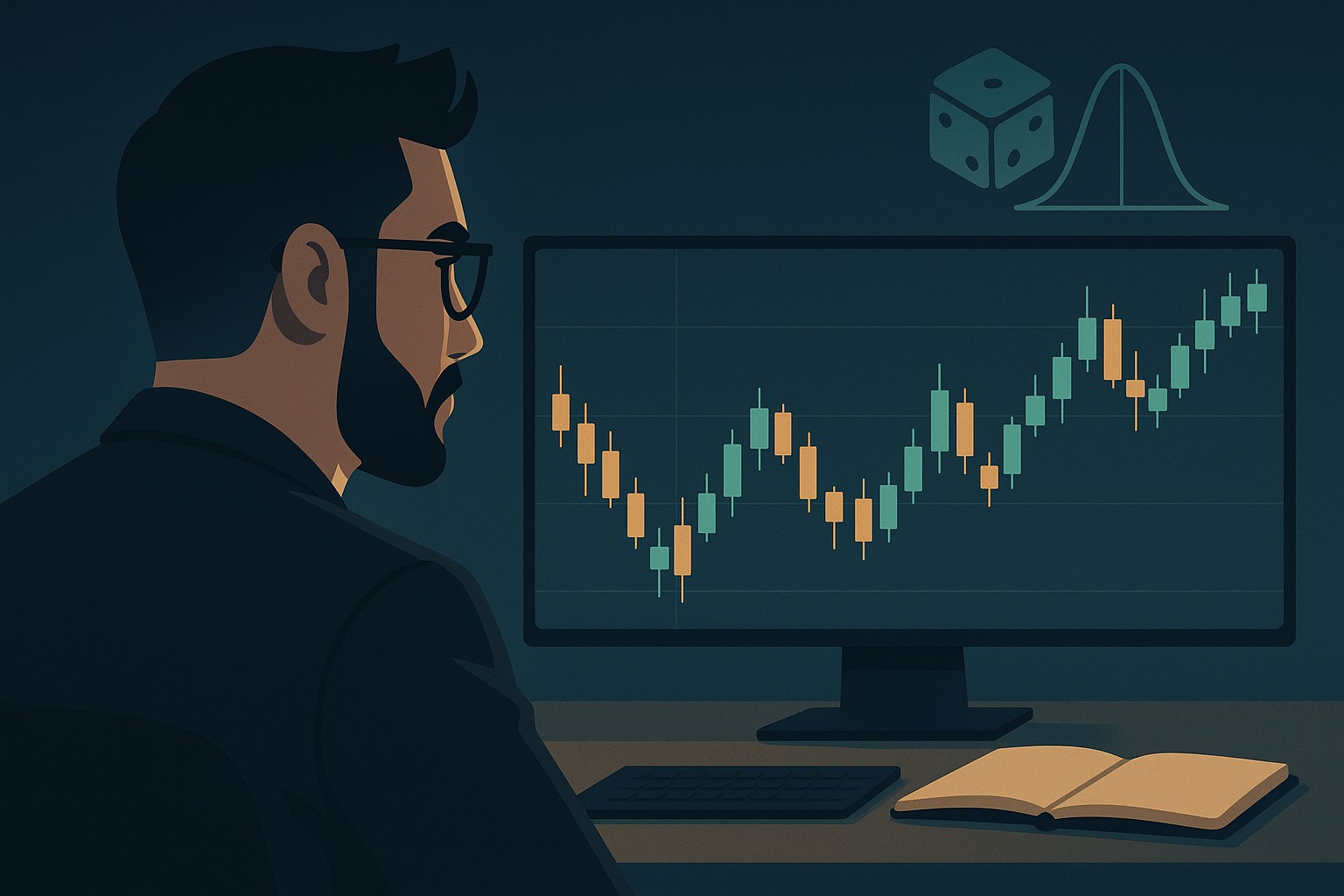
Imagine a casino. The house knows some players will win big. But over thousands of spins, the edge always pays out. That’s the professional trader’s mindset - detached from short-term emotion, committed to long-term execution. If you’re defining an edge right now, see Trading Edge: Definition, Misconceptions & Casino Analogy.
Why Most Traders Never Develop This Mindset

It’s not because they don’t understand the logic. Most traders know intellectually that losses are part of the game. But emotionally, they can’t accept it.
When real money is on the line, your brain’s survival instincts take over.
- Fear makes you close winners too early.
- Greed makes you overstay in hope.
- Ego blinds you from admitting mistakes.
The mind’s default setting is to seek comfort and avoid pain. But trading demands the opposite - to sit calmly through discomfort and let the probabilities unfold.
This is why journaling, batch testing, and reviewing data matter. They train your brain to see the bigger picture rather than the emotional chaos of one trade. Start here: Trading Journal & Reflection – The Trader’s Mirror.

The Zone - Where Confidence Meets Surrender

When you think in probabilities long enough, something magical happens - you enter the zone.
The “zone” isn’t mystical; it’s a mental alignment between logic and emotion. Your beliefs, expectations, and actions sync up perfectly. You stop second-guessing. You stop forcing trades. You start flowing.
In this state:
- Your focus narrows.
- Your mind quiets.
- You execute without hesitation.
- You respond, not react.
For a routine-based path to flow, use Trading in the Zone: Execution Through Habit and Structure.
Real-Life Analogy: The Archer and the Wind
Imagine an archer aiming at a target across a windy field. He adjusts his stance, steadies his breathing, and releases. If the arrow drifts slightly off, he doesn’t rage at the wind - he studies it, adjusts, and tries again.
The amateur blames the wind. The professional studies it.
The market is that wind. You can’t control it, but you can learn its rhythm. Every trade you release is an arrow guided by preparation - not prediction.
Over time, as your aim improves, the target feels closer. That’s what thinking in probabilities does - it builds calm confidence through repetition.
How to Practice Thinking in Probabilities
Here’s how to train your brain like a professional:
- 1. Detach from outcomes. Don’t label trades as wins or losses - label them as executed or not executed properly. A helpful structure: Step-by-Step Trading Confirmation Guide.
- 2. Define your edge. Know your criteria: structure, liquidity, displacement, FVG alignment - whatever your system uses. Validate it with Proving Your Edge: Backtesting Without Bias and Forward Testing in Trading.
- 3. Fix your risk. One consistent risk percentage keeps emotions stable. Calibrate with How Much Should You Risk per Trade?.
- 4. Journal everything. Record what you felt, not just what you saw. Patterns emerge faster than you think.
- 5. Batch your analysis. Review 20–30 trades as a series, not individually. Use Measuring Your Edge: Metrics That Matter.
- 6. Respect survival math. Know when drawdown threatens your future. Study Risk of Ruin in Trading.
Each step reprograms your nervous system to stay neutral - the foundation of true trading psychology.
Common Mindset Traps to Watch For
Even after learning probabilities, traders often relapse into old habits. Watch out for:
- Overanalyzing setups - Seeking the “perfect” confirmation out of fear of being wrong.
- Changing strategy mid-series - Breaking consistency before the edge can statistically play out.
- Equating self-worth with equity curve - Feeling good only when winning, feeling worthless when losing.
- Forcing trades after missing a move - Turning FOMO into impulsive entries that don’t fit your plan.
Remember: discipline without detachment still leads to burnout. True control is emotional flexibility - knowing when to act and when to stay still.

Final Thoughts

Mark Douglas taught that markets are never your enemy - your perception of them is. The real battle isn’t in the charts; it’s in the mirror.
Once you stop expecting the market to behave according to your plans and instead behave according to its nature, you’ll trade with clarity.
Confidence doesn’t come from winning - it comes from trusting your process even when you lose. That’s the mindset that separates amateurs from professionals.
When you finally think in probabilities, you stop fearing what might happen and start executing based on what should happen over time. And that’s when you enter the zone.
FAQs
1. What does “thinking in probabilities” mean?
It means trading without emotional attachment to individual outcomes. Each trade is one of many, where your edge plays out over time, not in one event.
2. Why do traders fear losing if they know losses are normal?
Because emotionally, the brain links money with survival. Losses trigger fear responses, even when logic understands risk. Repetition and measured exposure reduce that reaction - see Discipline vs. Impulse – How to Build Control.
3. Can emotions be eliminated from trading?
No-but they can be managed. The goal isn’t to suppress feelings but to respond rationally despite them. Emotional Awareness in Trading helps you name triggers so they lose power.
4. What’s the fastest way to build confidence in uncertainty?
Journal, backtest the same setup, and keep risk fixed. Confidence comes from proving to yourself that your edge works over a series, not a single outcome.
Start Practicing with Confidence - Risk-Free!
- Trade forex, indices, gold, and more
- Access ACY, MT4, MT5, & Copy Trading Platforms
- Practice with zero risk
It’s time to go from theory to execution - risk-free.
Create an Account. Start Your Free Demo!
Check Out My Contents:
Strategies That You Can Use
Looking for step-by-step approaches you can plug straight into the charts? Start here:
- How To Trade & Scalp Indices at the Open Using Smart Money Concepts (SMC)
- How to Trade Breakouts Effectively in Day Trading with Smart Money Concepts
- Complete Step-by-Step Guide to Day Trading Gold (XAU/USD) with Smart Money Concepts (SMC)
- The Power of Multi-Timeframe Analysis in Smart Money Concepts (SMC)
- Forex Trading Strategy for Beginners
- Mastering Candlestick Pattern Analysis with the SMC Strategy for Day Trading
- How to Use Fibonacci to Set Targets & Stops (Complete Guide)
- RSI Divergence Trading Strategy for Gold: How to Identify and Trade Trend Reversals
- Stochastics Trading Secrets: How to Time Entries in Trending Markets using Stochastics
- Gold Trading Stochastics Strategy: How to Trade Gold with 2R - 3R Targets
- RSI Hidden Divergence Explained: How to Spot Trend Continuations Like a Pro
- Moving Averages Trading Strategy Playbook
- Mastering Fibonacci Trading Psychology - Trusting the Levels, Managing the Mind
- Mastering Price Action at Key Levels - How to Spot, Trade, and Win at the Most Crucial Zones
- Mastering Retests: How to Enter with Confirmation After a Breakout
Indicators / Tools for Trading
Sharpen your edge with proven tools and frameworks:
- The Ultimate Guide to Risk Management in Trading - A Complete Compilation for 2025
- Moving Averages Trading Strategy Playbook
- How to Think Like a Price Action Trader
- Mastering Fibonacci Trading Psychology - Trusting the Levels, Managing the Mind
How To Trade News
News moves markets fast. Learn how to keep pace with SMC-based playbooks:
- Why Smart Money Concepts Work in News-Driven Markets - CPI, NFP, and More
- How to Trade NFP Using Smart Money Concepts (SMC) - A Proven Strategy for Forex Traders
- How to Trade CPI Like Smart Money - A Step-by-Step Guide Using SMC
- Learn to Trade News by Backtesting it with Forex Tester
Learn How to Trade US Indices
From NASDAQ opens to DAX trends, here’s how to approach indices like a pro:
- How to Start Trading Indices and Get into the Stock Market with Low Capital (2025 Guide)
- Best Indices to Trade for Day Traders | NASDAQ, S&P 500, DAX + Best Times to Trade Them
- How To Trade & Scalp Indices at the Open Using Smart Money Concepts (SMC)
- NAS100 - How to Trade the Nasdaq Like a Pro (Smart Money Edition)
How to Start Trading Gold
Gold remains one of the most traded assets - here’s how to approach it with confidence:
- How to Swing Trade Gold (XAU/USD) Using Smart Money Concepts: A Simple Guide for Traders
- Complete Step-by-Step Guide to Day Trading Gold (XAU/USD) with Smart Money Concepts (SMC)
- The Ultimate Guide to Backtesting and Trading Gold (XAU/USD) Using Smart Money Concepts (SMC)
- Why Gold Remains the Ultimate Security in a Shifting World
- How to Exit & Take Profits in Trading Gold Like a Pro: Using RSI, Range Breakdowns, and MAs as Your Confluence
- Backtest Gold using Forex Tester Online
How to Trade Japanese Candlesticks
Candlesticks are the building blocks of price action. Master the most powerful ones:
- Mastering the Top Japanese Candlesticks: The Top 5 Candlesticks To Trade + Top SMC Candlestick Pattern
- How to Trade Candlestick Patterns with High Probability: A Complete Guide for Beginners
- The Top Japanese Candlestick Guide: What is an Engulfing Pattern and How to Trade It?
- Piercing Pattern Candlestick Explained: How to Trade It - Step-By-Step Guide
- Morning & Evening Star Candlestick Patterns - How to Trade Market Reversals with Confidence
How to Start Day Trading
Ready to go intraday? Here’s how to build consistency step by step:
- 5 Steps to Start Day Trading: A Strategic Guide for Beginners
- 8 Steps How to Start Forex Day Trading in 2025: A Beginner’s Step-by-Step Guide
- 3 Steps to Build a Trading Routine for Consistency and Discipline - Day Trading Edition
- The Ultimate Guide to Understanding Market Trends and Price Action
- Trading with Momentum: The Best Trading Session to Trade Forex, Gold and Indices
Swing Trading 101
- Introduction to Swing Trading
- The Market Basics for Swing Trading
- Core Principles of Swing Trading
- The Technical Foundations Every Swing Trader Must Master
- Swing Trader’s Toolkit: Multi-Timeframe & Institutional Confluence
- The Psychology of Risk Management in Swing Trading
- Swing Trading Concepts To Know In Trading with Smart Money Concepts
- Becoming a Consistent Swing Trader: Trading Structure & Scaling Strategy
Learn how to navigate yourself in times of turmoil
Markets swing between calm and chaos. Learn to read risk-on vs risk-off like a pro:
- How to Identify Risk-On and Risk-Off Market Sentiment: A Complete Trader’s Guide
- How to Trade Risk-On and Risk-Off Sentiment - With Technical Confirmation
- The Ultimate Guide to Understanding Market Trends and Price Action
- Metals in Risk-On and Risk-Off Environments: How Sentiment Moves Gold and Commodities
Want to learn how to trade like the Smart Money?
Step inside the playbook of institutional traders with SMC concepts explained:
- Why Smart Money Concepts Work: The Truth Behind Liquidity and Price Action
- Mastering the Market with Smart Money Concepts: 5 Strategic Approaches
- Understanding Liquidity Sweep: How Smart Money Trades Liquidity Zones in Forex, Gold, US Indices
- The SMC Playbook Series Part 1: What Moves the Markets? Key Drivers Behind Forex, Gold & Stock Indices
- The SMC Playbook Series Part 2: How to Spot Liquidity Pools in Trading - Internal vs External Liquidity Explained
- Fair Value Gaps Explained: How Smart Money Leaves Footprints in the Market
- Accumulation, Manipulation, Distribution: The Hidden Cycle That Runs Every Market
- Institutional Order Flow - Reading the Market Through the Eyes of the Big Players
- London Session Trading Secrets: How Smart Money Sets the High & Low of the Day
- Mastering the New York Session - Smart Money Concepts Guide
- Anatomy of a Perfect Execution: How SMC Traders Trade with Precision
- Step-by-Step Trading Confirmation Guide for Precise Execution
- Execution Psychology: Turning Hesitation into Confidence
Master the World’s Most Popular Forex Pairs
Forex pairs aren’t created equal - some are stable, some are volatile, others tied to commodities or sessions.
- The Top 5 All-Time Best Forex Pairs to Trade
- Top Forex Pairs Beyond the Big Five
- EUR/USD: The King of Forex
- USD/JPY: The Fast Mover
- GBP/USD: The Volatile Cable
- AUD/USD: The Commodity Currency
- USD/CAD: The Oil-Backed Pair
- GBP/JPY: How to Trade The Beast
- Asian & London Session Secrets
- Mastering the New York Session
Metals Trading
- Metals Trading: Why Gold and Metals Are Rising Again
- Silver Trading: The Underdog with Dual Identity
- Gold vs Silver: Institutional Demand Breakdown Explained
- How to Day Trade Silver Like a Pro: Smart Money Tactics for XAG/USD
- Platinum & Palladium: The Quiet Power Duo of Industrial Metals
- How to Trade Metals with SMC and Fundamentals - Gold Trading Strategy
- Metals in Risk-On and Risk-Off Environments: How Sentiment Moves Gold and Commodities
- Future of Metals Market: Gold Forecast 2026 & Long-Term Commodities Outlook
Stop Hunting 101
If you’ve ever been stopped out right before the market reverses - this is why:
- Stop Hunting 101: How Swing Highs and Lows Become Liquidity Traps
- Outsmarting Stop Hunts: The Psychology Behind the Trap
- How to Lessen Risk From Stop Hunts in Trading
- How Stop Hunts Trigger Revenge Trading - Breaking the Pain Cycle
- How to Accept Stop Hunts Without Losing Discipline - Shifting From Frustration to Focus
Trading Psychology
Mindset is the deciding factor between growth and blowups. Explore these essentials:
- The Mental Game of Execution - Debunking the Common Trading Psychology
- Managing Trading Losses: Why You Can Be Wrong and Still Win Big in Trading
- The Hidden Threat in Trading: How Performance Anxiety Sabotages Your Edge
- Why 90% of Retail Traders Fail Even with Profitable Trading Strategies
- Top 10 Habits Profitable Traders Follow Daily to Stay Consistent
- Top 10 Trading Rules of the Most Successful Traders
- Top 10 Ways to Prevent Emotional Trading and Stay Disciplined in the Markets
- Why Most Traders Fail - Trading Psychology & The Hidden Mental Game
- Emotional Awareness in Trading - Naming Your Triggers
- Discipline vs. Impulse in Trading - Step-by Step Guide How to Build Control
- Trading Journal & Reflection - The Trader’s Mirror
- Overcoming FOMO & Revenge Trading in Forex - Why Patience Pays
- Risk of Ruin in Trading - Respect the Math of Survival
- Identity-Based Trading: Become Your Trading System for Consistency
- Trading Psychology: Aligning Emotions with Your System
- Mastering Fear in Trading: Turn Doubt into a Protective Signal
- Mastering Greed in Trading: Turn Ambition into Controlled Growth
- Mastering Boredom in Trading: From Restless Clicking to Patient Precision
- Mastering Doubt in Trading: Building Confidence Through Backtesting and Pattern Recognition
- Mastering Impatience in Trading: Turn Patience Into Profit
- Mastering Frustration in Trading: Turning Losses Into Lessons
- Mastering Hope in Trading: Replacing Denial With Discipline
- When to Quit on Trading - Read This!
- The Math of Compounding in Trading
- Why Daily Wins Matter More Than Big Wins
- Scaling in Trading: When & How to Increase Lot Sizes
- Why Patience in Trading Fuels the Compounding Growth
- Step-by-Step Guide on How to Manage Losses for Compounding Growth
- The Daily Habits of Profitable Traders: Building Your Compounding Routine
- Trading Edge: Definition, Misconceptions & Casino Analogy
- Finding Your Edge: From Chaos to Clarity
- Proving Your Edge: Backtesting Without Bias
- Forward Testing in Trading: How to Prove Your Edge Live
- Measuring Your Edge: Metrics That Matter
- Refining Your Edge: Iteration Without Overfitting
- The EDGE Framework: Knowing When and How to Evolve as a Trader
- Scaling Your Edge: From Small Account to Consistency
- Trading in the Zone: Execution Through Habit and Structure
Market Drivers
- Central Banks and Interest Rates: How They Move Your Trades
- Inflation & Economic Data: CPI Trading Strategy and PPI Indicator Guide
- Geopolitical Risks & Safe Havens in Trading (Gold, USD, JPY, CHF)
- Jobs, Growth & Recession Fears: NFP, GDP & Unemployment in Trading
- Commodities & Global Trade: Oil, Gold, and Forex Explained
- Market Correlations & Intermarket Analysis for Traders
Risk Management
The real edge in trading isn’t strategy - it’s how you protect your capital:
- Mastering Risk Management: Stop Loss, Take Profit, and Position Sizing
- Why Risk Management Is the Only Edge That Lasts
- How Much Should You Risk per Trade? (1%, 2%, or Less?)
- The Ultimate Risk Management Plan for Prop Firm Traders - Updated 2025
- Mastering Position Sizing: Automate or Calculate Your Risk Like a Pro
- Martingale Strategy in Trading: Compounding Power or Double-Edged Sword?
- How to Add to Winners Using Cost Averaging and Martingale Principle with Price Confirmation
- Managing Imperfect Entries in Trading - How Professionals Stay Composed
Suggested Learning Path
If you’re not sure where to start, follow this roadmap:
- 1. Start with Trading Psychology → Build the mindset first.
- 2. Move into Risk Management → Learn how to protect capital.
- 3. Explore Strategies & Tools → Candlesticks, Fibonacci, MAs, Indicators.
- 4. Apply to Assets → Gold, Indices, Forex sessions.
- 5. Advance to Smart Money Concepts (SMC) → Learn how institutions trade.
- 6. Specialize → Stop Hunts, News Trading, Turmoil Navigation.
This way, you’ll grow from foundation → application → mastery, instead of jumping around randomly.
Follow me for more daily market insights!
Jasper Osita - LinkedIn - FXStreet - YouTube
This content may have been written by a third party. ACY makes no representation or warranty and assumes no liability as to the accuracy or completeness of the information provided, nor any loss arising from any investment based on a recommendation, forecast or other information supplies by any third-party. This content is information only, and does not constitute financial, investment or other advice on which you can rely.
LiquidityFinder
LiquidityFinder was created to take the friction out of the process of sourcing Business to Business (B2B) liquidity; to become the central reference point for liquidity in OTC electronic markets, and the means to access them. Our mission is to provide streamlined modern solutions and share valuable insight and knowledge that benefit our users.
If you would like to contribute to our website or wish to contact us, please click here or you can email us directly at press@liquidityfinder.com.