just now


Liquidity Finder Ltd is incorporated in England and Wales, company number 10610740, registered address 167-169 Great Portland Street, Fifth Floor, London W1W 5PF, United Kingdom.
Published: just now


The Federal Open Market Committee (FOMC) meetings are closely watched events, providing critical insights into the Federal Reserve’s views on the economy and their future policy directions. The minutes from these meetings offer a deeper dive into the discussions and considerations that shape monetary policy. The latest FOMC minutes revealed several important developments across financial markets, economic forecasts, and inflation expectations. Let's break down the key points.
For the full report you can visit this link; FOMC Minutes
Developments in Financial Markets and Open Market Operations
The minutes began with a comprehensive review of the recent developments in financial markets. Over the intermeeting period, financial conditions eased slightly, a shift driven by lower long-term interest rates and rising equity prices. It was noted that "current financial conditions appeared to be providing neither a headwind nor tailwind to growth." This neutral stance suggests that while markets are stable, they aren't contributing significantly to economic acceleration or deceleration.
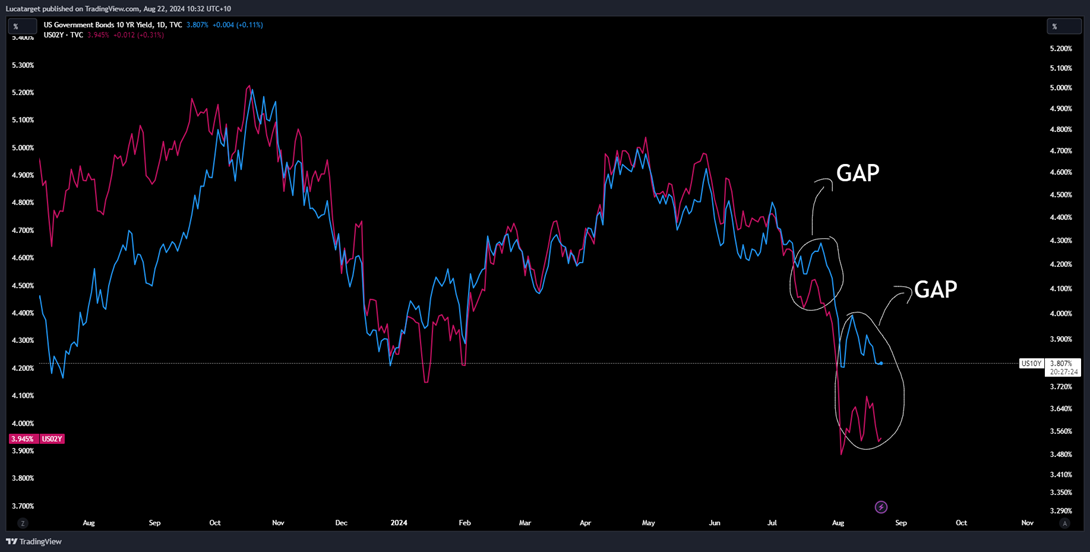
One of the notable shifts was in Treasury yields, where shorter-term yields like the US02Y declined more than their longer-term counterparts like US10Y, leading to a steepening of the yield curve. This change in the yield curve often signals investor expectations of future economic conditions, with sensitivity to economic data such as the Consumer Price Index (CPI) and employment reports remaining high.
US10Y On Blue & US02Y On Pink
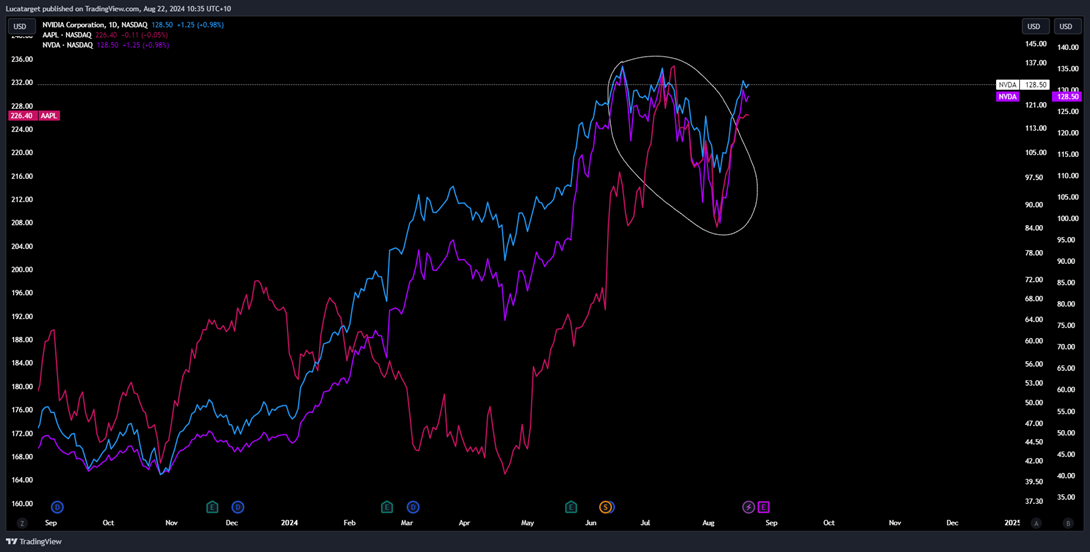
In the equity markets, the anticipation of a September rate cut had a pronounced effect. Stocks of smaller firms, which are more sensitive to interest rates, saw notable gains, while larger companies, particularly in the technology sector, underperformed as we can see with NVIDIA & Microsoft or even Apple. This divergence highlights the varied impact of monetary policy expectations across different market segments.
Apple (Pink), NVIDIA (Blue) & Microsoft (Purple)
On the international front, policy rate expectations in most advanced foreign economies (AFEs) declined, with most central banks expected to ease further. However, the Bank of Japan remained an outlier, with market participants still anticipating a potential tightening of policy.
Money markets also saw minor shifts, with the effective federal funds rate remaining stable, but rates on repurchase agreements (repo) edging higher due to increased demand for financing Treasury securities. The minutes also highlighted the staff's ongoing monitoring of money market developments, with particular attention to the Secured Overnight Financing Rate (SOFR).
Staff Economic Outlook
The economic forecast presented by the staff at the July meeting reflected a somewhat more cautious outlook compared to previous projections. Growth expectations for the second half of 2024 were revised down, largely due to weaker-than-expected labour market indicators. This adjustment narrowed the output gap at the start of 2025, though it remains unclosed.
Over the longer term, through 2025 and 2026, real GDP growth is expected to align more closely with potential, leading to a relatively stable output gap. The unemployment rate is anticipated to rise slightly over the remainder of 2024 and remain steady in the following years.
Inflation expectations were also revised lower, driven by a combination of incoming data and the projected lower level of resource utilization. The staff expects both total and core Personal Consumption Expenditures (PCE) price inflation to decline further, with inflation reaching around 2% by 2026. Despite this more optimistic inflation outlook, the risks are not entirely one-sided. The uncertainty surrounding these projections is considered close to the average of the past 20 years, with risks to inflation still slightly tilted to the upside.
Participants' Views on Current Conditions and the Economic Outlook
The participants in the meeting noted that while inflation has eased over the past year, it remains elevated. They observed that recent disinflation was broad-based across core inflation components, with slowdowns in core goods and housing services. Notably, "participants noted that the recent progress on disinflation was broad based," indicating a more widespread reduction in inflationary pressures.
The discussion also highlighted that firms’ pricing power appears to be waning, with businesses more sensitive to consumer resistance to price increases. This shift is seen as a positive sign that inflation might continue to decline, supported by factors such as moderating economic growth and the reduction of excess household savings accumulated during the pandemic.
Despite these positive trends, some participants expressed caution, noting that inflation pressures could persist due to the economy’s considerable momentum and the still-strong labour market. This divergence of views underscores the complexities involved in predicting the trajectory of inflation and the economy.
The latest FOMC minutes offer a nuanced view of the current economic landscape. While there is optimism around the ongoing disinflation and a stabilizing economic outlook, uncertainties remain, particularly regarding inflation pressures and labour market dynamics. As the Fed continues to navigate these challenges, the insights from these minutes will be crucial in shaping market expectations and guiding future policy decisions.
These developments suggest a cautious yet hopeful path forward, with the Fed keeping a close eye on economic indicators to inform its next moves. As always, the interplay between data and policy will be key in determining the direction of the U.S. economy in the months ahead.
This content may have been written by a third party. ACY makes no representation or warranty and assumes no liability as to the accuracy or completeness of the information provided, nor any loss arising from any investment based on a recommendation, forecast or other information supplies by any third-party. This content is information only, and does not constitute financial, investment or other advice on which you can rely.
Why Is Forex Trading So Difficult?
How To Master MT4 & MT5 - Tips And Tricks For Traders
The Importance Of Fundamental Analysis In Forex Trading
Forex Leverage Explained: Mastering Forex Leverage In Trading & Controlling Margin
The Importance Of Liquidity In Forex: A Beginner's Guide
Close All Metatrader Script: Maximise Your Trading Efficiency And Reduce Stress
Best Currency Pairs To Trade In 2024
Forex Trading Hours: Finding The Best Times To Trade FX
MetaTrader Expert Advisor - The Benefits Of Algorithmic Trading And Forex EAs
ACY Securities is one of Australia's fastest growing multi-asset online trading providers, offering ultra-low-cost trading, rock-solid execution, technologically superior account management and premium market analysis.

Select the categories and companies you wish to follow directly to your person rss feed.
Create Custom RSS FeedSign up and join over 5,000 professional members who receive personalized news alerts, curated professional connections, and more for free!
Bybit has launched Perp Options, described as the first options contracts built on TradFi perpetuals, giving traders round-the-clock access to US equity options. SpaceX and Nvidia are the first underlying assets, with USDT settlement and integration into Bybit's Unified Trading Account.
Use this trading preparation checklist to plan your session, define entry rules, manage risk, and build a disciplined trading routine in seven steps.
Your Bourse expands its crypto liquidity ecosystem with Caladan, giving brokers access to broader market coverage, institutional execution capacity and streamlined settlement.
Scope Markets, the retail brokerage part of Rostro Group, has appointed Ibrahim Hossny as Head of Research and Marketing for the Middle East and North Africa.
Hantec Prime, the institutional division of Hantec Markets, has reported trading volume up more than 300% year-to-date, alongside the addition of 42 new institutional clients since December, capping one of its strongest years of growth to date.
Learn how to refine XAUUSD support and resistance on the daily chart using candle bodies, market structure and weekly gold levels for swing trading. A slug alone cannot guarantee a top Google ranking. Keep it focused rather than adding every supporting keyword.
The week in Dubai will be focused on connecting directly with the industry and discussing how technology can help modern brokerages simplify operations, automate workflows, strengthen operational control, and scale efficiently.
Devexperts has launched a turnkey solution giving brokers in South Korea access to US equity markets, combining its DXtrade trading platform, dxFeed market data, and execution services. The offering targets South Korea's growing retail demand for US stocks, worth several billion USD monthly.
Assess why WTI crude oil surged past $105 per barrel amid Saudi pipeline disruptions, record tanker charter rates, and escalating geopolitical tensions.
Bitcoin price forecast: BTC/USD retests $78,460–$80,215 resistance. Watch bearish confirmation toward $72,480 or a bullish breakout toward $86,150.