just now


Liquidity Finder Ltd is incorporated in England and Wales, company number 10610740, registered address 167-169 Great Portland Street, Fifth Floor, London W1W 5PF, United Kingdom.
Published: just now

As we head into a shortened trading week due to the U.S. Fourth of July holiday, markets are anything but quiet. Investors have their eyes on interest rate expectations, key employment data, eurozone inflation numbers—and oil, which may finally be waking up from a long nap.
Let’s break down what’s ahead by region and market:
This week’s focus for the U.S. is crystal clear: rate cuts. As trade tensions continue to cool off, financial markets are starting to believe that the Federal Reserve might move quicker than expected. Earlier, the outlook was for just two 25bp cuts—one in September and another in December. Now, we're inching closer to the possibility of a third 25bp cut by year-end.
Some Fed officials, like Kevin Warsh and Michelle Bowman, are even hinting at a potential cut as soon as July. But others are staying cautious. Their concern? The price hikes caused by tariffs might be short-term noise. They want to be sure inflation won’t stick around longer than it should before making any big moves.
The Fed doesn’t just look at inflation—it also keeps a close eye on jobs. That’s why this week’s employment numbers matter. Expectations are for a decent showing, with around 100,000 new jobs added. Sounds good on the surface, right?
But dig a little deeper, and cracks start to show. Job vacancy numbers are dipping. Business hiring surveys are slowing. Jobless claims are rising. If that trend continues into the summer months, we could be looking at softer data from July to September. And that might push the Fed to act sooner—cutting rates in September and possibly again in October and December.
Inflation in the eurozone has been tame lately—too tame, in fact, which is why the European Central Bank already cut rates to 2%. This month, however, we might see a slight uptick. Why? Oil prices are creeping higher, and we’re starting to see that at the pump.
Services inflation in May was unusually soft, so June might bounce back a little. Still, with economic growth slowing, any price increases are expected to stay limited in the near term.
Unemployment across the eurozone remains low, especially in the south. Spain, Italy, Greece, and Portugal are seeing solid job growth, which is helping to offset weakness in northern economies like Germany and the Netherlands. As a result, the eurozone-wide unemployment rate is expected to stay in the low 6% range.
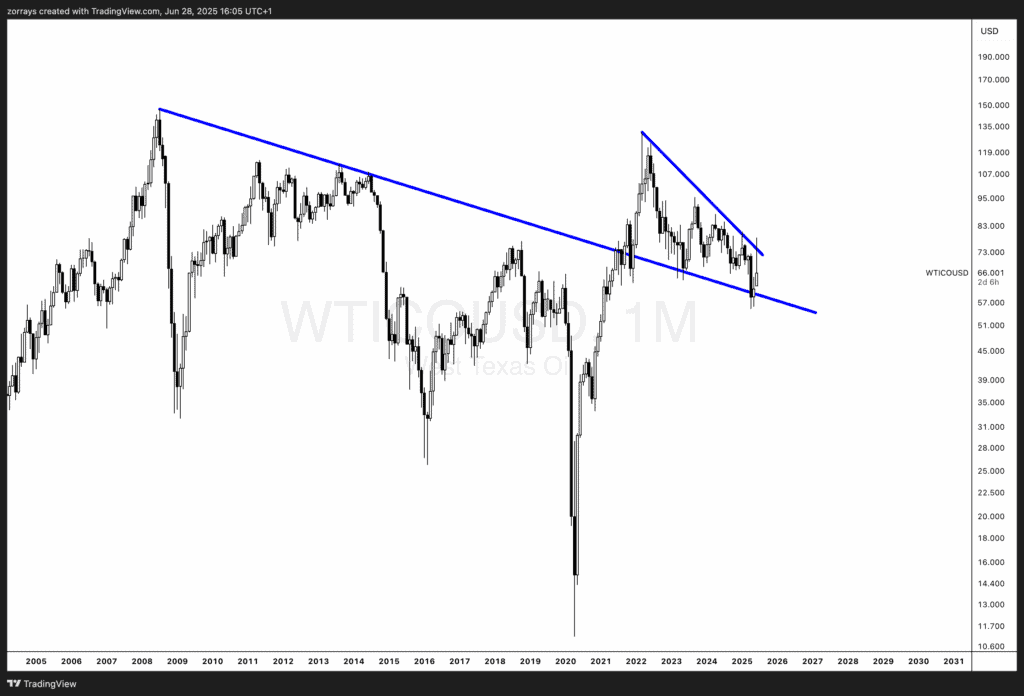
Looking at the monthly chart of WTI crude oil, we’re sitting at an interesting crossroads.
After breaking above a major long-term trendline that’s capped price since the 2008 peak, oil has since pulled back — and now, that same trendline is acting as key support. Technically, price is compressing into a wedge or triangle formation. The range is narrowing, the swings are getting smaller, and typically, this sort of tightening leads to expansion — a breakout.
But what gives this setup real weight is how the fundamentals are lining up beneath the surface.
From a macro-technical lens, WTI is sitting just above the confluence of long-term trendline support and horizontal structure around the $65–$67 zone. This area may act as a springboard if bulls step in.
If the price breaks below the wedge, it could suggest deeper economic worries are gaining traction — like fading global demand or recessionary pressures. But if it holds and turns up from here, it may mark the start of a new uptrend, quietly supported by tightening supply and overly bearish sentiment.
Keep an eye on this chart — it could be telling us something about broader market sentiment and economic resilience long before the headlines do.
Alchemy Markets is a multi-asset brokerage providing retail traders with the same elite trading conditions, tools, and transparency typically reserved for institutions.

Select the categories and companies you wish to follow directly to your person rss feed.
Create Custom RSS FeedSign up and join over 5,000 professional members who receive personalized news alerts, curated professional connections, and more for free!
Theorem has integrated Symbiotic’s Liquid Lane RFQ network, letting holders of tokenised real-world assets trade against on-chain pool liquidity and market-maker quotes. The integration is live on Ethereum, with Midas’s yield-bearing mHYPER fund as the first supported asset. Holders can trade for the USDC stablecoin.
US equities were volatile with technology selloff erasing much of the earlier rebound.
FM Summit London 2026 returns to Old Billingsgate on 24 November for its 15th edition, with LMAX Group, Plus500 and oneZero among confirmed exhibitors. The one-day event adds Business Connect meetings and roundtables, and opens with a networking evening at The Folly on 23 November.
Finance Magnates Summit London returns to Old Billingsgate on 24 November 2026 for its 15th edition. The one-day event brings together brokers, liquidity providers, institutional firms, trading technology vendors, payments businesses and digital asset firms.
iSAM Securities Apex has integrated with Match-Prime, giving brokers access to liquidity across more than 2,000 instruments, with tailored pricing and up to 10 levels of market depth.
propfunding.com's free-entry instant funding changes the order of prop funding. Start trading first. Its free-entry instant funding model offers two qualification attempts without an upfront activation fee.
US stocks closed higher on Wednesday, with the Nasdaq gaining 1%, the S&P 500 rising 0.6%, and the Dow advancing 0.7%, as renewed enthusiasm for AI-related stocks lifted market sentiment.
SpaceX went public in June as a rocket company. On October 20 it reported as something else entirely: an AI infrastructure business, financed by a satellite broadband network, with a launch division attached. Rockets generated 12% of third quarter revenue and lost money. The AI segment generated 52% of revenue and consumed 84% of capital expenditure. Starlink generated 85% of operating profit.
Standard Chartered has signed definitive agreements to acquire 100% of Zodia Custody UK Limited, folding its regulated digital asset custody business into Securities Services. Zodia Solutions will be set up under SC Ventures with bank investors including Northern Trust, NAB Ventures, Emirates NBD and Investcorp.
Bybit Fintech FZE has secured a Virtual Asset Service Provider licence from Dubai’s Virtual Assets Regulatory Authority for Exchange Services, covering spot trading. Bybit’s Peter Loo said the firm hopes to add derivatives, subject to regulatory approvals. Its international Dubai headquarters opened in 2022.