just now


Liquidity Finder Ltd is incorporated in England and Wales, company number 10610740, registered address 167-169 Great Portland Street, Fifth Floor, London W1W 5PF, United Kingdom.
Published: just now

Wall Street just turned bad news into good vibes.
Last Friday’s Non-Farm Payrolls (NFP) report came in well below expectations. The economy added only 73K jobs, far short of the 110K forecast. Worse still, June’s number was quietly revised down from 147K to just 14K — a far cry from the original report.
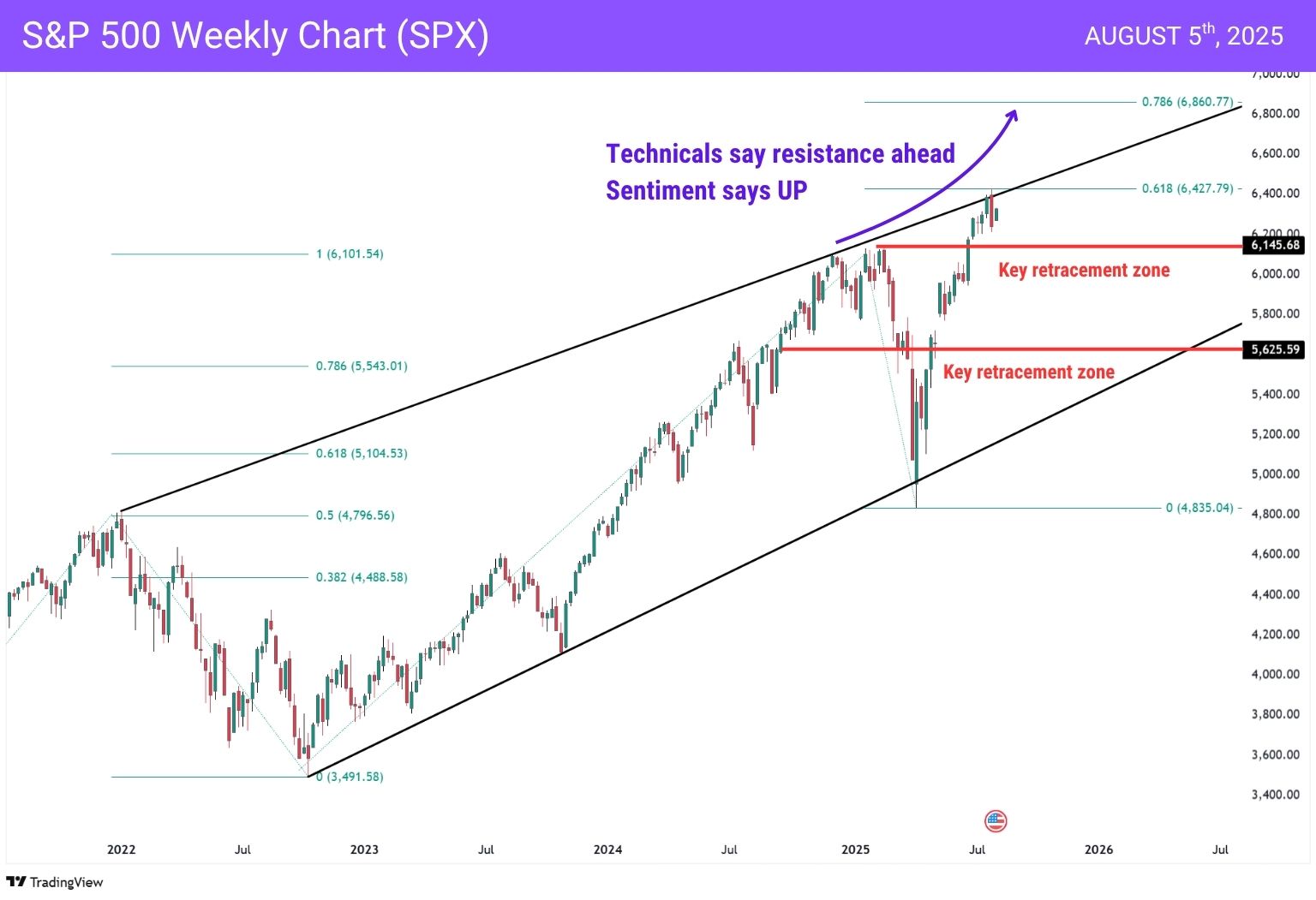
Despite this, equity markets rallied — this highlights a key factor: markets are now driven by the narrative of an interest rate cut.
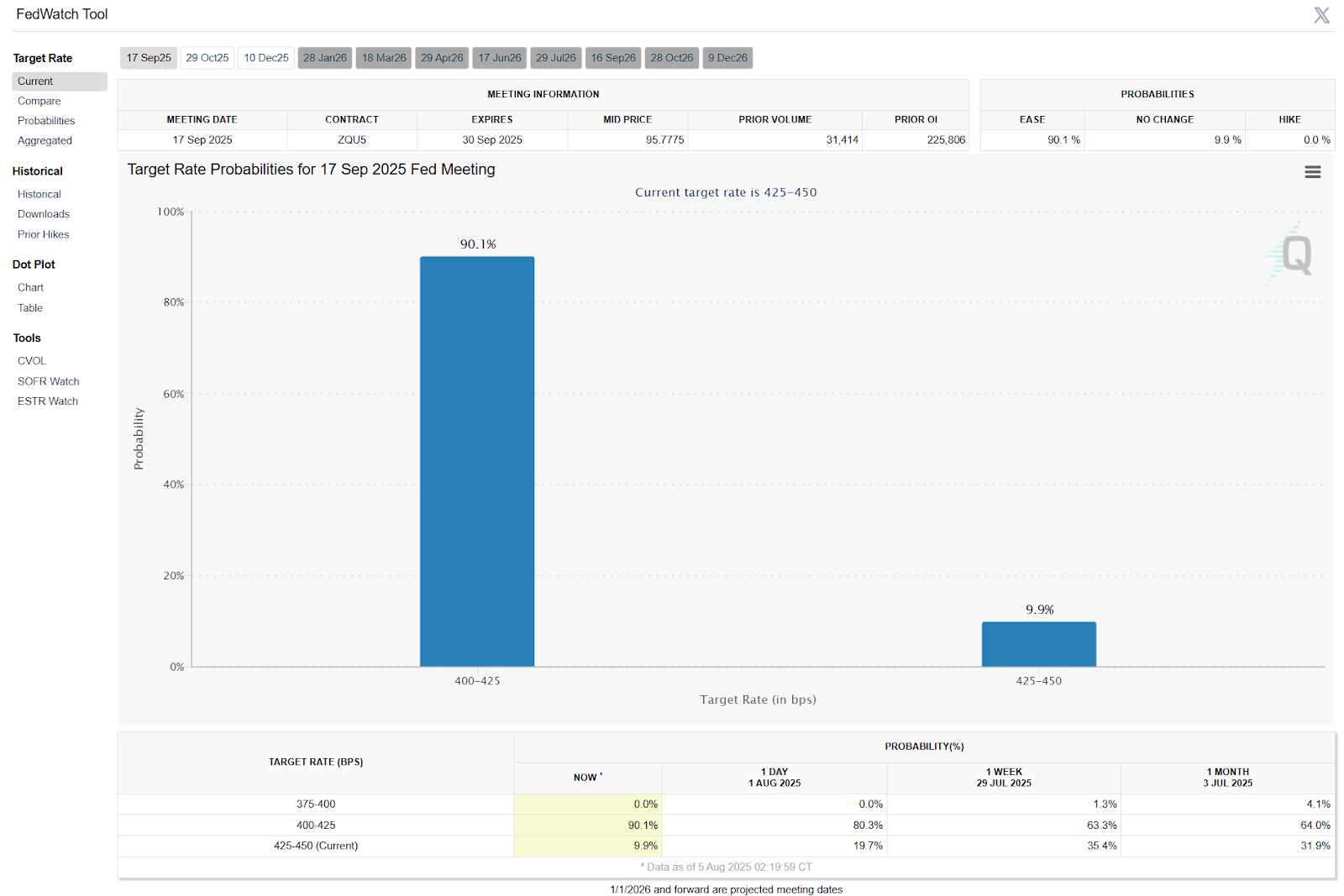
Traders now believe the Federal Reserve will be forced to cut rates as early as September, potentially bringing the federal funds rate down to 4.00–4.25%.
Source: Fedwatch Tool
On the CME FedWatch Tool, odds of a September rate cut jumped to 92.1%, up from just roughly 40% the week before. That same reading had been above 80% prior to last week’s FOMC meeting. This kind of volatility in expectations shows that markets are highly emotional right now — highly reactive, and not rational.
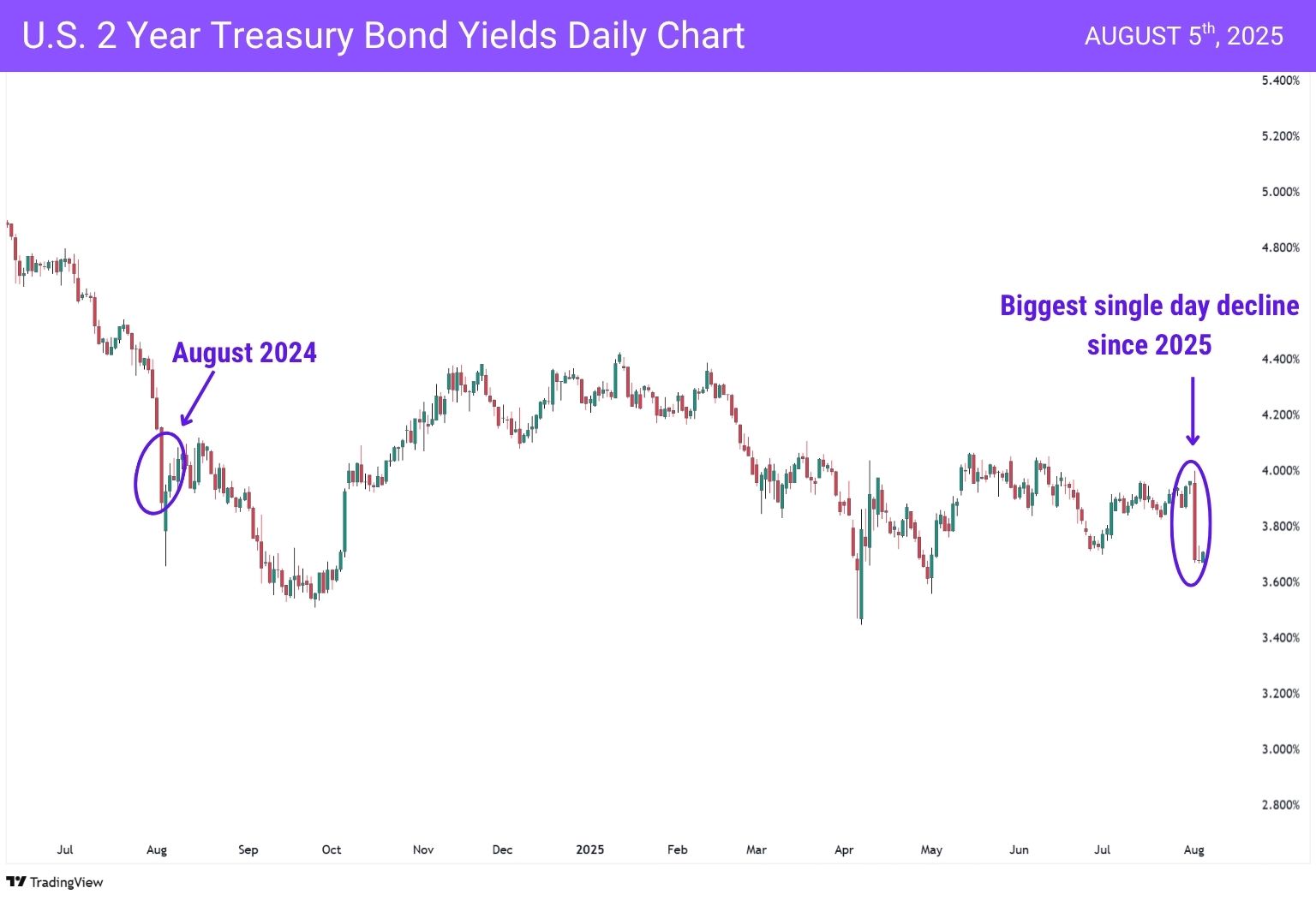
While stocks pushed higher, bond markets moved the other way. The 2-year Treasury yield dropped more than 25 basis points after the NFP release. This was the biggest single-day fall in nearly a year.
Bond yields represent the return investors demand for lending money to the government. When yields fall, it usually means demand for bonds is rising. This often signals that investors are moving into safer assets and expecting weaker economic conditions ahead.
While stocks pushed higher, bond markets moved the other way. The 2-year Treasury yield dropped more than 25 basis points after the NFP release. This was the biggest single-day fall in nearly a year.
It is not because inflation is collapsing. It is because growth expectations are getting worse. Traders now expect the Fed to cut, but bonds are reacting to weakness, not optimism — this signals a major divergence in the current equity price action, and the underlying expectation.
This points to a deeper problem. The Fed may be forced to cut not because the market is healthy, but because something has broken. It is a rescue move, not a reward.
Historically, this kind of shift often marks the start of a Fed pivot, which I discussed in my quarter 3 equities outlook.
And Fed pivots have not been bullish turning points for equities. They usually follow damage — not prevent it.
Follow the money for now, but stay cautious. The market is pricing in rate cuts on the back of weak economic data, not strong growth. This rally is sentiment-driven and may not be sustainable without real improvement in fundamentals.
Key considerations for traders:
This phase may still offer opportunity, but it is increasingly defined by positioning and narrative. Consider tightening risk and preparing for shifts in sentiment.
You may be interested in:
USD/JPY – Waiting on the 146 Trigger
DISCLAIMER: For educational purposes only. Trading comes with substantial risk, leading to possible loss of your capital. Traders are advised to do their own due diligence before investing.
Alchemy Markets is a multi-asset brokerage providing retail traders with the same elite trading conditions, tools, and transparency typically reserved for institutions.

Select the categories and companies you wish to follow directly to your person rss feed.
Create Custom RSS FeedSign up and join over 5,000 professional members who receive personalized news alerts, curated professional connections, and more for free!
Multi-asset trading broker AvaTrade has agreed to acquire the majority of FXCM Group’s business and brand, in a transaction that would bring a longstanding retail FX franchise into the AvaTrade Group.
LSEG and CMC Markets have signed a multi-year strategic data agreement expanding CMC's access to LSEG's real-time and delayed pricing, reference and corporate actions data, news and analytics, plus AI-ready content, to support new products, entry into new markets and the growth of CMC's institutional and B2B partnerships.
The Tel Aviv Stock Exchange is considering a bid for the Cyprus Stock Exchange, with Israeli media citing its EU licence, trading platform and clearing house. Euronext’s Athens exchange and India’s National Stock Exchange are also seen as contenders, and Cyprus aims to sign a sale agreement by the end of this year.
CME Group will launch baseball futures on 12 October, pending regulatory review, tracking CME FutureSports Performance Indexes built on Official League Data. Standard and micro contracts will start with the 2026 Postseason and the four clubs in the League Championship Series, trading around the clock.
ESMA has published an opinion stating that MiCA-authorised crypto-asset service providers should cease services tied to non-MiCA-compliant stablecoins for EU clients across MiCA crypto-asset services. National authorities should require remediation of existing exposures within three months, by early January 2027.
Nasdaq Ventures has made a strategic investment in Amsterdam-based derivatives and crypto exchange One Trading, with both firms to explore 24/7 trading of equity futures. The undisclosed investment follows Nasdaq's US$100 million investment in Payward, the parent of Kraken, and CME Group's move to 24/7 trading.
cTrader has opened multi-platform plugins to brokers and prop firms, which can pre-install their own tools for clients or list them in cTrader Store. The plugins run across Mobile, Web, Windows and Mac, and can be built and launched independently of core-platform releases, including trading journals and calculators.
Institutional brokerage and financial infrastructure provider Clear Street has joined TradingView’s broker network, allowing its clients to trade US stocks, exchange-traded funds and options directly through the charting and analysis platform.
Learn how to improve trading psychology, manage fear and greed, avoid revenge trading, and follow your trading strategy with discipline and a trading journal.
GTC Prime has announced a strategic partnership with Centroid Solutions to manage and distribute its liquidity through CS 360 Bridge, Centroid's multi-asset connectivity and execution engine, giving brokers and institutional clients access to tailor-made pricing, low-latency execution and real-time risk management.