
Search Companies, News, Members & more
Terms of ServicePrivacy PolicySecurity PolicyLegal InformationCommunity GuidelinesSitemapsCookie Settings
2026 Copyright © Liquidity Finder Ltd. All rights reserved.
Liquidity Finder Ltd is incorporated in England and Wales, company number 10610740, registered address 167-169 Great Portland Street, Fifth Floor, London W1W 5PF, United Kingdom.
Talking B2B Liquidity and Crypto With Andrey Stoychev, CEO of VS Capital

Published on Jan 6, 2026
Updated on Mar 7, 2026

Talking B2B Liquidity and Crypto With Andrey Stoychev, CEO of VS Capital
When I caught up with Andrey Stoychev, CEO of VS Capital, in Dubai at the ForexExpo last October, it was the first time I had seen the new VS Capital branding. Having walked around many of seemingly TikTok-focused broker booths I found the sort of stand I would be attracted to if I was an asset manager/hedge fund, the Financial Times reader shall we say. The website is similar (see the subliminal FT connection?) Something about the branding says ‘sophistication’ and ‘collaboration’. Cool sophistication – not shouty lambos. VS Capital is a serious, measured, B2B participant.
Andrey has a deep understanding of the requirements of his clients which comes from long market experience and a deep understanding of what it takes to be successful in this field: what works for his business must also work for the businesses he is servicing. Everyone in the chain needs to be in harmony, as far as possible.
Start with risk and dealing, and you see markets differently
The two minute version of his background; the experience this provides matters to clients.
Andrey has been in the industry for 21 years. He spent 12 years at Bulgarian based multi-asset broker DeltaStock, starting his career in risk and dealing, with the last five to six years as a director, rising to Chairman of the Board.
“I started originally in the risk and the dealing. This is still my thing.”
From there, he moved into helping Trading 212 build a risk team and support its move into stock trading, then joined JFD, where he led liquidity before becoming a Director.
Risk is clearly something he understands and focuses on.
Speaking to Andrey, I wanted to help LiquidityFinder’s audience understand what VS Capital is, what makes it different in a crowded B2B market, and why Andrey believes crypto liquidity has become the firm’s sharpest wedge to open doors.
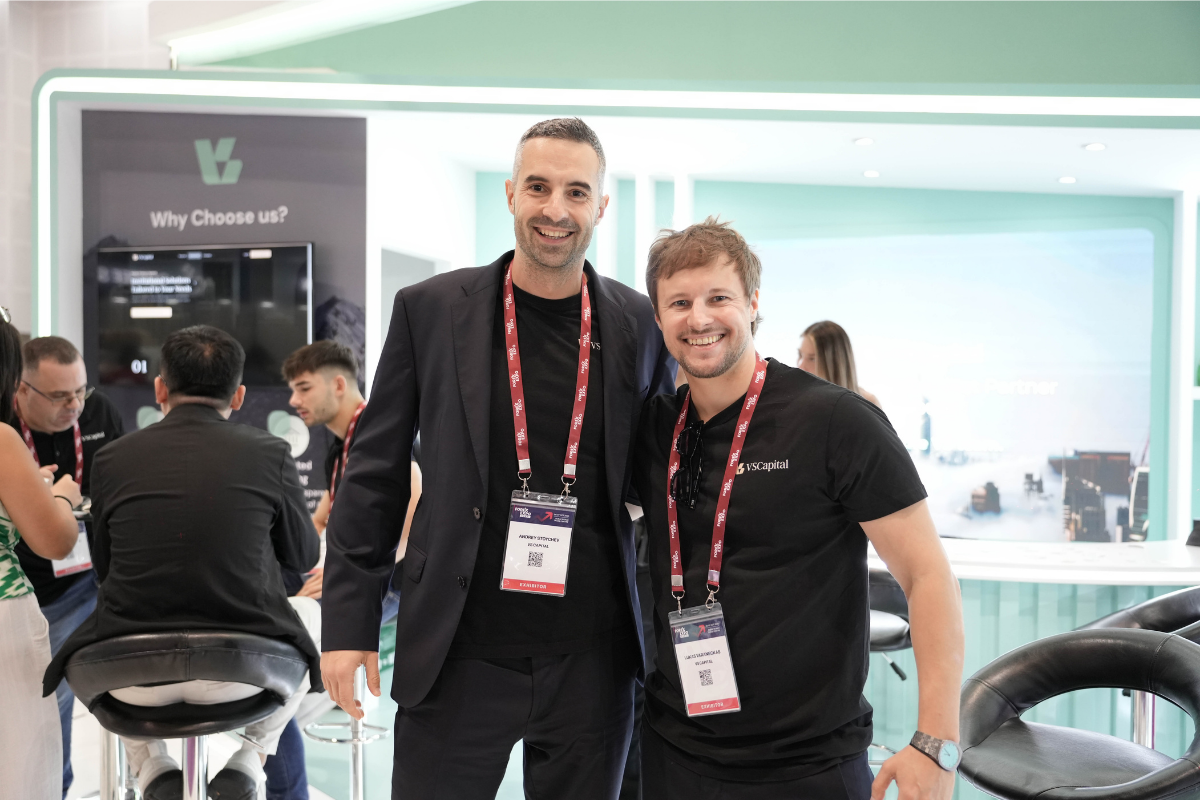
Andrey Stoychev CEO, and Lukas Varenackas, Partner, VS Capital.
Why set up VS Capital and why the focus on Crypto?
Andrey’s answer as to why he set up VS Capital and why he is particularly focused on Crypto, delivered in his blunt style, was that most brokers have not seen meaningful crypto flow for a very basic reason: they have been offering a poor product and charging too much for it.
He put it like this: “I thought the reason why FX/CFD brokers were not facing a lot of crypto flow is because they were, first of all, offering a sh*t product in general, and also very expensive. All of the companies are pretty much the same in terms of offering - the same Eurodollar, gold… the same conditions, the same commissions, the same technology.”
“I noticed the difference between the FX and crypto worlds in terms of making the pricing, execution, trading in general, and liquidity.”
If brokers weren’t seeing meaningful crypto flow, it wasn’t because clients didn’t want it, but because what brokers were offering was overpriced and uncompetitive, with execution and liquidity that didn’t stand up when conditions got fast.
Then he added a point that went beyond pricing and into trust. The pricing and execution might look similar whether you trade perpetuals on an exchange or a crypto CFD with a broker, but the experience and the accountability are not the same. Andrey’s view is a customer is better served dealing with a well-regulated broker, rather than being pushed towards unregulated venues for perpetual futures. Regulation forces a level of oversight that many exchanges simply don’t offer.
Crypto is a market structure problem that most brokers have not solved, and the brokers that solve it will unlock real flow. So, the suggestion is: offer a solid crypto product in a well-regulated and accountable environment.
"And this is how we position ourselves in the B2B space. OK, we are giving pretty much the same conditions for forex, for indexes, for commodities, etc. But we are very, very good in crypto CFD liquidity. Soon we expect that we will be able to expand to spot crypto, as part of our broader group strategy. Our Cyprus entity is exploring the development of spot-crypto services within its regulatory framework, while VS Capital is also assessing licensing options outside Europe in order to be able to offer spot crypto in the future."
If brokers can offer crypto exposure with better pricing and a more robust regulatory wrapper, then the broker channel becomes the safer and more scalable on-ramp for many clients into crypto.
VS Capital’s Evolution
VS Capital originally started as a consulting firm operating under a different name, where focus was to help brokers manage risk better as well as bring new business.
As a consultant, VS did not face any clients directly, as they were onboarded with few trusted and regulated brokers, with which Andrey worked with for many years. As business and client requirements grew, it became clear that the next step was to establish an independent licensed entity – that’s when Andrey and his partners formed VS Capital and applied for an FSA license in Seychelles. Existing business was shifted into the Seychelles entity and he built out the VS Capital structure there. (I know of other brokers that say Seychelles puts you under as much scrutiny, if not more, than the UK’s FCA).
To serve European clients under appropriate regulatory frameworks, a separate affiliated entity within the broader ownership structure was acquired in Cyprus which operates under CySEC authorisation. VS Capital itself continues to operate independently under its Seychelles regulatory permissions.
There were some B2B opportunities that could not be onboarded outside Europe and there was demand from European clients that Andrey did not feel comfortable onboarding in Seychelles. “I prefer, if we are having European clients, to be onboarding in European entities” he explains. Another consideration was the group’s intention to strengthen its position in the crypto space by applying for relevant Crypto Licenses in respective regions.
Now VS Capital is in a place, unlike many crypto native firms, where scrutiny is real, accountability exists, and the operation is forced to run under serious regulatory scrutiny.
So, what are the opportunities in the B2B space?
I asked Andrey to share where he sees opportunities in the B2B space. Definitely crypto due to its volatility, and it’s an area where liquidity can be improved, “That’s why we are pushing Crypto CFDs a lot…And this is our main selling point. The other one, obviously, these days, is very challenging gold stuff.”
“With gold, it's very complicated. Maybe it's an opportunity or maybe it's a topic which brokers need to be more careful of and to use more risk management tools. With the most current Gold flow, I would say, it's better to be on the safe side, to go to the street, because there can be some very, very strange behaviour. There are a lot of toxic strategies around, which are trying to take advantage of a broker’s good conditions. That's why brokers start giving worse conditions.”
“Actually, these [worse conditions] are coming from the liquidity provider because brokers notice that they cannot handle this. So that's why they start sending flow to LPs. Liquidity providers start receiving this toxic flow, and they say, ‘OK, it's not for the primary feed. I'm giving to the secondary feed’, which is worse than the primary one. And then the retail brokers start giving worse conditions to their clients. In that sense it’s very simple.”
“I can see a lot of front-running, a lot of arbitrage strategies, futures versus the spot, some hedge strategies as well. So, you know, there is a lot of complicated and some predatory flow that‘s not really good for the brokers.”
Client onboarding
I asked Andrey what they look for when onboarding a new client. Traditionally a B2B broker needs a trading statement showing the kind of flow they are going to get. “Actually, a trading statement, is a very traditional request. I’m not a fan of this traditional stuff and I'll explain why. First of all, the statement will be historical. Then if I'm onboarding a new retail broker, these guys can sometimes send only part of their client statements, but it's still just historical trades... I have no idea how it will go once they are live. And the broker in general, they have little control what will be tomorrow and the day after tomorrow. So I literally prefer to onboard clients and see the flow first hand, and then we can adjust our approach based on what flow looks like real time.”
So, you're quite happy to onboard somebody just on face value and test them out and then adjust as you go live?
“Exactly, because also - we have some clients who start improving their own business because of us…because they're using our liquidity, they start selling to their retail clients and they start facing more volume and this volume is coming to us.”
“Also, what type of statement are they going to send me for crypto...? If they were using, let's say, the crypto liquidity from (Prime of Prime X - name redacted), or any other Prime of Prime – mostly because of the costs there will only be a few trades. And then, when they start using my liquidity, they will start receiving more flow, which will be completely different and new for them, and obviously, that information is not in the statement they have provided.”
Andrey is basically saying that when people start trading with VS Capital, the nature of their trading might change (improve) because they see an improvement in their pricing and their liquidity and execution.
Asset Managers and funds are a different story. “This type of client is coming with specific requirements, because they know their strategy, they know what they're doing. And they were doing this in the past, so they know that they need, let's say, top-of-the-book five bitcoins, or two lots of gold. They know exactly, and they know that they are trading every five minutes, or every hour, or they are intraday. So with these clients we can discuss, we can check the statement, and we can address their requirements.”
What’s the counterparty risk with VS Capital?
If someone was to ask, “What’s the risk of my counterparty if I trade with VS Capital?” How do you reassure them?
“Well first of all, we operate under Seychelles regulation and maintain the required capital there. Also within the broader group there is a separately regulated entity in Cyprus, which also has its own capital requirements. We maintain fully segregated client accounts and follow a conservative approach to risk management - even if regulation allows rehypothecation under certain circumstances, we choose not to take unnecessary risks with client funds and use our own capital. In the Seychelles, segregated client accounts are also insured through Lloyds. Our balance sheet is not a problem for most of the brokers but in some specific cases, where a client is a lot larger than VS, we post capital with them, which further alleviates counterparty risk.”
VS Capital’s Crypto Liquidity
So what makes your crypto liquidity different, and where does it come from?
“We have our own technology where we integrate 10 plus different liquidity providers. Let’s say market-makers, exchanges, some other OTC desks, etc.”
Because VS Capital is aggregating many sources, he said that most of the time the spread they receive at source can be “inverse”. In other words, the best bid can be above the best offer at that instant due to microstructure, latency, and cross-venue differences.
“Because with these 10 plus liquidity providers, most of the time, our aggregated spread is… Inverse.”
He then pointed out the practical problem. “Especially in MetaTrader 5, it’s not allowed.”
He described an instance when they tried to pass inverse pricing through a bridge to a broker. “They told us, ‘why are you sending this? It’s not normal.’ And I said, okay. Let's put a minimum $1 on Bitcoin. And after that, we start sending the pricing with the minimum $1 just to be sure that we are not giving them a negative spread.”
A-book or B-book?
I will take any opportunity I can to ask a broker about their approach to A-book and B-book.
Andrey: “Honestly, these days, it’s around 50-50 (A-book v B-book), I would say, but it depends. With retail brokers, I have no idea what they're going to send me next week. So, that's why, with these guys, I'm trying to be more careful and prefer not to take a lot of risk. Of course, if some of the positions can be net between clients, of course, I can do this and I can save some money and be more profitable. But if the flow is directional, I prefer to try to be on the safe side and not to take risk.”
Gold and Crypto are 2 areas that Andrey would recommend retail brokers to offset their risk as much as possible. “Most brokers do not understand crypto well so naturally they are more risk-averse and that’s the right approach – you should offset your risk with a liquidity provider that understands the asset class more.”
Crypto is structurally more volatile and more fragmented than FX. It trades continuously, including weekends, and client behaviour can change quickly when you improve execution quality. Andrey’s comments reinforce that the biggest risk is not only market volatility. It is the feedback loop between execution quality, client behaviour, toxicity profiling, and the liquidity tier you ultimately receive.
Andrey’s approach to crypto liquidity includes multi-source aggregation, clear constraints around how pricing is distributed into broker platforms, and a risk posture that starts cautious and adapts based on observed flow.
The way Andrey frames VS Capital’s crypto liquidity is very direct. He does not pitch it as them being “crypto-native” but as CFD people who went into crypto with a broker’s mindset, because the end product has to work inside a CFD environment. In his view, most providers underestimate how different redistribution is versus trading on a venue, so the real job is packaging crypto liquidity in a way a broker can actually run: stable enough for platforms, consistent enough for clients, and engineered for the realities of a dealing desk.
He also described an advantage that is not purely technological. The model leans heavily on relationships that already sit deep in the exchange ecosystem. In simple terms, VS Capital piggybacks on those relationships to access higher-quality exchange pricing, without a retail broker client having to “earn” it slowly through its own volume brackets first. VS Capital also has dedicated streams from specific counterparties that are shaped for broker distribution, including streams that are intended to be exclusive for redistribution into the CFD market.
The other piece of the ‘magic sauce’ is the market making and risk component in the middle that plugs any gaps. Crypto is fragmented and can look liquid until you hit it, especially in fast markets and on weekends. So they focus on keeping top-of-book liquidity credible, not just tight, including depth and refresh behaviour that dealers care about, making sure pricing does not fall apart when it is tested.
VS Capital offer pricing transparency, meaning raw spread plus commission, with a clear all-in cost mindset and volume tiers that can take commissions down to very low basis-point levels.
The message is that if brokers want crypto flow to grow, the product has to be consistent, the economics have to be honest, and the liquidity has to behave when it is actually traded.
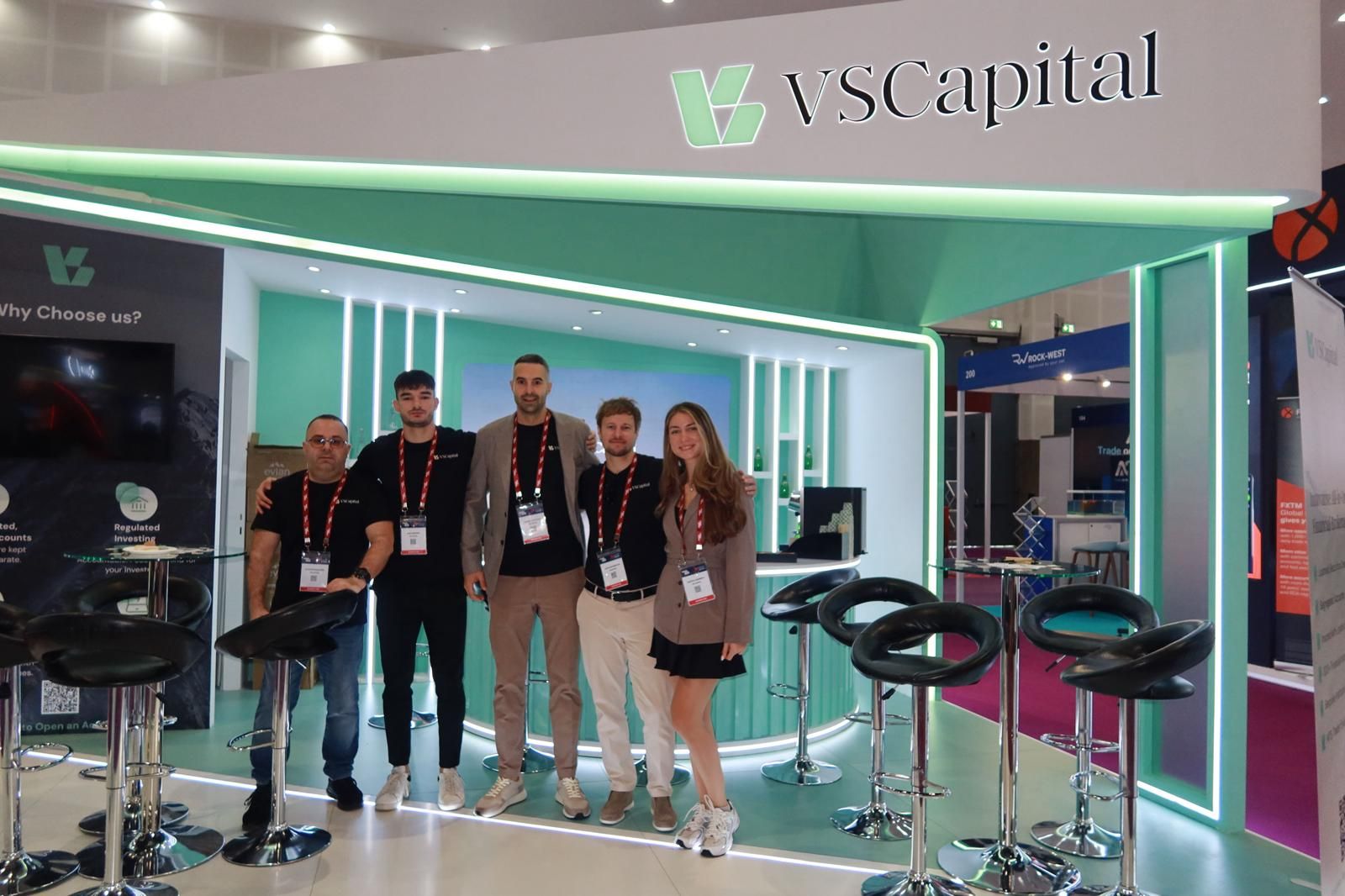
The VS Capital team in Dubai at ForexExpo
You can contact Andrey directly here, or send a message direct to the team by clicking on CONTACT US from their LiquidityFinder page here.
Found this interesting? Become a member of LiquidityFinder and get daily industry news direct to your inbox - join here.
Author

Share this article

Comments
Most Recent
Find The Right Partners for
Your Trading Business
Sign up and join over 5,000 professional members who receive personalized news alerts, curated professional connections, and more for free!
n in-depth review of TMGM (TradeMax Global Markets), the ASIC-regulated ECN broker offering raw spreads from 0.0 pips, MT4 and MT5, copy trading via HUBx and ZuluTrade, and 24/7 multilingual support across four regulated jurisdictions. Find out if TMGM belongs on your shortlist.
LiquidityFinder's Sam Low sits down with Nathan Sage, founder and CEO of Sage Capital Management, to trace his journey from FX fund manager to running a Bitcoin fund doing $1BN a day in 2016 — and how that experience of pain built one of the most connected prime brokerages in the digital assets market today.
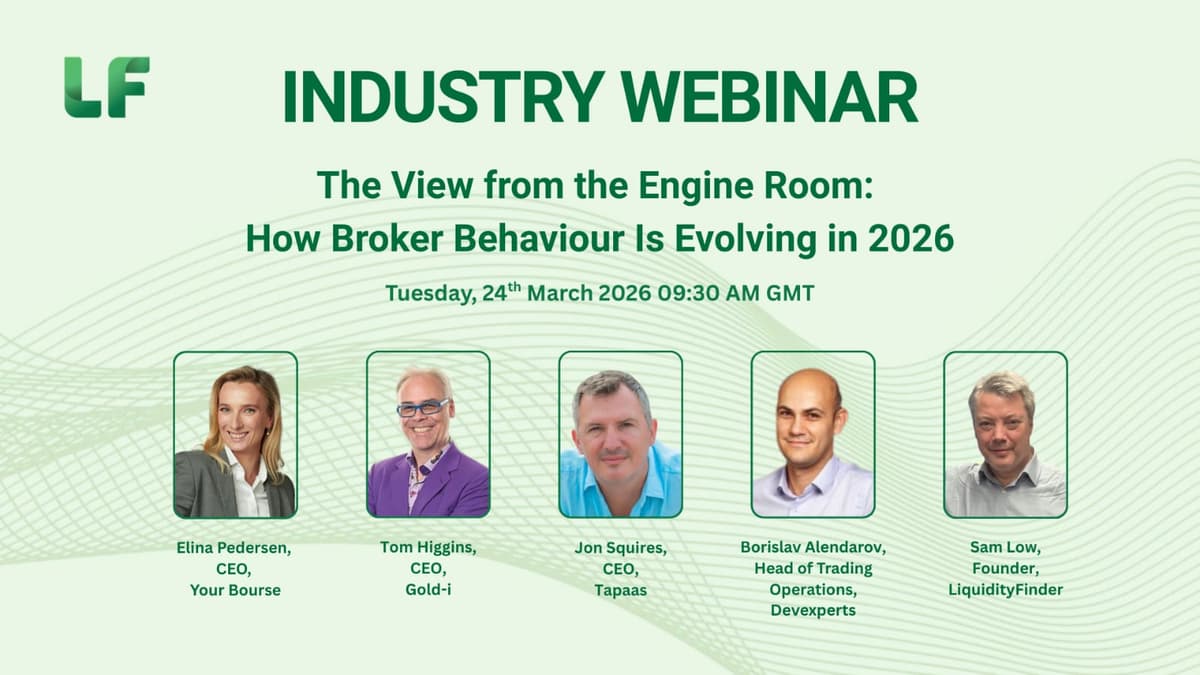
Gold at record highs, oil as a meme stock, and crypto exchanges eyeing your clients. Watch our expert panel - Gold-i, Your Bourse, Tapaas and Devexperts - discuss broker risk management, , AI trading and the MetaTrader debate.

Over a long tapas lunch in Shoreditch, London, Sam Low sits down with Peter Brooks and Jess Reed from ADMISI eFX, the dedicated electronic FX desk operating inside one of the world's largest agricultural commodities companies. What emerges is a compelling case for why this largely unknown operation deserves serious attention from brokers, payments firms, corporate treasuries, and digital asset companies alike.
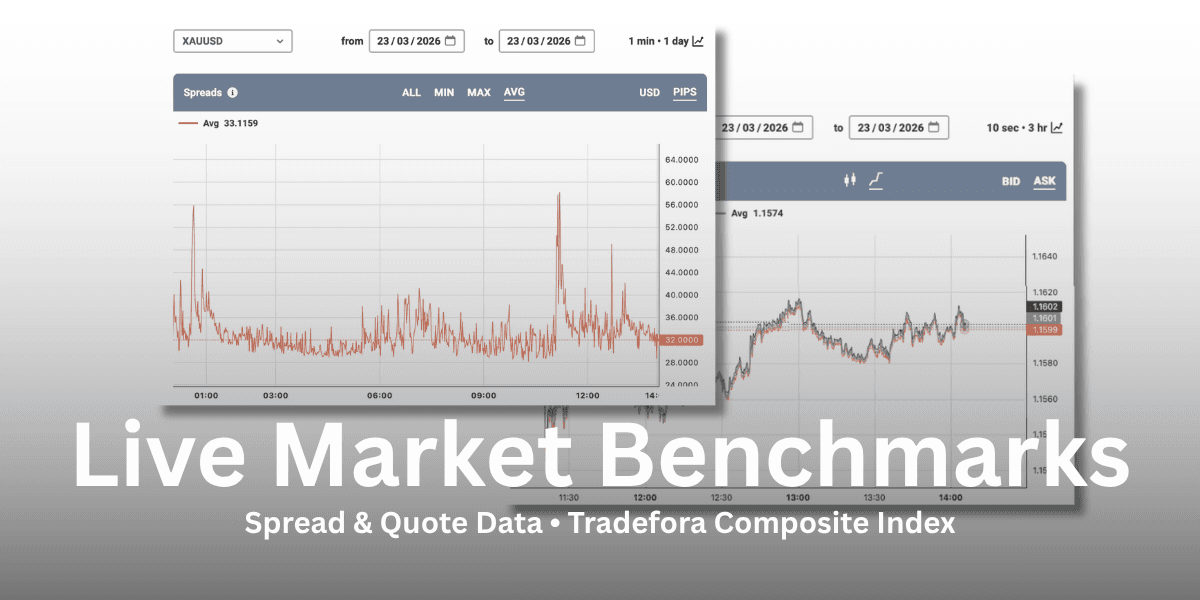
Explore live spread and quote benchmarks powered by the Tradefora Composite Index (TCI), an independent dataset aggregated from multiple FX and CFD brokers. View average, minimum and maximum spreads by instrument and timeframe, plus composite bid/ask quote data updated continuously at millisecond precision.
In Part 6 of his A-Book STP series, Youssef Bouz from GCC Brokers looks at how the rise of algorithmic and AI-assisted trading is forcing brokers to rethink risk models, revenue strategy, and long-term sustainability, and why trader longevity, not short-term extraction, is the real measure of a resilient execution business.
Fusion Capital is a specialist crypto liquidity provider offering brokers over 350 crypto CFD pairs with bespoke pricing, pure A-book execution, and access to decentralised exchange liquidity through Hyperliquid. In this broker profile, LiquidityFinder's Sam Low speaks with Head of Product Jasper Cooney about how Fusion's in-house trading bots monetise flow across centralised and decentralised venues, why crypto exchanges handle toxic flow differently to FX, and how brokers can now offer clients pre-IPO perpetual futures through their existing MT5 infrastructure.
In Part 5 of his A-Book STP series, Youssef Bouz from GCC Brokers provides a guide to distinguishing healthy algorithmic trading from latency arbitrage and structural abuse — and why behavior, not profitability, is the real risk indicator.
Create Your FREE Account
Get access to latest news, updates, real-time data, brokerage and trading firm insights and customized information feeds.


Multi-asset trading broker AvaTrade has agreed to acquire the majority of FXCM Group’s business and brand, in a transaction that would bring a longstanding retail FX franchise into the AvaTrade Group.

LSEG and CMC Markets have signed a multi-year strategic data agreement expanding CMC's access to LSEG's real-time and delayed pricing, reference and corporate actions data, news and analytics, plus AI-ready content, to support new products, entry into new markets and the growth of CMC's institutional and B2B partnerships.

The Tel Aviv Stock Exchange is considering a bid for the Cyprus Stock Exchange, with Israeli media citing its EU licence, trading platform and clearing house. Euronext’s Athens exchange and India’s National Stock Exchange are also seen as contenders, and Cyprus aims to sign a sale agreement by the end of this year.

CME Group will launch baseball futures on 12 October, pending regulatory review, tracking CME FutureSports Performance Indexes built on Official League Data. Standard and micro contracts will start with the 2026 Postseason and the four clubs in the League Championship Series, trading around the clock.

ESMA has published an opinion stating that MiCA-authorised crypto-asset service providers should cease services tied to non-MiCA-compliant stablecoins for EU clients across MiCA crypto-asset services. National authorities should require remediation of existing exposures within three months, by early January 2027.

Nasdaq Ventures has made a strategic investment in Amsterdam-based derivatives and crypto exchange One Trading, with both firms to explore 24/7 trading of equity futures. The undisclosed investment follows Nasdaq's US$100 million investment in Payward, the parent of Kraken, and CME Group's move to 24/7 trading.

cTrader has opened multi-platform plugins to brokers and prop firms, which can pre-install their own tools for clients or list them in cTrader Store. The plugins run across Mobile, Web, Windows and Mac, and can be built and launched independently of core-platform releases, including trading journals and calculators.

Institutional brokerage and financial infrastructure provider Clear Street has joined TradingView’s broker network, allowing its clients to trade US stocks, exchange-traded funds and options directly through the charting and analysis platform.

Learn how to improve trading psychology, manage fear and greed, avoid revenge trading, and follow your trading strategy with discipline and a trading journal.

GTC Prime has announced a strategic partnership with Centroid Solutions to manage and distribute its liquidity through CS 360 Bridge, Centroid's multi-asset connectivity and execution engine, giving brokers and institutional clients access to tailor-made pricing, low-latency execution and real-time risk management.
Feed