
Search Companies, News, Members & more
Terms of ServicePrivacy PolicySecurity PolicyLegal InformationCommunity GuidelinesSitemapsCookie Settings
2026 Copyright © Liquidity Finder Ltd. All rights reserved.
Liquidity Finder Ltd is incorporated in England and Wales, company number 10610740, registered address 167-169 Great Portland Street, Fifth Floor, London W1W 5PF, United Kingdom.
The A-Book Comfort Lie: Risk Never Left the Building
Published on Jan 30, 2026
Updated on Mar 7, 2026

LiquidityFinder Broker Insight · Guest Article
The A-Book Comfort Lie: Risk Never Left the Building
Author: Anya Aratovskaya Opinion / thought leadership for brokers, dealers, and market infrastructure teams.
A-book, B-book, C-book, and everything in between in the brokerage-LP-PoP world. The only word that unites anything with “book” in the name is risk.
Without proper risk management, any “book” turns into a nightmare. B-books have earned their share of bad press. A-book, though, is often treated as a moral upgrade. But is it, really?
A-book is not a proxy for a good company, a sound strategy, or competent risk management. Any book can be mismanaged. Each one is only as good as the discipline behind it. On that note, I want to elaborate that the idea that running an A-book will make you sleep better is overrated.
Risk is still there; it just takes a different form.
As risk and compliance officers (my absolute favorite people) love to say:
Risk can be reduced.
Risk can be reallocated.
But it can never be eliminated.
Here’s what most people underestimate when talking about A-book as the “safe” option:
1. The Leverage & Exposure Squeeze
The A-book is a constant balancing act. Sometimes, a miserable one.
Clients still want 1:200 and hold 500+ lots over the weekend.
But Prime Brokers - the ones who give you access to 30+ “dream” LPs while holding your margin in one place - aren’t leverage-friendly. Or net open position–friendly. You’re lucky to get 1:30 on crosses.
To stay competitive, you’re offering leverage you don't actually have. That mismatch has to be funded by your balance sheet.
This is why "decent" LPs are usually backed by massive banks or hedge funds; they need the deep pockets to bridge that gap.
Add in the lack of cross-margining (still an issue in 2026, somehow) and sudden weekend margin hikes, and your “safe” A-book is just a different flavor of over-leveraged gamble.
2. Institutional on Paper, Retail in the Head
My favorite industry paradox.
The client who is "Institutional" on paper … but has a $500 retail brain.
They legally deserve the label, but they demand 1:500 leverage and rage over 0.1 pip slippage during a news event.
You’re stuck providing white-glove service to people who have zero tolerance for how real markets actually function.
Side note: LPs secretly love these guys - they trade institutional volumes with retail-level predictability.
3. Collateral Risks
Let’s use a fancy term: Collateral Fragmentation.
Brokers love to brag about “50+ LPs.” If they do, ask them one thing: Where is the cash?
Posting margin with 10+ LPs is capital suicide - it can’t be redeployed easily.
You’re basically giving your counterparties a free loan.
Very few LPs offer interest on that margin.
It’s dead money - and in an agency model, dead money is a slow-motion death sentence for your ROI.
4. Technology Risks
Aggregation, routing, and stack management are always risk points.
When volatility spikes, LPs don’t just widen spreads. They (can) drop ticks, pile up rejections, and ghost the bridge.
Even top-tier tech providers are vulnerable to outages and routing errors.
When your primary LP’s feed freezes, even the best routing logic can fall short.
As the LP, you eat it all:
The complaints. The fill risk. The reputational damage.
All while operating on razor-thin commissions.
One operational hiccup can wipe out an entire month of “safe” A-book revenue.
5. Flow Quality Risk
A-book clients need just as much vetting as B-book ones.
Liquidity aggregators (and experienced dealers) may tolerate (or route around) some risky behaviors. But that doesn’t make the toxic flow non-toxic.
An A-book doesn’t magically clean your client base.
If anything, the toxicity just shows up with better grooming and more complex behavior.
If you don’t manage flow quality, your LPs will eventually manage you - right out of their pool.
P.S.
An A-book isn't a "night saver."
It’s a high-maintenance, capital-heavy, relationship-sensitive, tech-fragile monster.
Running one well takes just as much discipline as running any other book - especially when institutional clients are involved.
You might find this interesting: From B-Book to A-Book: Rethinking Broker Risk, Revenue & Valuation in the Age of AI Trading
Author
|
|
About the author
Anya AratovskayaAnya Aratovskaya is a Strategic Advisor asenior institutional FX sales and marketing positions with over a decade of experience helping brokers, banks, funds, and liquidity providers scale distribution across the US, UK, Europe, and APAC.
|

Share this article
Comments
Most Recent
Find The Right Partners for
Your Trading Business
Sign up and join over 5,000 professional members who receive personalized news alerts, curated professional connections, and more for free!

Scope Prime's Andrew Taylor sets out how brokers serving Asian clients should measure and price sharp gold flow, citing the October 2025 and January 2026 sell-offs, thin liquidity at the Asian open, segmentation over relationship-wide repricing and the questions to ask a prime of prime provider.

GCC Brokers is a Dubai-based A-Book STP broker with FSC Mauritius and UAE SCA regulation, raw spreads from 0.0 pips, and an LBMA gold fix service. Here is an honest assessment of who it suits and who it does not.
n in-depth review of TMGM (TradeMax Global Markets), the ASIC-regulated ECN broker offering raw spreads from 0.0 pips, MT4 and MT5, copy trading via HUBx and ZuluTrade, and 24/7 multilingual support across four regulated jurisdictions. Find out if TMGM belongs on your shortlist.

LiquidityFinder's Sam Low sits down with Nathan Sage, founder and CEO of Sage Capital Management, to trace his journey from FX fund manager to running a Bitcoin fund doing $1BN a day in 2016 — and how that experience of pain built one of the most connected prime brokerages in the digital assets market today.

Gold at record highs, oil as a meme stock, and crypto exchanges eyeing your clients. Watch our expert panel - Gold-i, Your Bourse, Tapaas and Devexperts - discuss broker risk management, , AI trading and the MetaTrader debate.

Over a long tapas lunch in Shoreditch, London, Sam Low sits down with Peter Brooks and Jess Reed from ADMISI eFX, the dedicated electronic FX desk operating inside one of the world's largest agricultural commodities companies. What emerges is a compelling case for why this largely unknown operation deserves serious attention from brokers, payments firms, corporate treasuries, and digital asset companies alike.
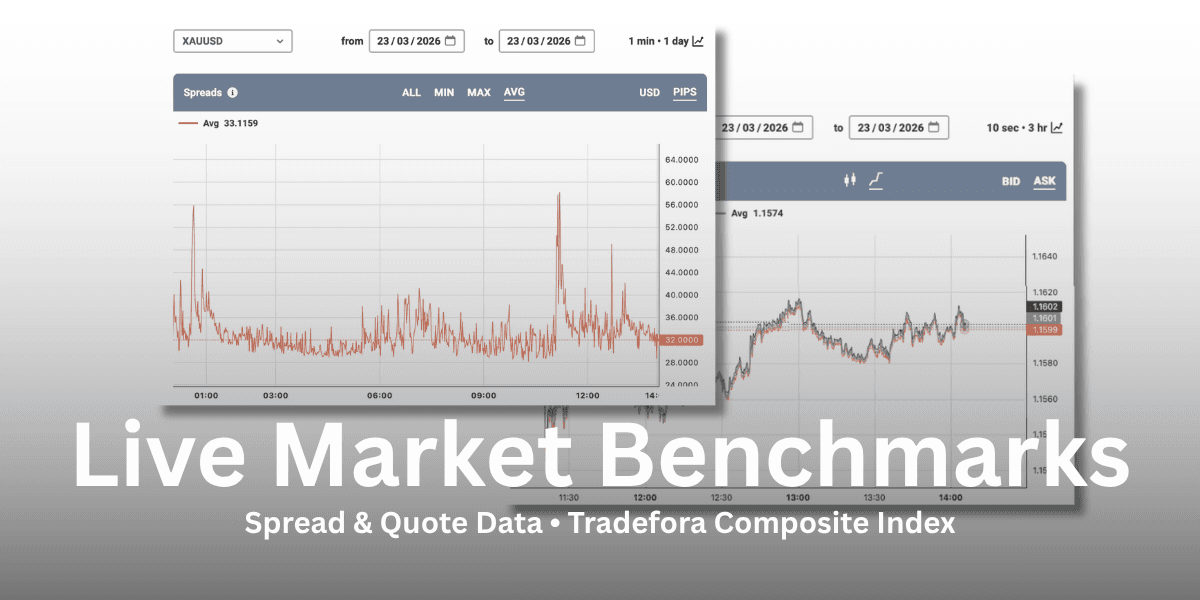
Explore live spread and quote benchmarks powered by the Tradefora Composite Index (TCI), an independent dataset aggregated from multiple FX and CFD brokers. View average, minimum and maximum spreads by instrument and timeframe, plus composite bid/ask quote data updated continuously at millisecond precision.

In Part 6 of his A-Book STP series, Youssef Bouz from GCC Brokers looks at how the rise of algorithmic and AI-assisted trading is forcing brokers to rethink risk models, revenue strategy, and long-term sustainability, and why trader longevity, not short-term extraction, is the real measure of a resilient execution business.
Create Your FREE Account
Get access to latest news, updates, real-time data, brokerage and trading firm insights and customized information feeds.


This is the most crowded week of the quarter. Alphabet and Microsoft report on Wednesday night, a few hours after the Federal Reserve announces its October decision. Amazon follows on Thursday, the same day as the advance read on third quarter GDP and September PCE inflation. The Bank of Canada, the ECB and the Bank of Japan all meet before Friday. And with the US midterms a week away on November 3, election-driven volatility starts to seep into prices from here.


NinjaTrader Group has launched its futures-only trading platform in the UK, giving traders access to CME and Eurex contracts, a free simulator and GBP or USD funding, following earlier 2026 expansion across Germany, Italy, France, the Netherlands, Spain and wider EU markets. Web, desktop and mobile access is offered.


US stock futures are positive in early trading today with the Dow rising 0.2%, while Nasdaq-100 futures gained 0.1%.

The Nasdaq 100 remains under bearish pressure after failing to sustain its recent recovery toward the 29,400–29,500 area. Following the sharp decline toward 28,838, the index entered a consolidation phase before rebounding toward approximately 29,400.

Hyperliquid says Kraken parent Payward is intended to be the first CFTC-regulated deployer on its HIP-3 markets, using Bitnomial and NinjaTrader Clearing to offer perpetual futures to U.S. clients, subject to approval. Hyperliquid also outlined HIP-3*, which adds optional permissioned markets with on-chain allowlists.

Deutsche Börse Group has launched 24/7 trading in DAX 40 equities via 360X’s regulated MTF, using a request-for-quote model outside Xetra hours. Existing clients can onboard directly, trade standard DAX ISINs and settle in euro into their Clearstream accounts, while core Xetra auctions and opening prices stay unchanged.

DXtrade, the multi-asset trading platform from Devexperts, has integrated with KuCoin, giving brokers licensing DXtrade access to KuCoin’s aggregate liquidity for spot and perpetual futures markets through its Market Maker Support System, which covers trading incentives, OTC lending and matching latency as low as 3ms.


AUDCAD remains bearish below 0.98500–0.98750 resistance. Explore confirmation signals for a decline toward 0.97900 or a bullish recovery toward 0.99100.

Nasdaq 100 forecast recap: NAS100 falls after breaking 29,800–30,400 support. Review bearish price action, the daily 50 EMA and the original 29,000 target.

AUDCAD turns bearish after breaking key support and the 50 EMA. Watch 0.98455–0.98720 resistance for confirmation, with 0.98075 the downside target.
Feed