
Search Companies, News, Members & more
Terms of ServicePrivacy PolicySecurity PolicyLegal InformationCommunity GuidelinesSitemapsCookie Settings
2026 Copyright © Liquidity Finder Ltd. All rights reserved.
Liquidity Finder Ltd is incorporated in England and Wales, company number 10610740, registered address 167-169 Great Portland Street, Fifth Floor, London W1W 5PF, United Kingdom.
The Definitive Guide to Token Listing & Liquidity Generation

Published on Jan 10, 2026
Updated on Jun 20, 2026

When you launch a token, the goal isn't just to release code. The goal is to create a healthy, tradable asset that people can buy and sell easily. This guide breaks down the process of token listing and liquidity generation. It’s a step-by-step roadmap for making your asset functional in the real world.
Part 1: The Foundation — Preparation Before Launch
The biggest mistakes happen before the first line of liquidity is added. Proper preparation dictates whether your token survives or fails in the first 90 days.
1) The Critical Audit and Legal Check
Before any exchange or launchpad takes you seriously, you need to prove your token contract is secure. A contract audit is mandatory. No one wants to list an asset with known vulnerabilities.
| Checkpoint Requirement Purpose | ||
| Smart Contract Audit | Use a reputable firm (e.g., CertiK, Trail of Bits). | Identifies bugs, exploits, and security flaws, protecting users and the project. |
| Legal Opinion Letter | Consult with legal experts specialized in digital assets. | Determines token classification (utility, security, currency) in relevant jurisdictions (e.g., US, UK, EU). |
| Team KYC/Doxxing | Voluntary disclosure of team identity, often required by launchpads. | Builds trust with the community and reduces the risk of a "rug pull" (exit scam). |
Table: Audit and legal checkpoints before listing a token, Source: www.liquidityfinder.com
Entity Spotlight: CertiK
Description: A leading Web3 security firm specializing in formal verification and smart contract auditing.
Main Features: Skynet security score, active monitoring, formal verification.
Pros: High reputation, thorough analysis, globally recognized.
Cons: Expensive, process can take several weeks.
2) Tokenomics And Distribution Clarity
Liquidity isn't just about money; it’s about predictable supply. If the market doesn't understand who holds the tokens and when they unlock, confidence collapses.
Vesting Schedules: Clearly define when team, advisors, and private investors get their tokens. Use smart contracts to enforce these schedules. No one should be able to dump billions of tokens unexpectedly.
Treasury Management: What percentage of tokens is dedicated to ecosystem growth, liquidity provision, and community incentives? This needs to be public.
Liquidity Pool (LP) Allocation: Typically, a project dedicates 10-20% of the total supply, paired with stablecoins or ETH/BNB, solely for generating initial liquidity.
Data Insight: Projects with clear, linear, and long-term vesting schedules (12-24 months or more for core teams) tend to secure better listings because it signals commitment.
3) Community and Social Proof
Exchanges and platforms look at genuine activity, not bot numbers. A strong community validates demand and trading volume.
Real Engagement: Measure engagement on Telegram, Discord, and X (formerly Twitter). The ratio of active users to total members matters more than raw numbers.
Content: Produce quality documentation, clear roadmaps, and frequent, honest updates.
Part 2: The Listing Strategy — Where to Launch
You have two main paths for listing: Decentralized Exchanges (DEXs) and Centralized Exchanges (CEXs). These are not exclusive; most successful projects start on a DEX and aim for a CEX later.
1) Decentralized Exchanges (DEXs): The Immediate Launch
DEX listings are permissionless. If you have the tokens and the collateral, you can launch immediately. This is the first stop for almost every token.
The Mechanism: Automated Market Makers (AMMs)
DEXs don't use traditional order books. They use liquidity pools governed by an Automated Market Maker
x: Amount of Token A (e.g., your new token)
y: Amount of Token B (e.g., ETH or USDC)
k: A constant value
Key DEX Platforms
| Platform Network Focus Key Feature Pros Cons Official URL | |||||
| Uniswap (V3) | Ethereum, Polygon, Arbitrum | Concentrated Liquidity. | Deepest liquidity, highest prestige for DEX launch. | High gas fees (on mainnet), requires active management of LP positions. | https://uniswap.org/ |
| PancakeSwap | BNB Chain | Low fees, high volume farming incentives. | Extremely low gas costs, ideal for retail users and immediate community traction. | Lower perceived status than Ethereum DEXs, prone to more speculative projects. | https://pancakeswap.finance/ |
| Curve Finance | Ethereum, Polygon, Avalanche | Optimized for stablecoin swaps and pegged assets. | Very low slippage for large trades of stablecoin pairs (e.g., USDT/USDC). | Not ideal for volatile, non-pegged pairs (like a new utility token). | https://curve.fi/ |
Table: Key DEX platforms for listing a new token, Source: www.liquidityfinder.com
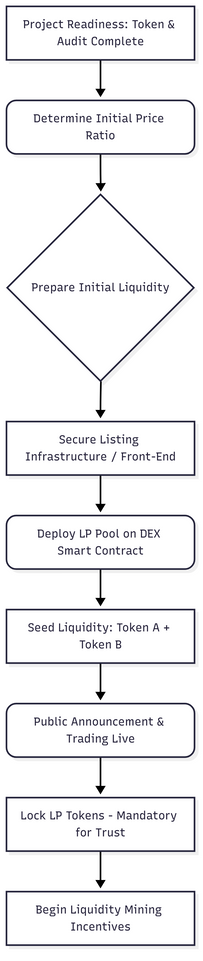
Image: The DEX Listing Process – Flowchart, Source: www.liquidityfinder.com
The process is fast, but requires careful timing to prevent "sniper bot" attacks.
Part 3: Ecosystem Partners — Consultation, Market Making, and Launchpads
Navigating the crypto market requires specialized partners. These entities provide the capital, expertise, and connections necessary to secure major listings and maintain a healthy, liquid market.
1) Market Makers (Liquidity Providers)
Market Makers (MMs) are firms that actively trade your token on both CEXs and DEXs to ensure there is always a buyer and a seller, reducing volatility and slippage.
| Firm Specialization Key Role in Listing Key Clients/Reputation | |||
| DWF Labs | High-frequency trading, Web3 venture capital. | Provides guaranteed volume and liquidity pools for new CEX listings. | Highly active in the space, known for supporting early-stage projects. |
| GSR Markets | Algorithmic trading, institutional liquidity. | Focuses on deep liquidity, structured products, and risk management. | One of the earliest MMs, specializing in established exchange efficiency. |
| Wintermute | Multi-exchange algorithmic execution. | Offers 24/7 liquidity across CEX and DEX venues, minimizing slippage. | High reputation, partners with top-tier exchanges and protocols (e.g., Optimism, 1inch). |
| Jump Crypto | Proprietary trading, infrastructure development. | Provides robust, deep liquidity, leveraging TradFi expertise. | Known for supporting major Layer 1 ecosystems (e.g., Solana, Pyth Network). |
Table: Major market makers for enhancing the liquidity of a newly launched token, Source: www.liquidityfinder.com
Entity Spotlight: DWF Labs
Description: A global digital asset market maker and multi-stage Web3 investment firm. They focus heavily on providing initial liquidity and trading services for newly listed tokens.
Pros: Offers liquidity commitment often required by CEXs; acts as a partner/investor.
Cons: Market-making contracts can be complex and expensive.
2) Listing Consultants and Advisory Firms
These consulting agencies act as intermediaries, helping projects prepare their documentation, improve tokenomics, handle PR, and submit applications to top-tier Centralized Exchanges (CEXs).
| Firm Core Service Listing Focus Note | |||
| Coinbound | Full-stack Crypto Marketing & PR | CEX Listing Applications, Influencer Marketing | Often helps prepare the project's public profile and brand before application. |
| TokenMinds | ICO/Token Sale Strategy, Tokenomics | End-to-end token launch advisory. | Specializes in crafting optimized token sale strategies and go-to-market plans. |
| Blockchain App Factory | Development, Tokenomics, Exchange Listing | Full-cycle CEX/DEX listing support. | Known for combining technical development with listing strategy. |
| PwC / EY / BCG | Enterprise-level Legal & Compliance | Regulatory compliance, high-level strategy. | Ideal for large firms or highly regulated tokens requiring robust legal opinions. |
Table: Listing consultants and advisory firms, Source: www.liquidityfinder.com
3) Launchpads (Initial Distribution Platforms)
Launchpads facilitate the initial token distribution (IDOs or IEOs), providing an instant community, pre-audited status, and high credibility before the public listing.
| Platform Model Primary Benefit Target Audience | |||
| Binance Launchpad | IEO (Initial Exchange Offering) | Maximum exposure and guaranteed CEX listing on Binance. | Highly vetted, established projects seeking Tier-1 exposure. |
| Polkastarter | IDO (Initial DEX Offering) | Decentralized launch model, multi-chain access (Ethereum, Polygon, BNB Chain). | Projects focused on community governance and fair distribution. |
| DAO Maker | SHO (Strong Holder Offering) | Focuses on finding long-term holders and venture funding. | Projects that benefit from early strategic investors and community participation. |
Table: Initial distribution platforms for a new token, Source: www.liquidityfinder.com
Centralized Exchanges (CEXs): The Validation Step
Listing on a CEX (like Binance or KuCoin) offers massive benefits: regulatory compliance confidence, huge trading volume, and access to millions of retail users who don't use MetaMask.
The CEX Application Criteria
CEXs are gatekeepers. They are looking for projects that won't damage their reputation or run off with user funds.
1) Project Quality & Utility: Clear use case, functioning product, active development.
2) Community Size & Activity: High social media metrics, real discussion, global reach.
3) Legal & Compliance: Clean legal review and adherence to KYC/AML procedures.
4) Existing Liquidity: Proof of sustained trading volume on DEXs or Tier-2 CEXs.
5) Market Maker Commitment: Proof that a professional firm will ensure market depth.
CEX Listing Costs (Data Metrics)
Listing costs are negotiable, confidential, and highly variable based on your project's reputation and funding. However, we can establish tiers:
| Exchange Tier Example Exchanges Estimated Fee Range (USD) Additional Requirements | |||
| Tier 1 (Premium) | Binance, Coinbase | $150,000 - $500,000+ | Large security deposit (often multi-million, sometimes refundable), mandatory market making budget, substantial marketing spend. |
| Tier 2 (Volume) | KuCoin, Bybit, Gate.io | $80,000 - $300,000 | Smaller deposit, often requires a dedicated market making partner, strong community metrics. |
| Tier 3 (Entry) | MEXC, LBank | $30,000 - $80,000 | Lower volume expectation, focus on high token utility and team accessibility. |
Table: CEX listing – various data metrics, Source: www.liquidityfinder.com
Entity Spotlight: Binance
Description: The world's largest cryptocurrency exchange by trading volume. The "gold standard" CEX listing.
Main Features: Launchpad, Binance Research reports, vast product ecosystem.
Pros: Immediate, massive liquidity; unparalleled exposure; high user trust.
Cons: Extremely strict vetting; very high cost; slow approval process.
Part 3: Liquidity Generation — The Engine of Trading
A token listing is just a public appearance. Liquidity is the oxygen that keeps the token alive. Without deep liquidity, large trades move the price violently (high slippage), discouraging institutional investors and sophisticated traders.
1) The Initial Offering (IDO/IEO/ILO)
The initial offering is the primary mechanism to raise the capital needed to seed the first liquidity pools.
| Offering Type Mechanism Platform Example Purpose of Funds | |||
| IDO (Initial DEX Offering) | Hosted on a decentralized launchpad (e.g., Polkastarter). Investors use one token (e.g., ETH) to swap for the new token. | Polkastarter | Mostly used to fund the initial token-to-ETH/USDC liquidity pool. |
| IEO (Initial Exchange Offering) | Hosted directly by a CEX (e.g., Binance Launchpad). Exchange handles KYC, fundraising, and immediate listing. | Binance Launchpad | Secures capital for exchange listing fees, marketing, and CEX liquidity provision. |
| ILO (Initial Liquidity Offering) | Users contribute capital directly to the LP pool smart contract. Often uses a locked, smart-contract mechanism. | Self-hosted or using specialized tools. | Guarantees the resulting LP tokens are immediately locked, protecting investors from rug pulls. |
Table: IDO/ IEO/ ILO – mechanism, Source: www.liquidityfinder.com
Entity Spotlight: Polkastarter
Description: A decentralized launchpad platform known for hosting IDOs across multiple chains. Projects are strictly vetted.
Main Features: Fixed Swap Pools, multi-chain support, tiered access based on holding $POLS tokens.
Pros: Strong vetting process, high average ROI for listed projects, decentralized governance.
Cons: High demand means most retail users struggle to get allocation; requires staking POLS.
URL: https://polkastarter.com/
2) Market Making (MM): Ensuring Depth and Health
Market makers (MMs) are professional firms that ensure your order book (on a CEX) or liquidity pool (on a DEX) always has enough buy and sell orders.
Why You Need a Market Maker
A professional MM serves two vital functions:
Depth: They place orders close to the current price, reducing slippage. For a $100,000 trade, a strong market maker ensures the price barely moves.
Spread Management: They keep the gap between the highest bid and lowest ask (the spread) tight, making the market attractive to traders.
| Entity Description Focus Areas Pros Cons URL | |||||
| Wintermute | One of the largest algorithmic trading firms and liquidity providers in crypto. | CEX and DEX liquidity, OTC trading, strategic investment. | Wide exchange coverage (60+ exchanges), highly sophisticated algorithms. | High capital requirement, usually only works with high-potential projects. | https://wintermute.com/ |
| GSR Markets | Pioneer crypto trading firm, active since 2013. Offers market making and investment. | Liquidity provision, algorithmic trading, structured products. | Deep experience, works with major exchanges (Kraken, Coinbase). | Less aggressive public profile compared to some competitors. | https://www.gsr.io/ |
| DWF Labs | A newer, highly aggressive Web3 investor and market maker. | Venture investment, tokenomics consulting, high-frequency trading. | Very active in media, strong venture capital backing. | Known for high-volume trading, which can sometimes lead to volatility. | https://www.dwf-labs.com/ |
Table: Prominent market makers CEX/ DEX, Source: www.liquidityfinder.com
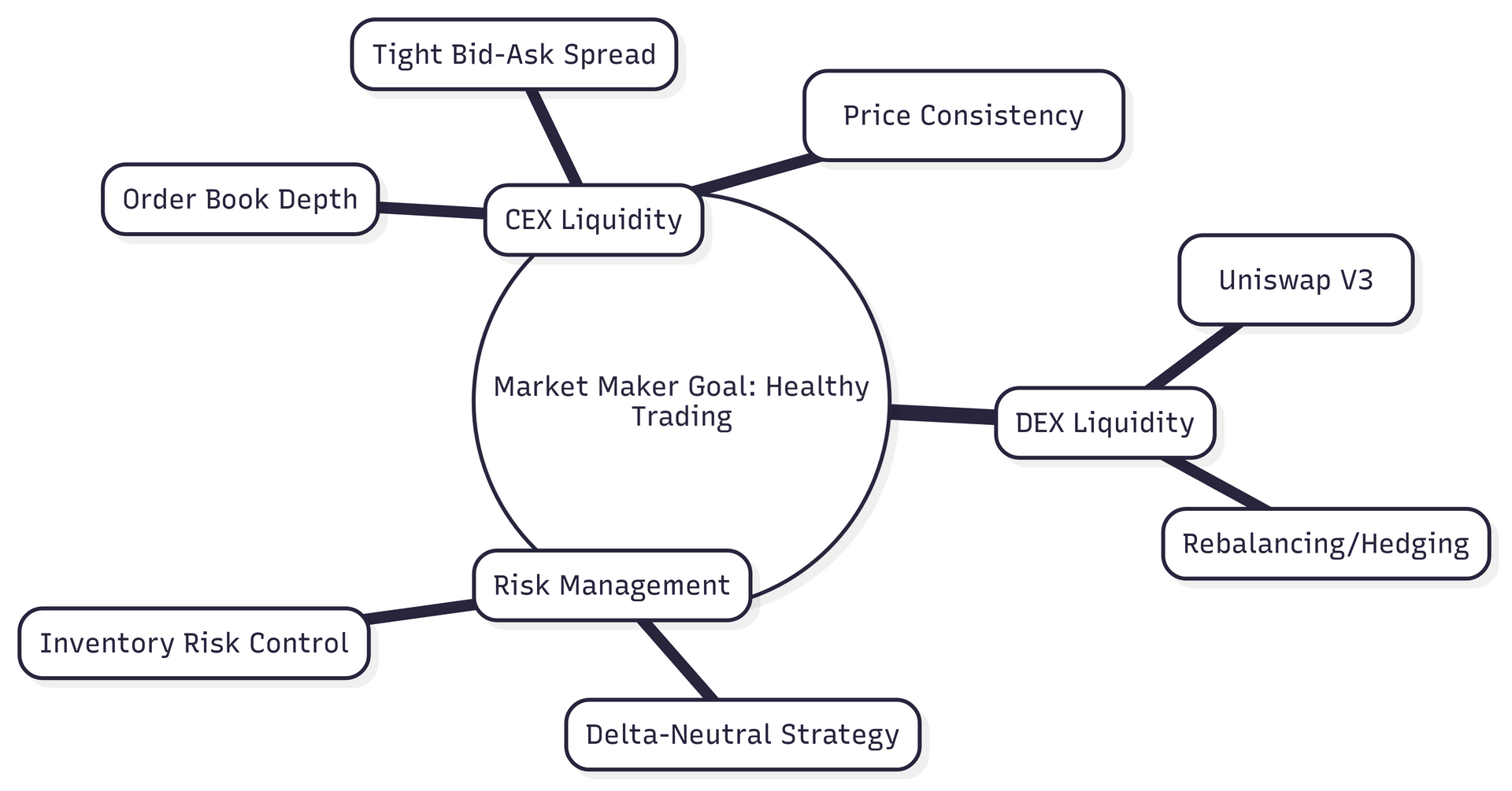
Image: Objective of a market maker for a newly listed token, Source: www.liquidityfinder.com
3) Liquidity Mining and Incentives
Once the initial liquidity is seeded, you need to attract and retain community liquidity providers (LPs). This is where yield farming comes in.
The Mechanism: Projects reward LPs (who deposited Token A + Token B) with extra tokens (often the project's native governance token) on top of the trading fees they already earn.
Goal: To decentralize liquidity and reduce the project's reliance on its own treasury.
Risk: LPs face Impermanent Loss, which happens when the price ratio of the two tokens changes after they are deposited. The loss is 'impermanent' until they withdraw. High mining rewards must offset this risk.
Data Metric: A competitive farming Annual Percentage Rate (APR) usually starts above 50% in the first few weeks, tapering down over time as the token establishes stability.
Part 4: Post-Listing Maintenance — Sustaining the Market
The listing day is not the finish line; it’s the start of the race. Continuous effort is needed to maintain trading health.
1) Price Consistency (Arbitrage)
It is common for the price of your token to differ between exchanges (e.g., $1.00 on Uniswap and $0.98 on KuCoin). This difference is usually fixed quickly by arbitrage traders.
Arbitrageurs: They buy low on one exchange and sell high on another, pocketing the difference.
Importance: This activity is essential because it keeps the price consistent across all venues. If the prices diverge wildly, it confuses traders and breaks trust. Professional market makers handle this automatically.
2) Transparency and Investor Relations
After the listing buzz fades, projects must maintain confidence through honest communication.
Burn and Lock Proofs: Publicly share the transaction hashes that prove your team's LP tokens are locked (and for how long) and that tokens are being burned (if applicable). Use tools like Team.Finance or Unicrypt for locking.
Quarterly Reports: Provide updates on development, treasury spending, and roadmap achievements, even when the market is down.
Entity Spotlight: Team.Finance (or Pinksale)
Description: A common DeFi platform used by projects to lock liquidity pool (LP) tokens and team tokens, providing verifiable proof that the assets cannot be dumped prematurely.
Main Features: Liquidity locking, token vesting, audit badges.
Pros: Essential for establishing trust post-launch; easy to use interface.
Cons: Requires users to pay a fee to lock assets.
URL: https://www.team.finance/
3) Creating Real Utility (Beyond Trading)
The best way to sustain liquidity is to create genuine, non-speculative demand for the token.
• Staking and Governance: Allow holders to stake the token to earn rewards or vote on project proposals. This removes tokens from the circulating supply, reducing sell pressure.
• Product Access: Make the token required to access premium features, APIs, or services within your ecosystem. This generates constant, organic buying pressure.
• Burning Mechanisms: Integrate a mechanism where a portion of transaction fees or service revenue is used to buy back and destroy tokens. This makes the remaining tokens scarcer.
The Liquidity Generation Cycle
Liquidity generation is a repeating cycle, not a one-time event. You must keep all these systems running.
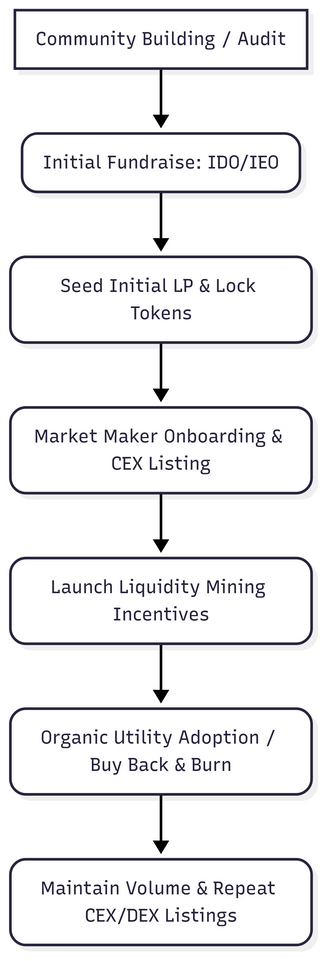
Image: Liquidity generation cycle of a token, Source: www.liquidityfinder.com
Conclusion
Listing a token successfully is about planning, credibility, and sustained effort. It's easy to get distracted by hype, but the market rewards preparation.
Start small, often on a platform like Uniswap or PancakeSwap, focusing on verifiable security and transparency. Use that initial success to attract a reputable market maker and then aim for a Tier-2 or Tier-1 CEX.
Remember, listing costs hundreds of thousands of dollars and often takes months. Be honest about your product's readiness and always prioritize investor security. That's what builds long-term success.
Author
 | Navneet Giri - Navneet is a professional quantitative trader with extensive experience in derivatives trading across major global exchanges and financial markets, including cryptocurrencies. | He employs market-making strategies and participates in liquidity enhancement programs to achieve optimal trading results. |
FAQs: Crypto Listings, Launchpads & Liquidity
What is a crypto exchange listing?+A crypto exchange listing is the process of getting a token approved and made available for trading on a cryptocurrency exchange (CEX or DEX). For centralized exchanges, this typically involves due diligence on the project, the team, tokenomics, security, compliance, and liquidity readiness. For decentralized exchanges, listing is usually permissionless, but serious projects still need strong liquidity planning, audited smart contracts, and a clear go-to-market strategy.
What’s the difference between an IDO and an IEO?+An IDO (Initial DEX Offering) is typically run via a decentralized launchpad and leads into trading on a DEX, with funding often used to seed liquidity pools. An IEO (Initial Exchange Offering) is hosted by a centralized exchange, where the exchange typically handles KYC, fundraising mechanics, and then lists the token shortly after. IDOs can be faster and more open; IEOs can deliver wider exposure but usually come with tougher vetting and higher costs.
How much does it cost to list a token on a CEX?+Costs vary widely by exchange tier, region, and the project’s traction. Many listings involve not just a listing fee but also a security deposit, a market making commitment, and marketing spend. Some exchanges structure costs as a mix of upfront fees plus performance-based commitments (like liquidity targets or trading activity). In practice, budgeting for liquidity provisioning and market making can matter as much as the nominal “listing fee.”
Why do exchanges require market makers and liquidity commitments?+Exchanges want orderly markets: tight spreads, consistent depth, and enough liquidity to handle volatility without extreme slippage. Market makers help provide two-sided quotes (bids and offers) across price levels, improving the trading experience and supporting healthier price discovery. Without adequate liquidity, new listings can become unstable, discouraging users and creating reputational risk for both the project and the exchange.
What does a crypto market maker actually do?+A crypto market maker typically provides continuous buy and sell quotes across one or more venues (CEXs, DEXs, or both), aiming to maintain spreads and depth while managing inventory risk. They may support launches by stabilizing early trading, helping meet exchange liquidity requirements, and reducing slippage. Many also advise on listing strategy, exchange sequencing, and liquidity allocation across pairs and venues.
Do I need a smart contract audit before listing?+For most credible listings, a smart contract audit is either required or strongly expected. Audits help identify vulnerabilities, misconfigurations, and exploit paths that could put users and liquidity at risk. Even on DEX launches where listing is permissionless, an audit improves credibility with communities, launchpads, and exchanges — and it’s a basic risk-control step before meaningful liquidity is deployed.
How long does it take to get listed on an exchange?+Timelines depend on the exchange’s process, the project’s readiness, and the complexity of legal/compliance review. Some DEX listings can happen quickly once liquidity is prepared, but structured launches (IDO/IEO) add scheduling, marketing windows, and technical checks. For centralized exchanges, timelines can stretch if the exchange requires additional documentation, security reviews, KYC/verification of team members, or liquidity planning.
What are the biggest mistakes projects make when pursuing listings?+The most common mistakes are underestimating liquidity requirements, overpaying for marketing without ensuring market depth, and launching without robust security and compliance preparation. Another frequent issue is poor sequencing—trying to jump straight to a top-tier exchange without the metrics, community strength, or infrastructure to support it. A disciplined approach usually prioritizes audits, realistic liquidity planning, strong communications, and a clear strategy for sustaining volume after the initial launch spike.
Share this article

Comments
Most Recent
Find The Right Partners for
Your Trading Business
Sign up and join over 5,000 professional members who receive personalized news alerts, curated professional connections, and more for free!
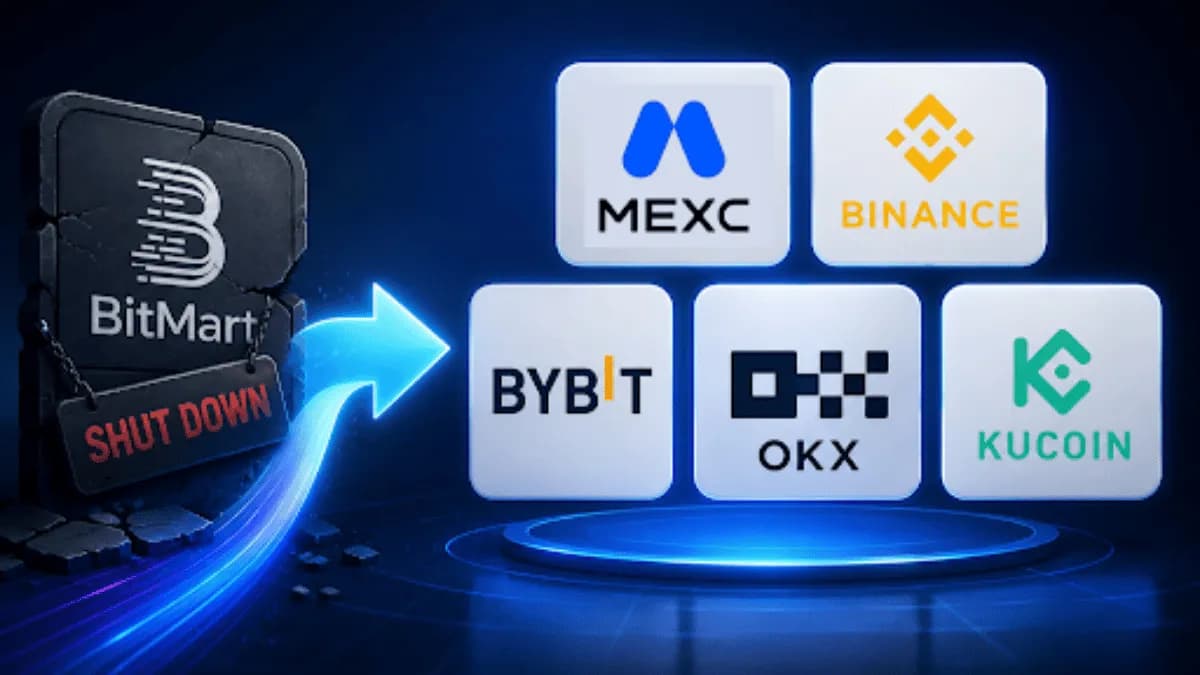
BitMart announced on July 26, 2026 that it is winding down its trading platform: new registrations and deposits stopped immediately, spot and futures trading ends August 26, 2026, and operations fully close by January 31, 2027. Anyone still holding funds on BitMart needs a reliable replacement exchange immediately.
A new stablecoin backed by 140+ firms, from Visa to BlackRock. Can Open USD challenge USDT and USDC, and will it clear MiCA? Olaf Ransome weighs in.

Discover whether KuCoin is still “The People’s Exchange” in 2026. This in-depth KuCoin review breaks down fees, KYC, security, Proof of Reserves, supported coins, deposits/withdrawals, futures, margin, Earn and the platform’s standout free trading bots — plus who it’s best for (and who should avoid it).
Gas fees can be the most confusing part of using Ethereum and other blockchains. This guide explains what gas fees are, why they exist, how costs are calculated (including EIP-1559’s base fee and priority tip), and the key factors that drive price spikes. You’ll also learn practical ways to reduce fees using gas trackers, smarter timing, batching, and Layer 2 networks like Arbitrum, Optimism, Polygon and zkSync.
This guide covers how proof-of-stake works, the best assets to stake, liquid staking protocols, and the risks you need to understand before committing funds.

S&P Global Ratings gave Tether (USDT) the weakest Stablecoin Stability Assessment. Olaf Ransome breaks down what drives stablecoin risk—asset backing, custody/correspondent chains, transparency and reporting.
Decentralized exchanges (DEXs) allow peer-to-peer trading without intermediaries. This guide covers how AMMs work, how to connect a wallet, understand liquidity pools, manage slippage, and trade safely across Ethereum, BNB Chain, and Solana.

Gold-i CEO Tom Higgins explains why most crypto exchanges are still retail-first and what must change to win institutional flow — including FIX support, independent custody, predictable liquidity, and pricing models that reward aggregator-driven volume.
Create Your FREE Account
Get access to latest news, updates, real-time data, brokerage and trading firm insights and customized information feeds.


OANDA Japan has restricted trading on accounts that may have been affected by unauthorised access after login details stored on GMO's Onamae.com Desktop Cloud VPS leaked. The broker says its core systems were not breached and is directing affected clients to GMO's compensation process while urging password changes and 2FA.

Alpaca has received in-principle approval from ADGM's FSRA for Alpaca Clearing & Custody ME Ltd. Subject to a Financial Services Permission, the entity plans to offer brokerage services and virtual asset custody, bringing Alpaca's API-driven brokerage infrastructure closer to partners in the Middle East region.


US stock futures edged higher in early trading today as investors prepared for a week of major central bank decisions. S&P 500 futures rose 0.2%, Dow futures gained 0.3%, and Nasdaq-100 futures advanced 0.3%, following Friday’s selloff.

Brent crude is trading at $115.57 after retreating from its recent high of $118.23. The moving averages indicate a mixed short term picture.


iSAM Securities Apex is working with LMAX Group to bring perpetual futures pricing to FX and CFD brokers through the Apex platform.

ICM MENA has promoted Ahmed Kamal to Chief Executive Officer. Kamal joined the firm in March 2019 as Business Development Manager and most recently served as Regional Manager. He brings more than a decade of experience in financial markets, with expertise in foreign exchange, business development and team leadership.

Theorem has integrated Symbiotic’s Liquid Lane RFQ network, letting holders of tokenised real-world assets trade against on-chain pool liquidity and market-maker quotes. The integration is live on Ethereum, with Midas’s yield-bearing mHYPER fund as the first supported asset. Holders can trade for the USDC stablecoin.

US equities were volatile with technology selloff erasing much of the earlier rebound.

FM Summit London 2026 returns to Old Billingsgate on 24 November for its 15th edition, with LMAX Group, Plus500 and oneZero among confirmed exhibitors. The one-day event adds Business Connect meetings and roundtables, and opens with a networking evening at The Folly on 23 November.

Finance Magnates Summit London returns to Old Billingsgate on 24 November 2026 for its 15th edition. The one-day event brings together brokers, liquidity providers, institutional firms, trading technology vendors, payments businesses and digital asset firms.
Feed