
Search Companies, News, Members & more
Terms of ServicePrivacy PolicySecurity PolicyLegal InformationCommunity GuidelinesSitemapsCookie Settings
2026 Copyright © Liquidity Finder Ltd. All rights reserved.
Liquidity Finder Ltd is incorporated in England and Wales, company number 10610740, registered address 167-169 Great Portland Street, Fifth Floor, London W1W 5PF, United Kingdom.


Payments & Digital Assets
What does Klarna see in Stablecoins? New meaning for BNPL
My summary view is that the motivation is not a case of Buy Now, Pay Later — rather it is Build Now, Profit Later.
 Olaf Ransome
Founder, 3C Advisory | Published on LiquidityFinder
The big retail payments player is dipping its toes into the stablecoin waters. They have announced a partnership with Coinbase: not big news. They are raising funding denominated in stablecoins: bigger news. And, they are creating their own stablecoin, bigger news as well.
When big players start to do interesting new things, it is time to dig in. In this article, Olaf shares some views on the "why bother" — and why this might be of interest to other treasuries.
What is Klarna up to?
First, Klarna announced a partnership with Stripe to create KlarnaUSD. Then came the partnership with Coinbase to accept stablecoins and to raise funding in stablecoins.
What difference might this make?
In card transactions, merchants do not get paid immediately and they are paid net of interchange fees — hugely variable, but easily 2 to 3%, with the usual hassle of weekends and holidays in between. When consumers elect to buy things using Klarna's Visa card, with or without the BNPL option, Klarna has to pay the merchants. So it needs working capital. Sometimes it will raise this funding at short notice. The better aligned Klarna's treasury is with the means of payment which institutional investors want to use, the easier and cheaper sourcing that funding becomes.
If Klarna has stablecoin funding on tap, it can encourage merchants to accept payment in stablecoin — either KlarnaUSD or another one. The attraction is instant payment: the whole 24/7 "always on" promise that on-chain digital assets bring.
For Klarna's CFO, holding long balances in stablecoins is generally less risky than holding long cash positions with a bank. A regulated stablecoin has broadly the same risk characteristics as a money market fund — secured and, as a securities-like holding, remote from any bankruptcy proceedings.
And, in general, correspondent banks do not really like their clients holding big, long cash balances. As an alternative, stablecoins are even more instantly available than cash at a bank.
The wallet-to-wallet play: If merchants are willing to accept a stablecoin for instant payment, Klarna could orchestrate a wallet-to-wallet transfer — eliminating interchange fees entirely. "Accept KlarnaUSD and you can have your money instantly" versus "accept stablecoins generally and we will credit you next business day."
On top of this could come additional incentives: a free custody service, discounted fees versus card interchange. Klarna earns on KlarnaUSD and merchants are happy to deal with them.
Agentic AI and programmable payments
"Agentic AI" is a term you may have heard. In simple terms: a machine will do something for you — and that something could involve a payment. For a consumer, this might be: "Buy tickets for a Rolling Stones concert in London as soon as you see an email in my inbox or a post on Ticketmaster." For a business: "Buy me cacao at $80 or better if you see it on offer from suppliers A, B or C." That is the "programmability" we have heard about. Stablecoins are a natural mechanism for those payments.
The next effect on the flywheel is a first derivative: the merchants' suppliers. In many niches today, businesses are already willing to do business in stablecoins — even USDT Tether — because their clients will pay in USDT or USDC and suppliers will accept the same. We could of course philosophise about some of those risks (for more, see Olaf's earlier article: Stablecoins and the "Pint Test": What S&P's USDT Rating Tells Us). Klarna is now offering an alternative.
Klarna's stated focus is on consumers — "to reimagine how consumers spend and save in their daily lives." The introduction of stablecoins extends that scope considerably, or perhaps rewrites the mission statement altogether: how we spend and save in our daily lives.
Just maybe, clients themselves can become a source of funding. Whilst there is a debate about whether stablecoin issuers may pay interest to holders, there would be no debate about Klarna paying a retail or corporate client to borrow those stablecoins.
In summary
My overall view of what Klarna is doing here is a variant on the standard meaning of BNPL: Build Now, Profit Later.
Building the infrastructure to operate financial services is never quick. In TradFi, adding a new correspondent banking relationship is almost invariably a marathon, not a sprint. Klarna's direction of travel might be described as: "New means of payment are evolving. We need to be able to use them, whether a lot or a little happens. And, just maybe, we might be able to drive something to happen."
"Preparing when you can and not when you have to is always a good strategy in financial services."
Olaf Ransome
Founder, 3C Advisory
Whilst your business is not the same as Klarna's, the thoughts here are intended to trigger your own thinking on what to do next.
With all things bleeding edge in financial services, there is every risk that some points have been missed or some conclusions are implausible. If so, please call it out — and do share a comment or two.
Please feel free to get in contact via LiquidityFinder here.
 Olaf Ransome
Olaf is a liquidity and financial services expert and the founder of 3C Advisory. You can message Olaf directly here.
Found this interesting? Become a member of LiquidityFinder and get daily industry news direct to your inbox — join here.
Share this article

Comments
Most Recent
Find The Right Partners for
Your Trading Business
Sign up and join over 5,000 professional members who receive personalized news alerts, curated professional connections, and more for free!

Scope Prime's Andrew Taylor sets out how brokers serving Asian clients should measure and price sharp gold flow, citing the October 2025 and January 2026 sell-offs, thin liquidity at the Asian open, segmentation over relationship-wide repricing and the questions to ask a prime of prime provider.

Scope Prime's Andrew Taylor sets out how brokers serving Asian clients should measure and price sharp gold flow, citing the October 2025 and January 2026 sell-offs, thin liquidity at the Asian open, segmentation over relationship-wide repricing and the questions to ask a prime of prime provider.

GCC Brokers is a Dubai-based A-Book STP broker with FSC Mauritius and UAE SCA regulation, raw spreads from 0.0 pips, and an LBMA gold fix service. Here is an honest assessment of who it suits and who it does not.
A new stablecoin backed by 140+ firms, from Visa to BlackRock. Can Open USD challenge USDT and USDC, and will it clear MiCA? Olaf Ransome weighs in.

Dark pool trading was once the preserve of institutional desks, but a new wave of AI tools is promising self-directed investors a look into non-displayed liquidity and where the big money sits. This article explains what dark pools actually are, why retail traders face an even bigger information gap in FX than in equities, and what AI-driven intelligence platforms like IUX24 can and cannot reveal about institutional positioning.
SoFi's SoFiUSD is the first stablecoin issued by a US national bank. But do holders actually have the protection they think?

As tokenisation and digital assets move from niche curiosity to mainstream expectation, banks and financial institutions face an uncomfortable truth: their legacy core banking systems were never built for this. From order execution and pre-funding to custody, portfolio management and gas fees, Olaf Ransome explores the key infrastructure challenges FIs must navigate and asks whether to re-use, buy or build their way to a solution that actually scales.

LSEG's DiSH promises atomic settlement and 24/7 PvP and DvP capability using tokenised commercial bank deposits. But when the balances move and the banks don't, who actually owns what? Olaf Ransome examines the mechanics - and the risks.
Create Your FREE Account
Get access to latest news, updates, real-time data, brokerage and trading firm insights and customized information feeds.


Running a venue around the clock is the easy part. Pricing risk when the market underneath it is shut is not. Lars Holst, CEO of GCEX explains how to manage risk in 24/7 markets.

ATFX has released its Q4 2026 Trader Magazine, offering a closer look at the macroeconomic and market forces that could shape trading conditions in the final quarter of the year.


LSEG has announced a collaboration with NVIDIA that lets financial institutions analyse years of LSEG Tick History data in seconds using NVIDIA cuDF on GPUs, without creating another full copy of the dataset. Tick History holds 110 trillion rows across 100 million instruments and more than 580 venues and contributors.

Standard Chartered has launched a cryptocurrency trading solution letting eligible affluent clients buy and sell Bitcoin and Ether through existing bank accounts. Built with Zodia Markets and regulated by VARA, it launches first for Professional Investor clients in the UAE, with other markets to follow over time.


WTI crude oil breaks above daily resistance after rejecting weekly support. Explore key price levels, breakout confirmation, and the potential 100.305 target.

IG Prime has confirmed Investec Prime Services as a new partner for its institutional white label solution, giving institutional clients in South Africa access to IG’s multi-asset global trading platform under the Investec Prime Services brand. The offering spans equities, indices, FX, commodities and fixed income.


PLUGIT announcing a new YOONIT UX/UI experience coming across all six modules.


The AI conversation in brokerage risk management is mostly led by vendors. Here is what a dealing desk actually needs to know — before signing anything.

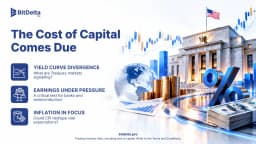
The cost of capital is becoming a defining force in global markets. But are investors pricing in the full impact? With the Fed's policy outlook under scrutiny, major bank and semiconductor earnings approaching, and key inflation data on the horizon, markets face a critical week. In this week's BitDelta Pro Weekly Outlook, we explore the signals shaping market expectations and the factors that could challenge the prevailing narrative.

September's US inflation report could be a defining moment for the Federal Reserve's next interest rate decision. With headline inflation expected to accelerate while core inflation remains steady, the growing divergence raises an important question: Is inflation pressure becoming more widespread, or is energy driving the narrative? Ahead of the October 14 CPI release, BitDelta Pro Research examines the forces shaping inflation expectations, the signals policymakers may prioritise, and what the data could mean for the Fed's next move.
Feed