just now

Liquidity Finder Ltd is incorporated in England and Wales, company number 10610740, registered address 167-169 Great Portland Street, Fifth Floor, London W1W 5PF, United Kingdom.
Published: just now
Key Highlights
Here is the part many traders overlook: a perpetual swap does not expire. That sounds simple, but it creates an important problem. Without some mechanism to pull its price back towards the underlying spot market, a perpetual could trade at a persistent premium or discount.
That mechanism is funding.
And funding rates are not fixed. They move, sometimes slowly and sometimes sharply. When they do, they can tell traders something useful about what is happening beneath the headline price, particularly around positioning, demand and market imbalance.
So, why do funding rates change in crypto perpetual swaps? Let's break it down.
What Is A Funding Rate In Crypto?
A funding rate is a periodic payment exchanged between traders holding long and short positions in a perpetual futures contract. The important distinction is that the payment is generally exchanged between traders. It is not simply a trading fee charged by the exchange.
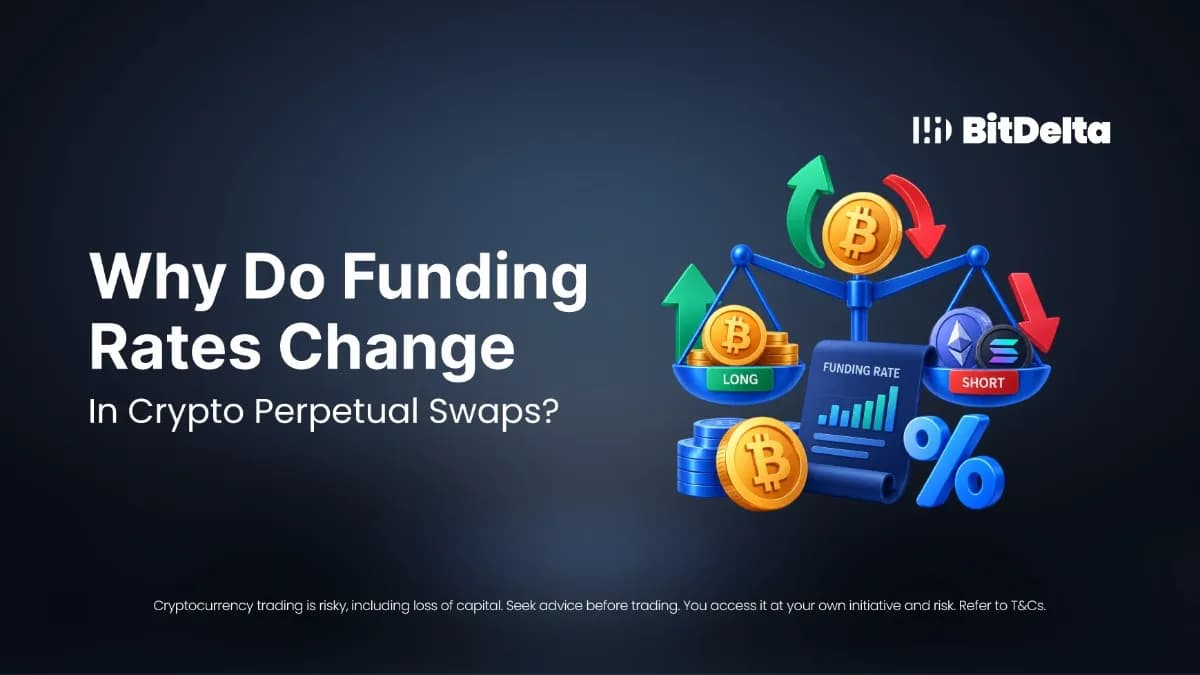
Think of it as a balancing mechanism. When the perpetual contract is trading above the spot price, demand for long positions may be stronger. The funding rate can turn positive, meaning long traders pay short traders. When the perpetual trades below the spot price, the opposite can happen, with the funding rate becoming negative and short traders paying long traders.
The exact calculation and funding interval depend on the trading platform and contract, but the basic idea is straightforward: funding encourages the perpetual contract to stay close to the spot market.
And that matters because traders can hold perpetual positions indefinitely.
Why Do Perpetual Contracts Need Funding?
Imagine Bitcoin is trading at $65,000 in the spot market, while its perpetual contract is trading at $65,500. That is a $500 difference.
If traders are willing to keep paying more for the perpetual, the gap could remain. Funding creates an economic incentive for traders to take the other side of that imbalance.
If funding becomes positive, long traders pay shorts. That additional cost can make some traders reconsider their positions, while receiving funding can make the short side more attractive. Over time, these incentives can help bring the perpetual price closer to the spot market.
That is the basic logic. It is not complicated, but it is extremely important.
How Does Crypto Funding Actually Work?
There are two broad scenarios: positive funding and negative funding. The direction of the rate determines which side of the market generally makes the payment.
Positive Funding
Positive funding usually occurs when the perpetual contract trades at a premium to the spot price and demand for long positions is stronger. In this situation, longs pay shorts.
For example, suppose:
A trader holding a $100,000 long position would pay approximately $10 per funding interval, assuming the quoted rate applies directly to the position value.
That sounds small, but stretch it across multiple funding periods and the cost starts to matter.
Negative Funding
Negative funding is the reverse. When the perpetual trades below the spot market and short positioning becomes more dominant, funding can become negative. In that case, shorts pay longs.
For traders holding positions for longer periods, funding can therefore become an important part of the overall trading cost or income. Price movement gets most of the attention, but funding often sits quietly underneath it.
Why Do Funding Rates Change?
This is where things get interesting.
Funding rates are constantly responding to the relationship between the perpetual market and the spot market, as well as changes in trader positioning, liquidity and demand. Several factors can push funding higher or lower.
1. Market Demand And Trader Positioning
When more traders want to hold long positions, demand for perpetual contracts can increase. That can push the perpetual price above the spot price, causing funding to become increasingly positive.
The reverse can happen when short demand becomes dominant. More shorts can create more downward pressure on the perpetual, potentially pushing funding into negative territory.
This is why funding rates are often used as a window into market positioning. But do not confuse the signal with a prediction. Positive funding does not automatically mean Bitcoin will rise, just as negative funding does not automatically mean Bitcoin will fall.
It tells you something about positioning and the cost of maintaining that positioning. There is a difference.
2. The Gap Between Spot And Perpetual Prices
The relationship between spot and perpetual prices is central to funding. If the perpetual is trading significantly above spot, the funding mechanism has a reason to incentivise traders to reduce that imbalance. Likewise, if the perpetual falls below spot, funding can shift in the other direction.
Consider a simple example.
Bitcoin spot: $65,000
Bitcoin perpetual: $66,000
The perpetual is trading at a $1,000 premium. If that premium persists, funding can increase and make long positions more expensive to maintain.
Now imagine the perpetual falls to $65,100. The gap is much smaller, so the pressure behind the funding mechanism can also change.
Small price differences matter. Large ones matter more.
3. Market Sentiment
Funding can also reflect how traders are feeling about the market. When traders become increasingly optimistic and aggressively build long positions, funding can move higher. When fear takes over and short positions become more dominant, funding can move lower or negative.
This is one reason platforms and market-data providers such as CryptoQuant use funding rates as one of several indicators for understanding market sentiment.
But sentiment is messy. A market can remain optimistic longer than expected, a heavily shorted market can continue falling, and a high funding rate can persist without an immediate reversal.
Funding is information, not a crystal ball.
4. Liquidity And Leverage
Liquidity matters because it affects how easily large positions can be opened or closed without significantly moving the market. In a highly liquid market, large amounts of buying and selling can often be absorbed more efficiently.
In thinner conditions, however, aggressive positioning can have a greater impact on perpetual prices.
Leverage can amplify this effect. A trader does not need $100,000 in capital to control a $100,000 position when leverage is involved, which means relatively modest capital flows can create much larger exposure in the derivatives market.
And when positioning becomes crowded, funding can move quickly. This is where traders need to pay attention, not just to the rate itself, but to why it is moving.
5. Arbitrage Activity
Professional traders and arbitrageurs also play an important role.
Suppose the perpetual trades at a significant premium to spot while funding becomes expensive for longs. A trader may look for ways to capture that difference by taking opposing positions across the spot and derivatives markets.
If enough traders pursue similar opportunities, the price difference can narrow. This is one reason extreme funding conditions do not necessarily last forever.
Research from BitMEX has highlighted how funding rates tend to cluster around relatively small positive levels, while extreme movements can sometimes be short-lived as market participants respond to the opportunity.
The market adjusts as traders respond to these differences, and eventually the imbalance gets tested as arbitrageurs and other market participants look for opportunities.
What Does A High Funding Rate Mean?
A high positive funding rate generally means that long positioning is strong enough for longs to pay a meaningful amount to shorts. That can happen during periods of strong bullish demand, but it can also happen when leverage and speculation become crowded.
Those are not necessarily the same thing.
A rising funding rate alongside rising prices may suggest increasingly aggressive long positioning. But if funding becomes extremely elevated, the cost of holding those positions can also rise.
That creates an important question: How much of the current positioning can the market actually sustain?
You do not need to predict the next move to ask that question.
What Does Negative Funding Mean?
Negative funding generally indicates that short positioning has become stronger relative to longs, with short traders paying long traders.
Again, the signal needs context. Negative funding can appear during a genuine bearish trend, but it can also appear after a sharp sell-off when traders become heavily positioned for further downside.
If price stabilises while short positioning remains crowded, the market can become vulnerable to a short squeeze. A short squeeze happens when short traders are forced to close positions, often by buying the underlying asset or contract back, and that buying can push prices higher.
But funding alone cannot tell you whether that will happen.
Context matters.
A Simple Funding Rate Example
Let's make the maths painfully simple.
You hold a perpetual position worth $100,000, and the funding rate is 0.01%.
Your funding payment would be approximately:
$100,000 × 0.01% = $10
One payment is not dramatic. But suppose you continue holding the position through multiple funding intervals while the rate remains elevated. The cumulative cost grows.
This is especially relevant for leveraged traders because the notional value of a position can be much larger than the trader's actual capital. A small percentage can therefore become a meaningful expense.
You'd better be sure you understand the funding schedule before treating it as a negligible number.
Why Funding Rates Matter To Crypto Traders
Funding rates are useful because they add another layer of information beyond price.
Price tells you what the market is doing. Funding can provide clues about how traders are positioned while it happens.
That distinction matters.
Crowded Long Positions
If prices are rising while funding becomes increasingly positive, traders may be aggressively positioned on the long side. That does not automatically mean the trend is about to reverse.
It does mean the cost of maintaining those positions is increasing.
Crowded Short Positions
If prices are falling while funding becomes deeply negative, short positioning may be increasingly concentrated. Again, that is not a guaranteed reversal signal, but it can help traders understand the structure behind the move.
Trading Costs
Funding directly affects the cost of holding perpetual positions. For short-term traders, the impact may be limited. For traders holding leveraged positions for days or weeks, it can become much more relevant.
Market Sentiment
Funding can act as one indicator of market sentiment because it reflects the relative demand for long and short exposure. Used alongside price, volume and other market data, it can provide a more complete picture.
Funding Rates Are Not A Buy Or Sell Signal
This distinction deserves its own section.
A positive funding rate does not mean buy Bitcoin. A negative funding rate does not mean short Bitcoin.
It is not that simple.
Funding tells you about the economics of perpetual positions and the balance between long and short demand. A trader can use that information to understand market conditions, but the rate itself does not predict where price will go next.
Think of it as another instrument on the dashboard. You would not drive by looking only at the speedometer, and the same principle applies here.
Funding Rates And Open Interest
Funding becomes even more useful when viewed alongside open interest.
Open interest refers to the total value of outstanding derivatives positions that have not yet been closed. If funding rises while open interest also rises, it can indicate that more leveraged positions are entering the market alongside increasingly expensive long exposure.
If funding falls while open interest changes significantly, the underlying positioning may also be shifting.
Neither combination guarantees a specific price outcome, but together they can tell a more detailed story than price alone.
That is the point.
Why Funding Rates Can Change So Quickly
Crypto markets operate around the clock, with no traditional market close. Positioning can change at any hour, liquidity can shift quickly, and large moves in the underlying asset can create sudden changes in demand for leveraged exposure.
As a result, funding can change rapidly when market conditions change.
A major Bitcoin move, a sudden liquidation event, a wave of new leverage or a sharp change in sentiment can all alter the balance between long and short positions. And when that balance changes, funding can respond.
What Should Traders Watch?
Do not watch the funding rate in isolation. Instead, look at the relationship between several things:
For example, rising prices with modest funding may tell a different story from rising prices accompanied by extremely high funding and rapidly increasing open interest.
Same direction. Very different market structure.
That is where funding becomes useful.
The Bigger Picture
Funding rates are a small part of crypto derivatives trading, but they reveal something important about how these markets actually function.
Perpetual contracts need a mechanism to stay connected to the underlying spot market, and funding provides that mechanism. When long demand becomes stronger, funding can turn positive and longs may pay shorts. When short demand dominates, funding can become negative and shorts may pay longs.
Simple enough. But the interpretation requires more care.
Funding rates can reflect market sentiment, positioning, leverage, liquidity and arbitrage activity at the same time. A very high rate can signal crowded positioning, while an unusually negative rate can point towards heavy short exposure.
Neither one guarantees what happens next.
For traders using perpetual markets, that is the key takeaway: do not just look at where price is going. Look at what it is costing traders to stay positioned there.

Select the categories and companies you wish to follow directly to your person rss feed.
Create Custom RSS FeedSign up and join over 5,000 professional members who receive personalized news alerts, curated professional connections, and more for free!
US stocks closed higher on Wednesday, with the Nasdaq gaining 1%, the S&P 500 rising 0.6%, and the Dow advancing 0.7%, as renewed enthusiasm for AI-related stocks lifted market sentiment.
SpaceX went public in June as a rocket company. On October 20 it reported as something else entirely: an AI infrastructure business, financed by a satellite broadband network, with a launch division attached. Rockets generated 12% of third quarter revenue and lost money. The AI segment generated 52% of revenue and consumed 84% of capital expenditure. Starlink generated 85% of operating profit.
Standard Chartered has signed definitive agreements to acquire 100% of Zodia Custody UK Limited, folding its regulated digital asset custody business into Securities Services. Zodia Solutions will be set up under SC Ventures with bank investors including Northern Trust, NAB Ventures, Emirates NBD and Investcorp.
Bybit Fintech FZE has secured a Virtual Asset Service Provider licence from Dubai’s Virtual Assets Regulatory Authority for Exchange Services, covering spot trading. Bybit’s Peter Loo said the firm hopes to add derivatives, subject to regulatory approvals. Its international Dubai headquarters opened in 2022.
ATFX Connect has released its Q4 2026 Institutional Edge, examining the geopolitical, monetary policy and fiscal pressures shaping global financial markets in the final quarter of the year.
The Nasdaq 100 is trading at 29,382. After reaching a recent high of 29,957, the index reversed sharply and has been recording a series of lower highs and lower lows.
FM Summit London returns to Old Billingsgate on 24 November 2026 for its 15th edition, with a curated one-day format aimed at senior executives. LMAX Group, Plus500, oneZero and MetaQuotes are among confirmed exhibitors, with Business Connect meetings, roundtables and an opening event at The Folly on 23 November.
GCEX has launched European-style, fiat-settled options on Bitcoin and Ethereum with monthly expiries for eligible professional and institutional clients. The service runs through the GCEX OTC desk, with pricing from Tier 1 liquidity providers and reporting on XplorPortal. GC Exchange Limited is authorised by the UK FCA
Wall Street closed mostly higher on Tuesday, led by a nearly 1% gain in the Dow. In Asia, South Korea’s Kospi rebounded 2.7% and Japan’s Nikkei gained 0.8%.
Brent crude is trading at $111.70. The latest price action show the recovery continuing toward $111.70, suggesting that demand has returned after the sharp correction.