just now


Liquidity Finder Ltd is incorporated in England and Wales, company number 10610740, registered address 167-169 Great Portland Street, Fifth Floor, London W1W 5PF, United Kingdom.
Published: just now

December 19, 2023
Calendar effects tend to create distinct trends in the global financial markets. For instance, the US stock markets are known to rally ahead of long weekends and three-day or longer holidays. The most impactful of them are Independence Day, Thanksgiving, and Christmas.
Sentiment shifts during festive seasons lead to heightened volatility, resulting in attractive opportunities for investors and traders. Here’s a look at the impact of festive seasons and holidays on market sentiment.
Even experienced traders relying completely on technical analysis are superstitious to a certain extent. After all, luck does play a role in success in the financial markets. Many traders believe that the performance of stocks and indices at the beginning of the year determines how they will perform through the rest of the year. “As goes January, so goes the year” is a popular saying among traders, meaning that January sets the tone for the year.
Is there any evidence to prove this? Surprisingly, yes. The S&P 500 climbed around 136 points in January this year and has risen close to 20% year to date. The Nasdaq 100 added 1,239 points in January and had soared around 45% so far this year.
This so-called January Barometer psychology is most evident in the US stock markets. For example, the Chinese New Year begins in February and the stocks markets do not exhibit a correlation between how the markets fared at the beginning of the year and their performance exiting the year.
The stock markets also tend to be volatile in January. This is because institutional investors rebalance their annual portfolios after the fourth-quarter earnings season and several analysts release their projections for various sectors for the new year. This creates a demand push. It also triggers volatility, which attracts more traders and intensifies the demand for certain stocks.
Although July has historically been a slow month for the US stock markets, trading is elevated when Independence Day falls on a Friday or Monday, making it a long weekend. The same goes for Labor Day in September. This is also called the “day of the week phenomenon”. For instance, when Independence Day fell on a Monday in 2011 and 2022, the S&P 500 climbed more than 1% on both occasions.
Whatever the season, the beginning and end of months mark stronger periods for stock trading. Combined with an extended weekend, this brings in traders who focus on exploiting bumps with ultra-short-term trading strategies.
Retail sales get a big boost during the Thanksgiving weekend. With retail brands offering an average of 30% discounts, Black Friday and Cyber Monday (BFCM) has become a weekend of robust revenue growth and spikes in the shares of retail giants. Shares of Walmart, Target, Home Depot, Amazon, and other retailers tend to rally ahead of the Thanksgiving weekend, which is popularly known as the “pre-holiday effect”.
According to Mastercard SpendingPulse, US retail sales on Black Friday in 2023 grew by 2.5% year-over-year across in-store and online channels. Although this represented a slowdown in growth from previous years, share prices in the sector outperformed, as BFCM marks the beginning of the holiday shopping season. In fact, the S&P 500 ended November with gains, after three consecutive months of declines.
Positive sentiment drives US stocks higher during this time of the year. This is popularly known as the Santa Claus Rally. The uptrend in the US equity market typically begins a week before Christmas and continues through the New Year. The climb is usually much steeper than the end-of-month rally.
The last five trading days of the outgoing year and the first two days of the new year typically takes the US stock markets higher by 1%-2%. This phenomenon was first documented in 1972, in a book called “Stock Trader's Almanac” by Yale Hirsch, which observed that the S&P 500 had gained an average of 1.5% during these seven days, from 1950 through 1971. Of course, the Santa Claus rally does not always hold true, but the odds are in its favour, with US stocks gaining in 34 of the last 45 years.
Trading volumes tend to be low and volatility high in the week from Christmas to New Year. This is because institutional investors are on holiday and markets are driven by the actions of retail traders. This could also be the reason for the rally during this period, as retail traders are more tenacious in their bullish sentiment and may invest some of their end-of-year bonuses in the stock market.
Sectors that tend to perform well during the holiday season are online retail, big-box retail, apparel, hospitality, and toys.
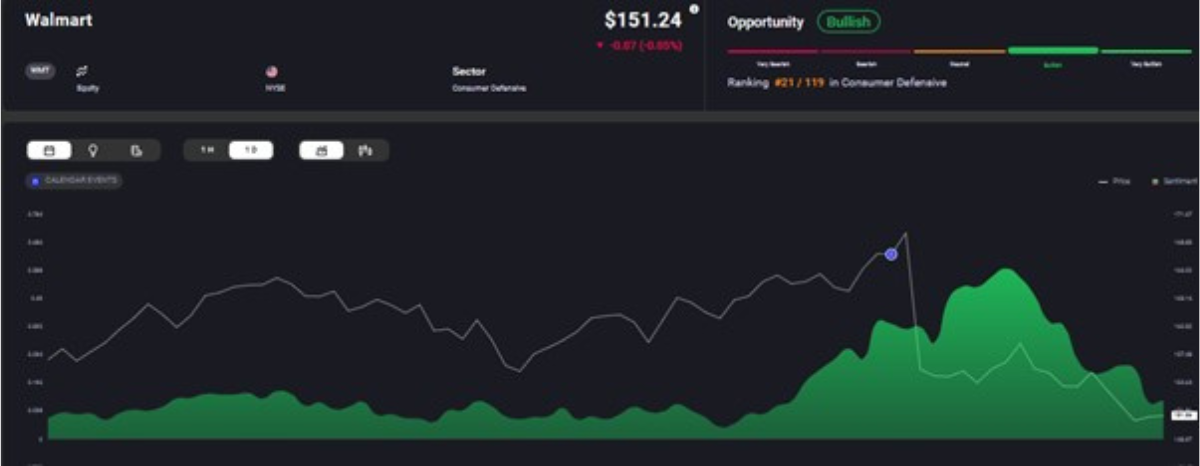
Shares of retail titans Amazon and Walmart tend to perform well during this period. Given that Walmart’s stock has gained only around 5% year to date, versus Amazon’s almost 72% climb, the former seems poised for a steeper rally this season. Acuity’s AssetIQ widget indicates positive market sentiment for Walmart ahead of this year’s holiday season.
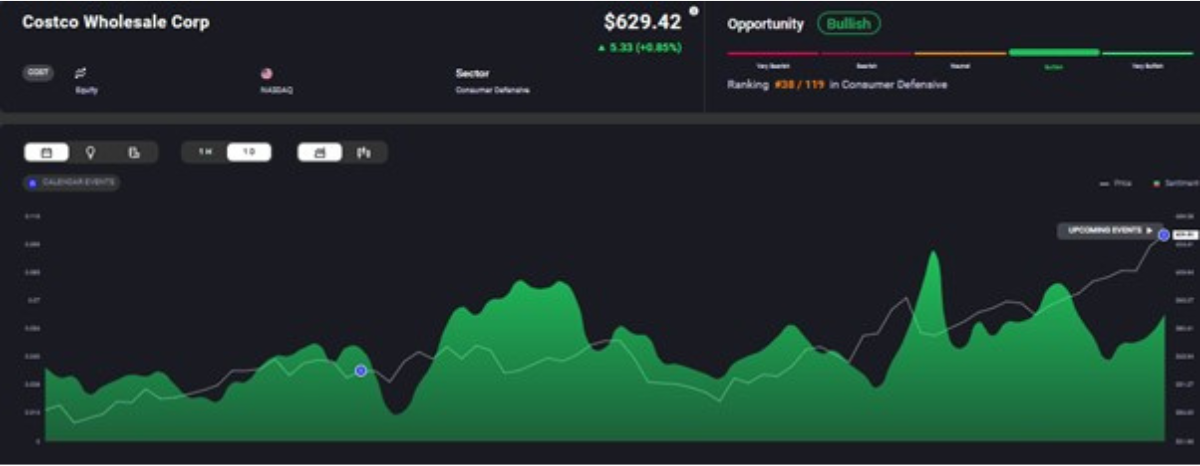
Among the big-box retailers, Costco seems better positioned than Target and Best Buy for stock gains.
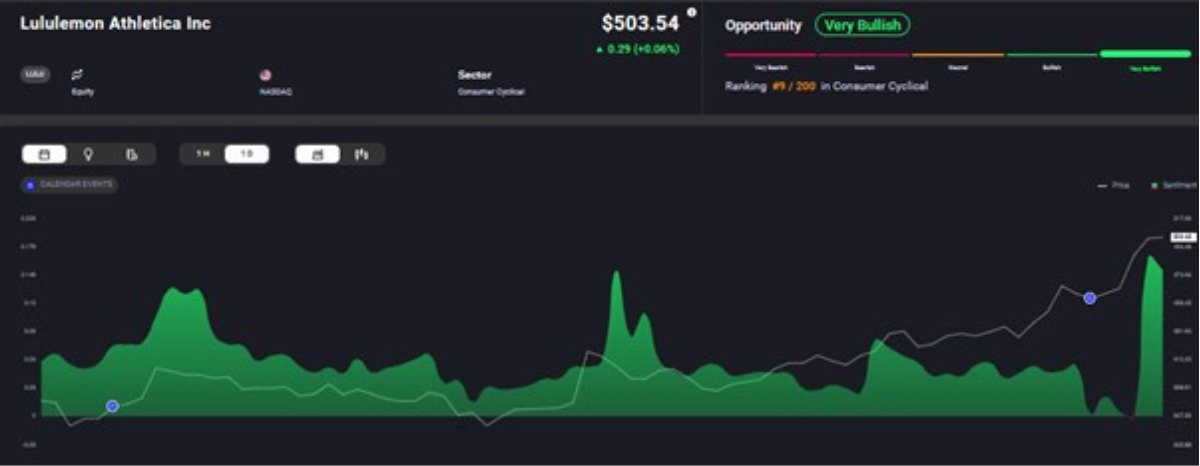
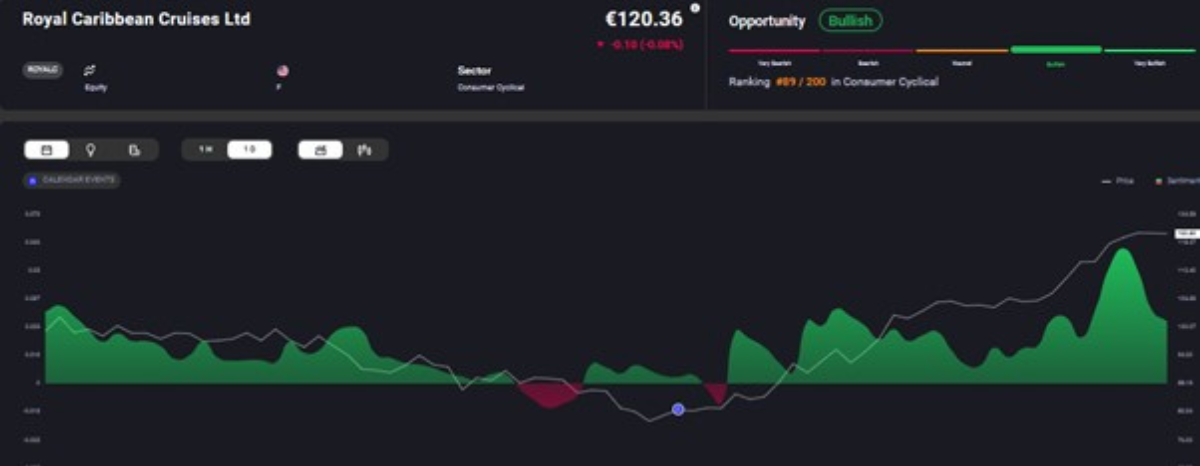
Lululemon Athletica’s stock has already climbed around 20% this month. Despite this, there is still some upside left. Royal Caribbean Cruises should also be in focus, with 2023 earnings growth projection of 182.1%.
Of the two toy majors, Mattel seems in a stronger position than Hasbro to record gains this season. While Hasbro is in the process of divesting its entertainment division, the success of the Barbie movie could lend support to Mattel’s stock.
As we approach Christmas, it’s important to remember that calendar events don’t always play out as one hopes. Markets are driven by a multitude of factors, some of which can drive stocks sharply lower. For instance, the Santa Claus rally did not materialise in 2020, as companies around the globe struggled with supply chain disruptions stemming from the pandemic and the world’s second-largest economy, China, remained in lockdown for an extended period.
Acuity Trading revolutionised the online trading experience for millions of investors with the introduction of visual news and sentiment tools in 2013. Today, Acuity continues to lead the fintech market with alpha generating alternative data and highly engaging trading tools using the latest in AI research and technology. Acuity’s team of academics, scientists, news and market professionals are dedicated to delivering highly effective data products that bring value to investors of all levels and experience. Flexible delivery options include APIs, MT4/5, plug and play widgets and third party automation services.
For further information or to request a demo, please visit www.acuitytrading.com
 | By Andrew Lane | CEO and Founder, Acuity Trading |
For over 10 years our focus has been to revolutionise the trading experience for investors around the world with powerful, alternative data that promotes better understanding of the financial markets.

Select the categories and companies you wish to follow directly to your person rss feed.
Create Custom RSS FeedSign up and join over 5,000 professional members who receive personalized news alerts, curated professional connections, and more for free!
etoro has agreed to acquire LB Finanzas, an Argentine all-in-one financial app covering investing and payments, and plans to make Argentina its regional hub in Latin America. There is no immediate impact for etoro users in Argentina, with future integration planned. Financial terms were not disclosed.
Spotware Systems, the company behind cTrader, has launched cAntifraud, an AI-powered fraud detection solution for FX/CFD brokers and prop firms.
Multi-asset broker and crypto asset service provider PrimeXBT has launched a Model Context Protocol (MCP) integration that lets clients connect AI assistants such as ChatGPT and Claude directly to their trading accounts
The global copy trading platform market is projected to grow at a compound annual growth rate of 17.8% through 2033, driven by the increasing adoption of automated trading technologies and social trading trends.
XS.com has appointed Hanna Le as Regional Business Development Director for Vietnam. She returns to the broker after serving as Country Manager, having previously worked at GTCFX, Radex Markets, Info Finance and Shinhan Bank. She will lead business development and partner relations initiatives in the Vietnamese market.
Prediction market operator Polymarket has received approval from the National Futures Association (NFA) for its affiliate PM Derivatives, LLC to operate as a Futures Commission Merchant (FCM) on a fully collateralised basis.
Within hours of the US Commodity Futures Trading Commission (CFTC) clearing perpetual futures on individual US stocks to trade from today, a trade group backed by exchange operator Cboe Global Markets and market maker Citadel Securities went to court to stop them.
Perpetual futures contracts on individual US equities can begin trading on CFTC-registered exchanges from today, 3 November 2026, after the US Commodity Futures Trading Commission (CFTC) confirmed the contracts had been deemed approved as security futures products.
Dubai-based financial derivatives group MultiBank Group has appointed former Crypto.com executive Mohammed Al Hakim as Vice Chairman of MultiBank Group and CEO of MB.io,
Interbank trading venue MultiBank Exchange, part of Dubai-based financial derivatives group MultiBank Group, has unveiled what it describes as the world’s first interbank trading platform to offer double exotic currency pairs with settlement in both fiat currencies and digital assets.