just now

Liquidity Finder Ltd is incorporated in England and Wales, company number 10610740, registered address 167-169 Great Portland Street, Fifth Floor, London W1W 5PF, United Kingdom.
Published: just now


Fluctuations in borrowing costs have a direct impact on both corporate profitability and broader economic activity.
Higher interest rates make bonds more appealing comparable to equities.
Heavily financed industries, like auto and housing, feel rate changes the most.
Investors using margin debt face higher carrying costs when rates go up.
Tracking financial markets, the direct connection between interest rates and stock prices is impossible to ignore. When the officials worry about the economic status, they often adjust the price charged for credit. This sudden fluctuation heavily influences the overall level of daily economic activity
These wide-ranging economic changes eventually have an effect on the profits of large corporations worldwide. Higher borrowing costs lead to much smaller corporate earnings. Because of these reduced corporate profits, we quickly see lower price multiples across the board.
Stock values drop accordingly.
Officials will lower short-term rates when they want to fix a slowdown. A powerful reverse effect quickly takes hold to stimulate growth, making equities much more appealing to the average buyer once again. Investors start buying again.
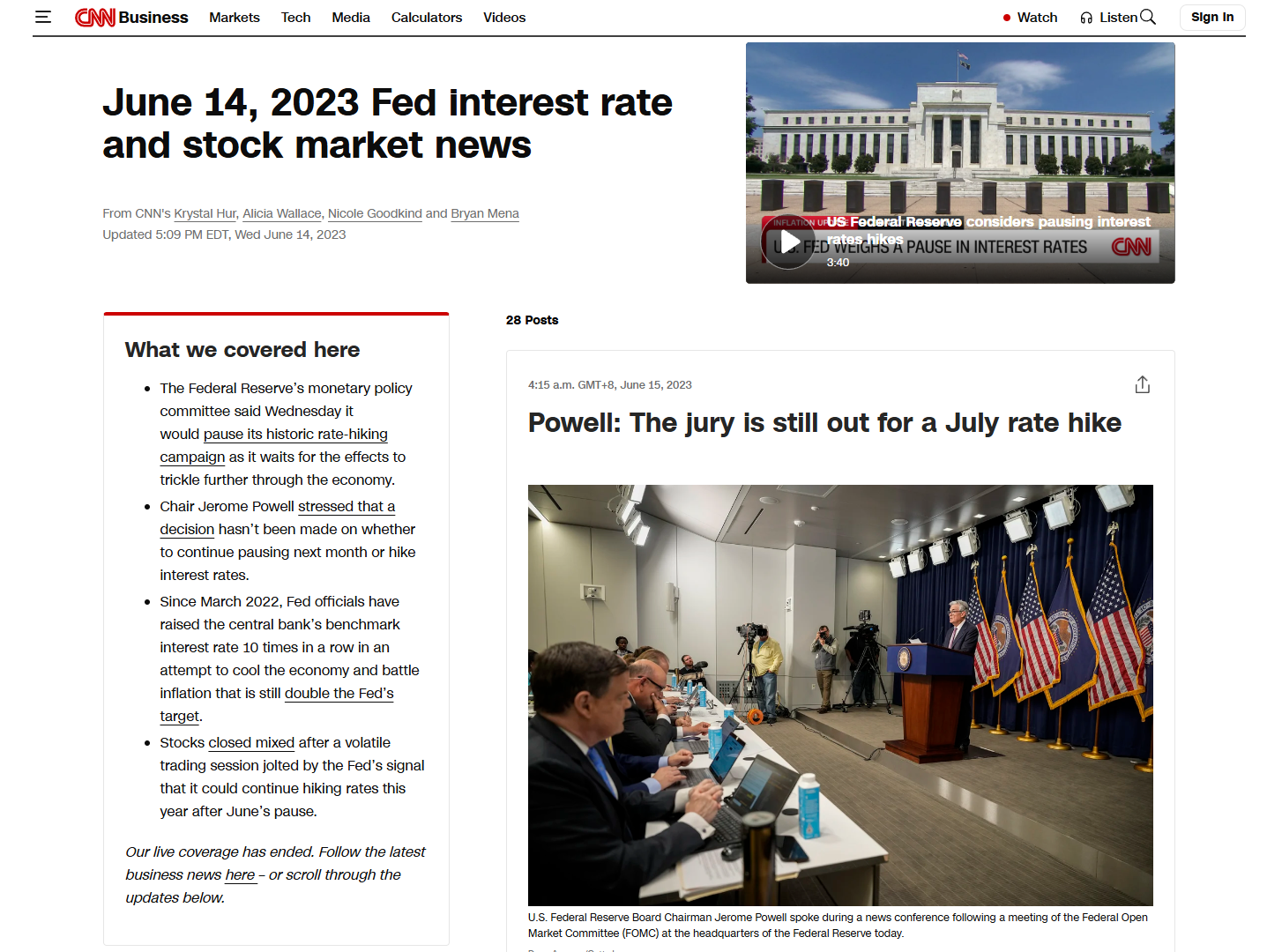
The changes in the cost of money influences a company’s net profit or revenues in two very distinct ways. First, most companies borrow money to finance their capital equipment, machinery and inventory. This inescapable reality makes the exact interest rate they pay extremely important for their survival. Profits simply shrink.
Another is a significant number of consumer sales are actually financed by borrowing. The overall level of these rates greatly influences the willingness of everyday customers to go out and make additional purchases. People buy less expensive things.
Example below of S&P500 reaction from the Interest Rate release
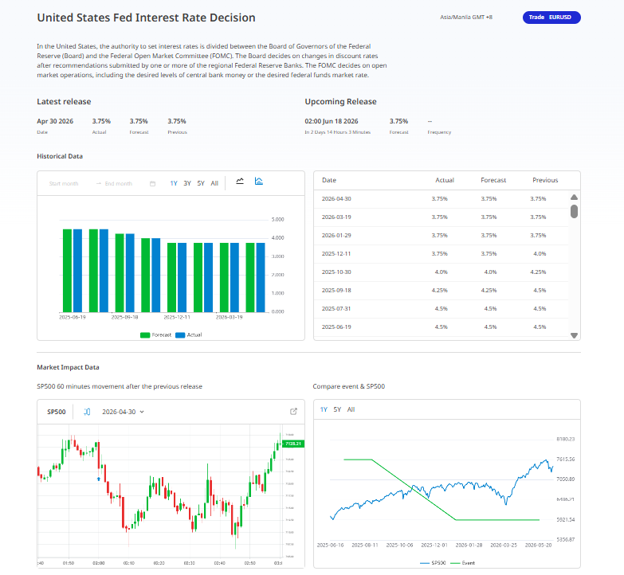
Notice its spiked price movement from green to red. You can also see the historical data from December 2025 it was consistent at 3.75% since the rate cut usually helps or supports the revenues or profits due to cost of funding will not lead into as a heavy load responsibility to finance the business also at this period the economy was further experiencing the tariffs imposed.
Another is a line chart in comparison showing of the long-term link between the interest rate as the Event or the data release in green line and the performance of the S&P 500 in blue since June 2025. This allows us to define as to how the Federal Reserve Monetary Policy decisions synchronize with stock market trends over time.

The extensively financed automotive industry that exists today is one of the most prominent examples of this dynamic, because both manufacturers and buyers depend on the cheapest loans to keep this particular industry going. Utilities including the transportation sectors are usually large borrowers because their industries require heavy capital investment, just like the highly leveraged construction and housing markets that require massive funding. High rates hurt them.
Why Do Rate Movements Shift Money Into Bonds?
Cost of financing fluctuation restructure asset competition as heavily impact the interest rates and equity or stock prices. The bond and equity market relationship is the most crucial. If interest rates climb faster than companies can raise their dividends, bonds will become much more appealing to investors looking for a safe and reliable return. Money flows out quickly.
Stocks will then fall in value until investors perceive them to reflect the new, higher rate environment. The effect on any particular stock group depends heavily upon the yield obtained combined with the realistic prospects for future business profit growth. Preferred shares held primarily for growth are incredibly sensitive to these shifts. Utilities suffer too.
What Is Margin Debt and How Does It Fit In?
A substantial number of stocks are actually purchased using borrowed money called margin debt. This is simply cash loaned by brokers for which the buyer's existing securities are officially pledged as collateral to secure the transaction. Changes in the carrying cost of this debt heavily influence investor behavior.
Higher fees reduce desire.
Normally, this specific type of funding is used strictly for the acquisition of new equities. Sometimes, people also use this margin debt for purchases of consumer items. Because these shifts usually lead the dance between interest rates and stock prices, identifying primary trend reversals in the debt market is crucial.
How each industry react to the Interest Rates shifts?
The Financial industry, banks and insurance companies benefit from a steepening curve, as they borrow short-term and lend long-term leading to higher Net Interest Margins.
With the Technology sector since these are highly sensitive to discount rates with the present value of future cash flows.
Consumer Staples and Utilities as viewed as bond proxies because of their dividends yet they suffer directly when risk-free rates (or bonds) rise and outperform their yield.
Market Reaction to News: How to Read Sentiment
By the time a widely anticipated event occurs, its potential impact is typically already reflected in the market price.
When assets ignore unexpected reports, the main trend is likely turning.
You must find a strict stop point to protect your capital.
Use this method alongside your regular technical indicators.
Markets sometimes ignore major headlines as a clue, analyzing the market reaction to news is an important way to judge overall market sentiment. Markets always look ahead.
They naturally factor all expected events right into the current price structure. Watching how prices handle unexpected events is incredibly revealing.
Traders usually brace for a big sell-off when a negative report hits. But sometimes, the asset just hangs there for a bit before taking off on a rally. If the news was already expected, the price might actually bounce back so watch carefully.
How Does the Market Reaction to News Show True Sentiment?
It is common for high-quality news headlines to surface without triggering a corresponding price movement. When this happens, the urge to hold your position can be incredibly strong, often driven by the hope that the rest of the market will eventually recognize the bullish potential and catch up.
Almost always, the price will soon decline. When the price does not respond as expected, you must act fast. Follow these steps.
Watch for a suitable stop point immediately.
Prepare to exit position if that limit gets hit.
Never hold out hope for a delayed rally.
Protect your capital first.
What Happens When the Price Ignores Convincing Headlines?
The more convincing the story, the more cautious a quiet response becomes. This rings especially true after the initial few hours of live trading pass. A muted market reaction to news means the downside risk is huge.
Why Is It Important to Exit Positions During Trend Turns?
Countless examples exist across many different stocks and financial markets today. The core principle always remains the exact same. If an asset fails to respond to a headline in the expected way, it is probably in the process of turning. Look closely.
Assessing this factor is subjective and ultimately depends on your personal conclusion. Even so, it serves as a valuable supplementary tool when used in conjunction with your existing technical indicators. Combine your tools.
Disclaimer: This content may have been written by a third party. ACY makes no representation or warranty and assumes no liability as to the accuracy or completeness of the information provided, nor any loss arising from any investment based on a recommendation, forecast or other information supplies by any third-party. This content is information only, and does not constitute financial, investment or other advice on which you can rely.
ACY Securities is one of Australia's fastest growing multi-asset online trading providers, offering ultra-low-cost trading, rock-solid execution, technologically superior account management and premium market analysis.

Select the categories and companies you wish to follow directly to your person rss feed.
Create Custom RSS FeedSign up and join over 5,000 professional members who receive personalized news alerts, curated professional connections, and more for free!
Bybit has launched Perp Options, described as the first options contracts built on TradFi perpetuals, giving traders round-the-clock access to US equity options. SpaceX and Nvidia are the first underlying assets, with USDT settlement and integration into Bybit's Unified Trading Account.
Use this trading preparation checklist to plan your session, define entry rules, manage risk, and build a disciplined trading routine in seven steps.
Your Bourse expands its crypto liquidity ecosystem with Caladan, giving brokers access to broader market coverage, institutional execution capacity and streamlined settlement.
Scope Markets, the retail brokerage part of Rostro Group, has appointed Ibrahim Hossny as Head of Research and Marketing for the Middle East and North Africa.
Hantec Prime, the institutional division of Hantec Markets, has reported trading volume up more than 300% year-to-date, alongside the addition of 42 new institutional clients since December, capping one of its strongest years of growth to date.
Learn how to refine XAUUSD support and resistance on the daily chart using candle bodies, market structure and weekly gold levels for swing trading. A slug alone cannot guarantee a top Google ranking. Keep it focused rather than adding every supporting keyword.
The week in Dubai will be focused on connecting directly with the industry and discussing how technology can help modern brokerages simplify operations, automate workflows, strengthen operational control, and scale efficiently.
Devexperts has launched a turnkey solution giving brokers in South Korea access to US equity markets, combining its DXtrade trading platform, dxFeed market data, and execution services. The offering targets South Korea's growing retail demand for US stocks, worth several billion USD monthly.
Assess why WTI crude oil surged past $105 per barrel amid Saudi pipeline disruptions, record tanker charter rates, and escalating geopolitical tensions.
Bitcoin price forecast: BTC/USD retests $78,460–$80,215 resistance. Watch bearish confirmation toward $72,480 or a bullish breakout toward $86,150.