just now


Liquidity Finder Ltd is incorporated in England and Wales, company number 10610740, registered address 167-169 Great Portland Street, Fifth Floor, London W1W 5PF, United Kingdom.
Published: just now
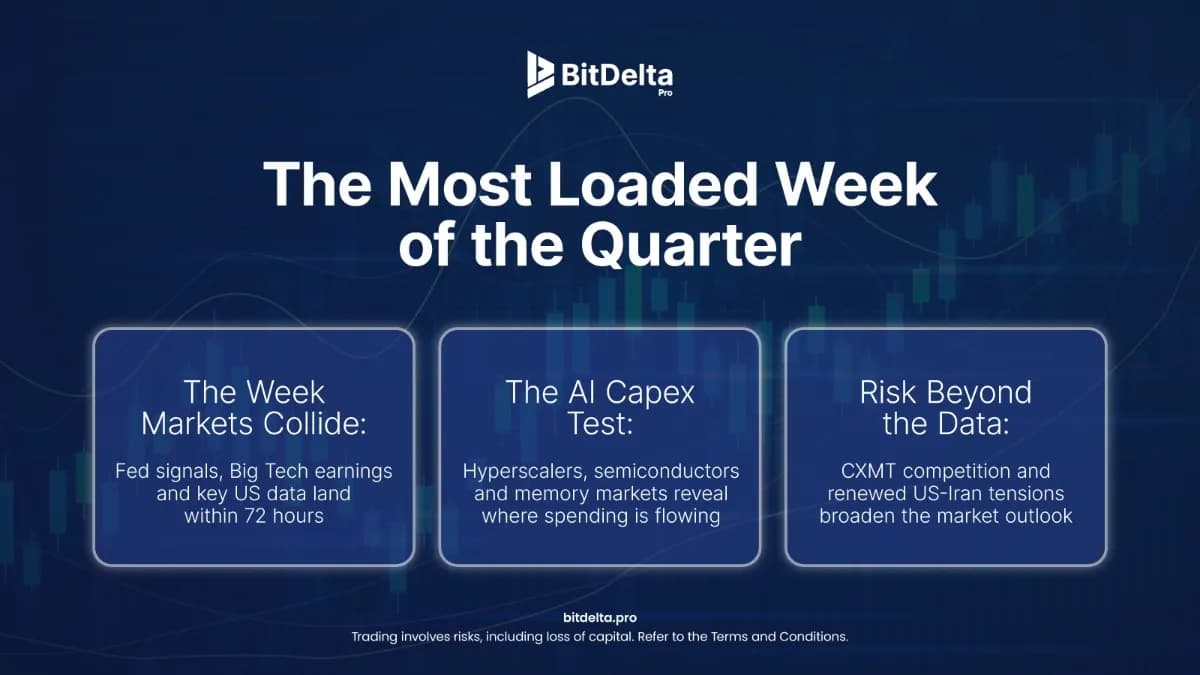
Four of the Magnificent Seven report earnings. The Federal Reserve announces its rate decision. Advance Q2 GDP drops. Core PCE prints. SK Hynix reports. All of it lands in a 72-hour window between Wednesday morning and Thursday evening.
The range of outcomes for this week is wider than any single week since the Iran conflict began in February. A hawkish Warsh press conference paired with disappointing hyperscaler guidance produces a compounding selloff. A dovish hold paired with strong earnings and cooling PCE produces a rally that could push indices to fresh highs. The market will not finish this week where it started. The question is which direction, and the answer depends on how four distinct catalysts interact with each other.
FOMC: The Language Matters More Than the Decision
The Federal Reserve concludes its two-day meeting on Wednesday, with the rate decision at 2:00 PM ET and Chair Warsh's press conference at 2:30 PM. The fed funds rate is expected to remain at 3.50-3.75%, with a 68.5% probability of no change and a 31.5% probability of a 25 basis point hike. Rate cuts are not on the table.
A hold is the base case. What matters is the press conference.
This meeting does not include a Summary of Economic Projections or a dot plot, which means the statement and Warsh's Q&A carry all the interpretive weight. The market will be listening for three things:
Whether Warsh opens the door to a September hike. Any language that frames the current rate as potentially insufficient, or that describes inflation risks as tilted to the upside, will be interpreted as hawkish guidance. The June meeting's 8-4 vote already showed the largest division at the Fed since 1992. If the July statement signals that the hawkish minority is growing, rate-sensitive assets (regional banks, small caps, housing, long-duration bonds) reprice immediately.
How Warsh frames the oil shock. The Iran re-escalation has pushed oil back above $78 after the ceasefire-driven decline to $68. If Warsh treats the renewed energy inflation as transitory (a supply disruption that monetary policy cannot address), that supports the case for holding. If he frames it as a risk to inflation expectations that may require a policy response, that opens the door to tightening.
Balance sheet commentary. Warsh is a balance sheet hawk whose primary tool is not the policy rate but the composition and size of the Fed's holdings. Any commentary on accelerating quantitative tightening, shifting the maturity profile of the portfolio, or reducing Treasury holdings faster than the current pace would tighten financial conditions without a rate change and may be underappreciated by a market focused exclusively on the rate decision.
The timing collision is critical. Microsoft and Meta report after the close on the same day as the FOMC decision. Warsh's press conference will end at approximately 3:30 PM. Ninety minutes later, two of the largest companies in the world report earnings. If Warsh is hawkish and either MSFT or META disappoints, the overnight session compounds the damage. If Warsh is dovish and both beat, the rally compounds. Wednesday evening will be one of the most volatile periods of the quarter.
Earnings: The Capex Wealth Transfer
This week's earnings calendar is not just a collection of individual company reports. It is a window into how hundreds of billions of dollars in capital expenditure flow through the AI value chain from buyer to seller.
The hyperscalers (Microsoft, Meta, Amazon) have committed staggering sums to AI infrastructure. Microsoft is expected to spend approximately $120 billion on AI and cloud capacity in fiscal 2026. Meta has guided $115-135 billion. Amazon has projected roughly $200 billion. These commitments are the revenue of their suppliers. Lam Research's order book is Microsoft's capex line. KLA's backlog is Amazon's equipment budget. Corning's fiber demand is Meta's data center buildout. Seagate's enterprise HDD shipments are everyone's cold storage expansion.
This is the wealth transfer happening in real time. When a hyperscaler reports, the market scrutinizes their capex guidance. If they guide higher, the semicap and infrastructure names rally on confirmation that orders are coming. If they guide lower, those same names sell off on the fear that the spending cycle is decelerating. But there is a lag built into this process. Orders placed six months ago are still being delivered. Revenue recognized this quarter at Lam or KLA reflects purchase decisions made last year. The semicap companies have visibility that extends well beyond a single quarter's guidance from any individual hyperscaler.
What to watch in each report:
Microsoft (Wednesday after close): Azure growth rate is the single most important number. The market wants to see AI-driven acceleration in cloud revenue. Copilot monetization across Office 365, GitHub, and Dynamics will be closely scrutinized for evidence that AI spending is converting to product revenue, not just infrastructure cost. Capex guidance for the remainder of fiscal 2027 determines whether the semicap supply chain gets a confidence boost or a scare.
Meta (Wednesday after close): Advertising revenue growth and user engagement metrics remain the foundation. The market will focus on whether AI-driven ad targeting improvements are translating to measurable revenue uplift. Capital expenditure guidance for "Superintelligence Labs" and AI training clusters will be evaluated against the ROI question that has weighed on the stock. If Meta can demonstrate that AI spending is improving ad efficiency and driving incremental revenue, it addresses the capex concern directly.
Amazon (Thursday after close): AWS revenue and margin are the priorities. Trainium custom silicon adoption rates signal whether Amazon's strategy of building its own AI chips (reducing dependence on NVIDIA) is gaining customer traction. Retail margins continue to improve through automation and logistics optimization, and any acceleration there supports the broader AI-productivity thesis.
Apple (Thursday after close): This is the first earnings report under CEO John Ternus, who succeeded Tim Cook in January 2026. Expectations should be calibrated carefully. Ternus has been in the seat for six months. Apple's product cycles run 18-36 months from concept to launch. Anything shipping this year was designed and approved under Cook. The strategic fingerprints of new leadership will not appear in hardware until late 2027 at the earliest.
What to listen for is not a product revolution but directional signals. Any commentary on AI integration across the product line, custom inference silicon investment, or partnerships for on-device model deployment would indicate where Ternus intends to take the company. Services revenue growth (likely 25%+ year-over-year) and Greater China performance are the near-term financial metrics that move the stock. The installed base approaching 2.5 billion active devices remains Apple's most durable competitive asset, and how Ternus plans to monetize that base through AI-enabled services is the forward-looking question worth tracking.
Semicap and infrastructure names: Lam Research, KLA, Corning, Seagate, NXP, Skyworks, and Cadence Design Systems all report this week. Collectively, these companies represent the physical layer of the AI buildout. Their revenue is a lagging indicator of hyperscaler spending decisions already made and a leading indicator of what the supply chain expects over the next 12 months. If they guide up, the AI infrastructure supercycle is intact. If they guide cautiously, the market will question whether the capex commitments are translating to orders as fast as expected.
SK Hynix (Wednesday): The Korean memory giant's Q2 results will provide a direct read on HBM demand, pricing trends, and capacity expansion plans. With Micron having just posted 84.9% gross margins, the market wants to know whether SK Hynix is seeing the same pricing environment and how aggressively they plan to expand capacity. Their commentary on HBM4 readiness and customer commitments will directly inform the memory margin sustainability debate.
GDP and PCE: The K-Shape Gets Its Data Point
Thursday brings advance Q2 GDP and Friday brings June core PCE. Together, these two releases will either confirm or complicate the K-shaped economy thesis that has defined our analysis throughout Q2.
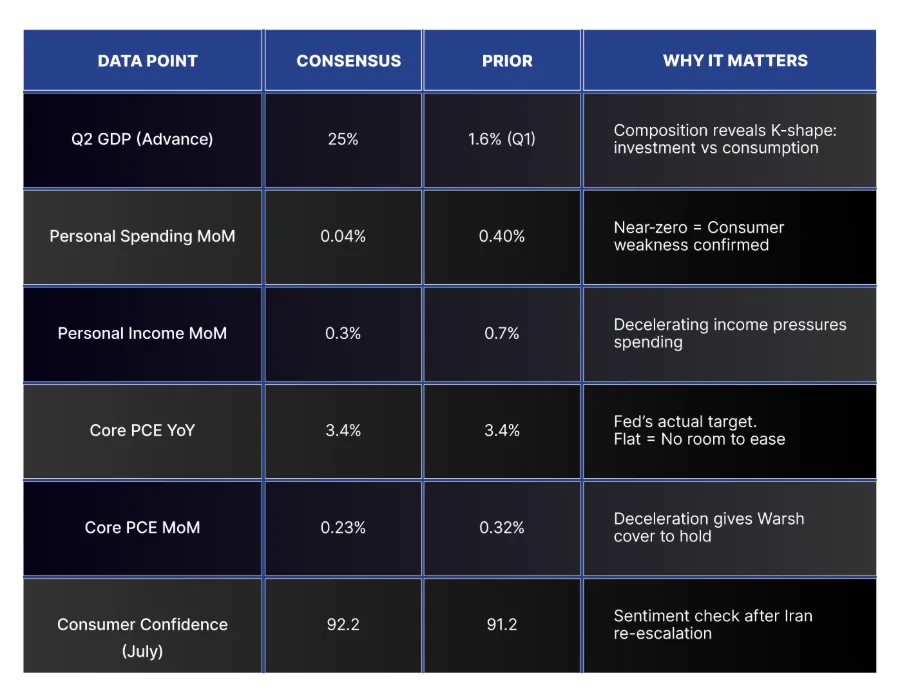
Q2 GDP consensus: 2.5% (up from 1.6% in Q1). The composition matters more than the headline. Q1 showed equipment investment at 17.2% and personal consumption at 1.4%. If Q2 shows the same pattern, with investment and government spending carrying the headline while consumption remains flat, the divergence between the investment economy and the consumer economy is widening. If consumption surprises to the upside, it challenges the thesis that the consumer is running out of steam.
Personal spending consensus: 0.04% MoM (vs 0.40% prior). This is the most important single number of the week for the macro picture. A 0.04% print is functionally zero consumption growth. If it prints negative, it would be the first monthly decline in consumer spending since the early pandemic period and would represent a significant deterioration in the consumer economy. The FIFA World Cup in June may have provided a modest boost to food and beverage, entertainment, and travel spending, but the effect is unlikely to change the overall trajectory materially.
Core PCE consensus: 3.4% YoY (flat from prior), 0.23% MoM (vs 0.32% prior). This is the inflation measure the Federal Reserve actually targets. If core PCE ticks down from 3.4%, it gives Warsh justification to hold and reduces September hike probability. If it ticks up or holds steady with a hot monthly print, the case for tightening strengthens. The gap between CPI (3.8% headline, celebrating disinflation) and core PCE (3.4%, still well above target) remains the key perception gap between what the market sees and what the Fed sees.
CXMT: Does a New Entrant Change the Memory Equation?*
ChangXin Memory Technologies completed its IPO on the Shanghai STAR Market on Monday, raising $8.6 billion in mainland China's largest semiconductor listing on record. Shares surged over 470% on their first day of trading, pushing CXMT's market capitalization to approximately $480 billion and making it the most valuable company listed on China's mainland exchanges.
The immediate question for investors in Micron, SK Hynix, and Samsung is whether CXMT's arrival permanently changes the margin structure of the memory industry. The market narrative says yes: a new, state-backed Chinese competitor will flood the market with supply and compress the extraordinary margins the incumbents have been earning. The data tells a more nuanced story.
Start with what CXMT actually makes. The company manufactures commodity DRAM: DDR4 and DDR5 modules for servers, PCs, smartphones, and automobiles. It does not make High Bandwidth Memory, which is the product category driving Micron's 84.9% gross margins. HBM requires advanced packaging capabilities and manufacturing expertise that CXMT has not yet developed, and US export controls constrain the company's access to the lithography and packaging equipment required to get there. The IPO prospectus allocates proceeds to DRAM production upgrades and research, not a standalone HBM program.
Then consider the pricing. According to Reuters (July 24, 2026), CXMT has been charging more than Samsung's approximately $1,240 per unit for comparable 64GB DDR5 server memory modules. The company reportedly refused discount requests from Huawei, one of its most important domestic customers. At Computex 2026, module makers confirmed that CXMT's DDR5 pricing is on par with the three incumbent manufacturers, with no price-destruction advantage. This raises an obvious question: if CXMT were planning to undercut the market, why is it pricing at or above the incumbents?
The answer appears to be that the entire DRAM market is supply-constrained, not just the HBM segment. As Samsung, SK Hynix, and Micron reallocate manufacturing lines toward higher-margin AI memory products, the supply of general-purpose server DRAM has tightened enough that even a relatively new entrant with 7.67% market share has pricing power. CXMT is not disrupting the market. It is benefiting from the same supply-demand imbalance that is driving margins for everyone else.
This does not mean CXMT is irrelevant to the competitive landscape. The company's capacity expansion plans are ambitious. Current output is approximately 200,000 wafers per month, with a target of 300,000 by year-end and a longer-term goal of 600,000 when two new fabs in Shanghai and Hefei are completed. If those targets are met, CXMT could approach Micron's current capacity by 2030. That additional supply, arriving over several years, will gradually shift the supply-demand balance toward buyers and put downward pressure on pricing.
But "gradually over several years" is different from "immediately upon IPO." The capacity expansion assumes uninterrupted execution, stable access to equipment (which remains subject to US export control policy), successful yield ramp at each new fab, and sustained demand growth. CXMT was founded in 2016. Samsung has been manufacturing DRAM since the 1980s. SK Hynix since 1983. Micron since 1978. The manufacturing expertise gap is real and is not closed by capital investment alone.
For investors, the question is not whether CXMT adds supply to the global DRAM market. It will. The question is whether that supply arrives fast enough and at large enough scale to compress margins before the incumbents have already earned years of returns at current levels. The current evidence, from pricing data to capacity timelines to product mix limitations, suggests the answer is not yet.
Iran: Sustained Degradation, Not Resolution**
The US-Iran conflict continues to produce volatile price action in energy markets without fundamentally altering the structural outlook for oil.
The ceasefire signed in late June collapsed within weeks. US strikes have expanded across multiple Iranian targets. Iran has attacked commercial vessels in the Strait of Hormuz. Two US service members were killed in Jordan. The naval blockade has been reinstated. Oil has bounced from $68 to above $78 on the re-escalation.
The market's reaction to each new headline is diminishing. The initial Hormuz closure in March sent oil to $120. The June ceasefire collapse sent it to $78. Each escalation cycle produces a smaller price response because the market is learning two things. First, the Strait has remained functionally open for commercial traffic despite the attacks. CENTCOM maintains a naval presence that enables transit, even if insurance premiums are elevated. Second, the structural demand picture continues to weaken independently of the geopolitical situation. China's crude imports have been cut significantly. ASEAN demand destruction is ongoing.
The conflict appears oriented toward degrading Iranian military capability through sustained strikes rather than achieving a decisive resolution through regime change. For markets, this means elevated but manageable volatility in energy prices, sustained defense spending that benefits the defense industrial base, and periodic risk-off episodes that create buying opportunities for investors focused on the structural bull case.
The key variable to monitor is whether the conflict expands to additional regional actors. The Saudi-Houthi truce collapse is a warning signal. If the conflict broadens beyond Iran to include sustained attacks on Gulf state infrastructure (Saudi Aramco facilities, UAE ports, Qatari LNG terminals), the oil price response would be materially larger than what the market has priced so far.
Sources: CENTCOM statement, July 18, 2026 (service member casualties); Washington Post, July 18 and July 20, 2026 (strike details, Pentagon identification of Pvt. Isabella Gonzales and 1st Lt. Tyler James Feehan); CNN, July 15, 2026 (naval blockade reinstatement, first vessel disabled); Fox News, July 14-15, 2026 (Trump blockade announcement, commercial vessel attacks); Gulf News, July 15, 2026 (tanker attacks near Oman, Kuwait air defense engagement); Reuters, via multiple outlets (oil price movements).
The Bottom Line
This is not a week to predict. It is a week to prepare for.
The interaction effects between FOMC language, hyperscaler earnings, GDP composition, and core PCE are too complex to reduce to a single directional call. A hawkish Warsh with strong earnings is a different market than a dovish Warsh with weak earnings, and both are different from a hawkish Warsh with strong earnings but hot PCE.
What we can say is that the structural forces driving equity markets higher have not changed. Corporate earnings are growing. The AI capex supercycle is producing record revenue for infrastructure suppliers. The investment economy is booming. The consumer economy is weakening but has not collapsed.
The risk this week is not that the structural story breaks. It is that the concentration of catalysts produces a volatility event that shakes out leveraged positions and creates short-term dislocations. For investors with a multi-quarter time horizon, those dislocations are opportunities. For investors who are over-concentrated or over-leveraged heading into Wednesday afternoon, this week could be very expensive.
Position sizing matters more than direction this week. Being right is secondary in our opinion
This article is for informational purposes only and does not constitute investment advice. Past performance is not indicative of future results. Do your own research.
Appendix
*CXMT DDR5 pricing (for the memory section):
**US service members killed in Jordan (July 17-18):
**Naval blockade reinstated, commercial vessel attacks (July 14-15):
Institutional multi-asset market access across MT5 Ultency, CQG, Iress Pro and BitDelta Terminal, with transparent execution standards and global market coverage.

Select the categories and companies you wish to follow directly to your person rss feed.
Create Custom RSS FeedSign up and join over 5,000 professional members who receive personalized news alerts, curated professional connections, and more for free!
Multi-asset trading broker AvaTrade has agreed to acquire the majority of FXCM Group’s business and brand, in a transaction that would bring a longstanding retail FX franchise into the AvaTrade Group.
LSEG and CMC Markets have signed a multi-year strategic data agreement expanding CMC's access to LSEG's real-time and delayed pricing, reference and corporate actions data, news and analytics, plus AI-ready content, to support new products, entry into new markets and the growth of CMC's institutional and B2B partnerships.
The Tel Aviv Stock Exchange is considering a bid for the Cyprus Stock Exchange, with Israeli media citing its EU licence, trading platform and clearing house. Euronext’s Athens exchange and India’s National Stock Exchange are also seen as contenders, and Cyprus aims to sign a sale agreement by the end of this year.
CME Group will launch baseball futures on 12 October, pending regulatory review, tracking CME FutureSports Performance Indexes built on Official League Data. Standard and micro contracts will start with the 2026 Postseason and the four clubs in the League Championship Series, trading around the clock.
ESMA has published an opinion stating that MiCA-authorised crypto-asset service providers should cease services tied to non-MiCA-compliant stablecoins for EU clients across MiCA crypto-asset services. National authorities should require remediation of existing exposures within three months, by early January 2027.
Nasdaq Ventures has made a strategic investment in Amsterdam-based derivatives and crypto exchange One Trading, with both firms to explore 24/7 trading of equity futures. The undisclosed investment follows Nasdaq's US$100 million investment in Payward, the parent of Kraken, and CME Group's move to 24/7 trading.
cTrader has opened multi-platform plugins to brokers and prop firms, which can pre-install their own tools for clients or list them in cTrader Store. The plugins run across Mobile, Web, Windows and Mac, and can be built and launched independently of core-platform releases, including trading journals and calculators.
Institutional brokerage and financial infrastructure provider Clear Street has joined TradingView’s broker network, allowing its clients to trade US stocks, exchange-traded funds and options directly through the charting and analysis platform.
Learn how to improve trading psychology, manage fear and greed, avoid revenge trading, and follow your trading strategy with discipline and a trading journal.
GTC Prime has announced a strategic partnership with Centroid Solutions to manage and distribute its liquidity through CS 360 Bridge, Centroid's multi-asset connectivity and execution engine, giving brokers and institutional clients access to tailor-made pricing, low-latency execution and real-time risk management.