just now


Liquidity Finder Ltd is incorporated in England and Wales, company number 10610740, registered address 167-169 Great Portland Street, Fifth Floor, London W1W 5PF, United Kingdom.
Published: just now

The most important move coming out of this week’s Federal Reserve meeting was not in the fed funds rate. It was in the Treasury curve.
The Fed left rates unchanged at 3.50%–3.75%, despite three FOMC members voting for a 25bp hike. Chair Kevin Warsh remained forceful on inflation but deliberately avoided giving markets a clear roadmap for what comes next. He acknowledged that higher bond yields are already tightening financial conditions and appeared comfortable allowing markets to do some of the work that would otherwise have to come from the Fed itself.
That helps explain why the reaction in Treasuries was unusual.
Short-dated yields fell as traders reduced the probability of a September hike, while long-dated yields moved sharply higher. The 30-year Treasury yield pushed above 5.20%, its highest level since 2007, while the 10-year yield also climbed. The resulting bear steepening suggests investors are demanding more compensation to own long-duration government debt even as they become less certain that the Fed will raise its policy rate in September.
That is the key macro story for the week ahead.
The rise in US10Y is increasingly about the long end questioning how inflation will ultimately be contained.
Warsh has repeatedly stressed that the Fed will deliver price stability, but this week he stopped short of committing to the conventional route of simply raising rates. Markets therefore appear to be pricing a larger term and inflation premium into longer-dated Treasuries.
In other words, the message from the bond market is becoming:
If the Fed does not tighten aggressively at the front end, the market may tighten conditions through the long end instead.
Reuters noted that September hike expectations dropped from near certainty before the meeting to roughly 55% immediately afterward. At the same time, longer yields surged.
That matters because a higher 10-year yield feeds directly into financial conditions through mortgages, corporate borrowing costs, equity discount rates and the broader cost of capital.
Normally, that would be a headwind for equities.
But there is another side to the story.
If markets interpret the Fed’s approach as allowing the yield curve to absorb the inflation risk while avoiding an immediate policy-rate shock, equities can potentially continue higher provided economic growth and earnings remain resilient.
That is why next week’s data matters so much.
A moderate growth slowdown would arguably be the best combination for risk assets: strong enough to avoid recession fears, but soft enough to stop the long end of the Treasury market from moving materially higher.
A renewed acceleration in growth or inflation would create the opposite problem. It could force US10Y higher again, steepen the curve further and increase pressure on equity valuations.
The first major test comes from the July ISM Manufacturing PMI, released Monday at 10:00 a.m. ET. ISM confirms that the July manufacturing report is scheduled for August 3.
Regional activity indicators suggest that a flat to slightly stronger manufacturing reading would remain consistent with an economy growing at roughly a 2%–2.5% annual pace.
For markets, the composition may matter more than the headline.
A healthy activity number accompanied by softer prices would fit the equity-friendly soft-landing narrative. However, stronger new orders alongside renewed price pressures could reinforce the Treasury market’s concerns and push long-term yields higher.
Services remain the more important part of the US economy, making Wednesday’s ISM Services PMI another key read on whether growth remains resilient.
ISM’s official calendar confirms the July services report will be released on August 5.
The ideal market outcome would again be steady activity without another acceleration in inflation-sensitive components.
If both ISM reports point toward growth around the current trend rather than a new upswing, it would give the bond market less reason to push long yields higher.
The main event comes Friday with the July Employment Situation report at 8:30 a.m. ET. The BLS calendar confirms the release date.
Rate expectations have already changed significantly following the Fed meeting. A September hike had effectively been priced at the beginning of this week, but markets have since scaled that probability back materially.
That makes payrolls the next major input into the September debate.
The labour market had an unusually weak period between early 2025 and early 2026 before improving in March, April and May. June then disappointed, with payroll growth of only 57,000 and substantial downward revisions.
Hiring surveys remain subdued.
Our working expectation is for approximately 75,000 jobs in July, with unemployment rising to around 4.3%.
The unemployment rate should still be treated carefully. Labour-force participation has recently weakened sharply, which means headline unemployment may provide a less complete picture of underlying labour-market health.
Consensus estimates reported by Reuters currently sit somewhat higher, at approximately 91,000 jobs.
For markets, the scenarios are fairly straightforward:
Soft payrolls + contained wages: lower front-end hike expectations, potentially lower US10Y and supportive conditions for equities.
Strong payrolls + firm wage growth: September hike expectations rebuild, US10Y potentially pushes higher and equity duration becomes more vulnerable.
Very weak payrolls: yields may initially fall, but markets could quickly shift from celebrating easier policy toward worrying about growth.
That makes a moderate number the cleanest outcome for the bullish equity narrative.
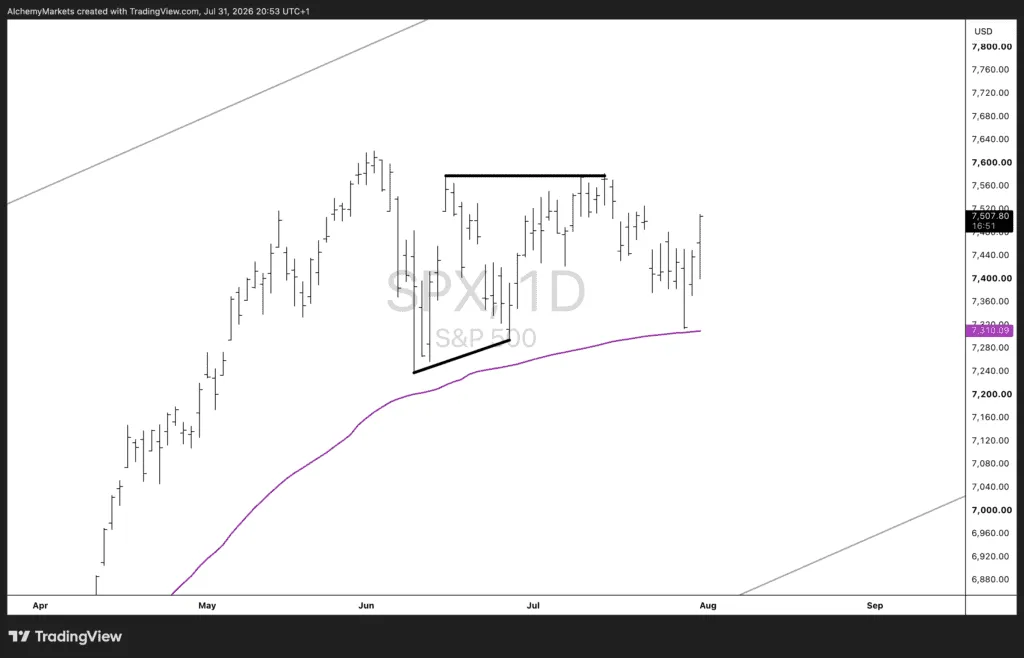
The macro environment may be complicated, but the S&P 500 chart is becoming relatively simple.
Price has spent the last several weeks consolidating beneath resistance around the 7,570–7,580 region, while successive lows have broadly held above a rising support structure.
That created a triangle-style consolidation following the strong advance from the April lows.
More importantly, the market recently tested the rising moving-average region near 7,310 and produced a sharp recovery.
The structure therefore continues to look more like consolidation within an existing uptrend than a confirmed distribution pattern.
The key level is the upper boundary around 7,570–7,580.
A clean daily breakout above that area would complete the consolidation and increase the probability that the S&P 500 is preparing for another impulsive leg higher.
The technical narrative therefore fits surprisingly well with the macro setup:
Bond yields are tightening financial conditions, the Fed is reluctant to over-commit to another hike, and equities are consolidating rather than breaking down.
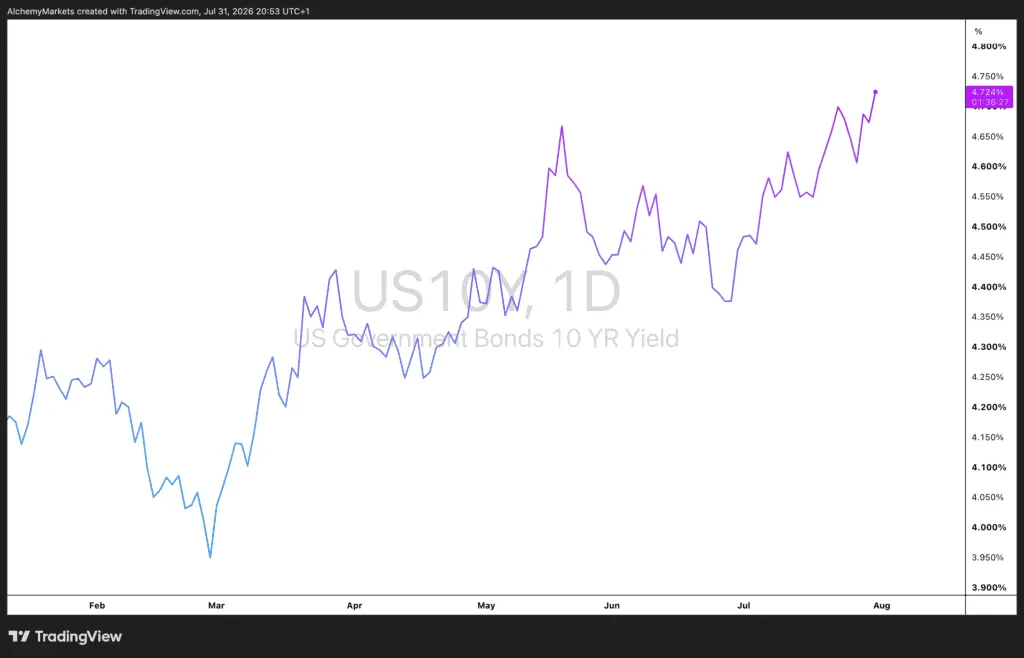
If next week’s ISM and payroll reports are moderate enough to prevent another disorderly rise in the 10-year yield, the S&P 500 may have the macro breathing room required to break through resistance.
The risk to that view is the Treasury market.
If US10Y continues climbing because investors become increasingly uncomfortable with the Fed’s inflation credibility, equity multiples will eventually have to compete with materially higher long-term risk-free rates.
For now, though, the chart is saying something important: despite the rise in yields and the uncertainty created by the Fed, the S&P 500 is still holding its bullish structure.
A breakout from this triangle would suggest the market is ready for its next impulse higher.
Alchemy Markets is a multi-asset brokerage providing retail traders with the same elite trading conditions, tools, and transparency typically reserved for institutions.
Select the categories and companies you wish to follow directly to your person rss feed.
Create Custom RSS FeedSign up and join over 5,000 professional members who receive personalized news alerts, curated professional connections, and more for free!
Multi-asset trading broker AvaTrade has agreed to acquire the majority of FXCM Group’s business and brand, in a transaction that would bring a longstanding retail FX franchise into the AvaTrade Group.
LSEG and CMC Markets have signed a multi-year strategic data agreement expanding CMC's access to LSEG's real-time and delayed pricing, reference and corporate actions data, news and analytics, plus AI-ready content, to support new products, entry into new markets and the growth of CMC's institutional and B2B partnerships.
The Tel Aviv Stock Exchange is considering a bid for the Cyprus Stock Exchange, with Israeli media citing its EU licence, trading platform and clearing house. Euronext’s Athens exchange and India’s National Stock Exchange are also seen as contenders, and Cyprus aims to sign a sale agreement by the end of this year.
CME Group will launch baseball futures on 12 October, pending regulatory review, tracking CME FutureSports Performance Indexes built on Official League Data. Standard and micro contracts will start with the 2026 Postseason and the four clubs in the League Championship Series, trading around the clock.
ESMA has published an opinion stating that MiCA-authorised crypto-asset service providers should cease services tied to non-MiCA-compliant stablecoins for EU clients across MiCA crypto-asset services. National authorities should require remediation of existing exposures within three months, by early January 2027.
Nasdaq Ventures has made a strategic investment in Amsterdam-based derivatives and crypto exchange One Trading, with both firms to explore 24/7 trading of equity futures. The undisclosed investment follows Nasdaq's US$100 million investment in Payward, the parent of Kraken, and CME Group's move to 24/7 trading.
cTrader has opened multi-platform plugins to brokers and prop firms, which can pre-install their own tools for clients or list them in cTrader Store. The plugins run across Mobile, Web, Windows and Mac, and can be built and launched independently of core-platform releases, including trading journals and calculators.
Institutional brokerage and financial infrastructure provider Clear Street has joined TradingView’s broker network, allowing its clients to trade US stocks, exchange-traded funds and options directly through the charting and analysis platform.
Learn how to improve trading psychology, manage fear and greed, avoid revenge trading, and follow your trading strategy with discipline and a trading journal.
GTC Prime has announced a strategic partnership with Centroid Solutions to manage and distribute its liquidity through CS 360 Bridge, Centroid's multi-asset connectivity and execution engine, giving brokers and institutional clients access to tailor-made pricing, low-latency execution and real-time risk management.