
just now


Liquidity Finder Ltd is incorporated in England and Wales, company number 10610740, registered address 167-169 Great Portland Street, Fifth Floor, London W1W 5PF, United Kingdom.
Published: just now


The market is chaotic right now! We’ve seen PPI and CPI behaving completely erratically. On one side, PPI came in much higher, and the USD Index dropped as if there were no tomorrow. Then, yesterday, the CPI came in lower, and the market continued to drop. Something is wrong, isn’t it?
Well, it’s not! This is called a market change. One thing we need to understand is that the impact of economic news on currencies isn't straightforward - it's all about the context. What makes a currency stronger one day might drag it down the next. Smart traders don't just chase after the latest news; they keep an eye on the broader picture.
By staying informed, looking at how things have played out in the past, and being ready for different possibilities, traders can navigate the tricky waters of the market more effectively. Remember, it's not just about reacting to the news; it's about understanding the whole story.
So, if you’re not on my Telegram group (Here is the link to join it now: https://t.me/+bkfmaA76P2VlMTQ1 ), I will break down my thought process of why I thought that the CPI would have a strong chance of coming in lower, starting with the following points:
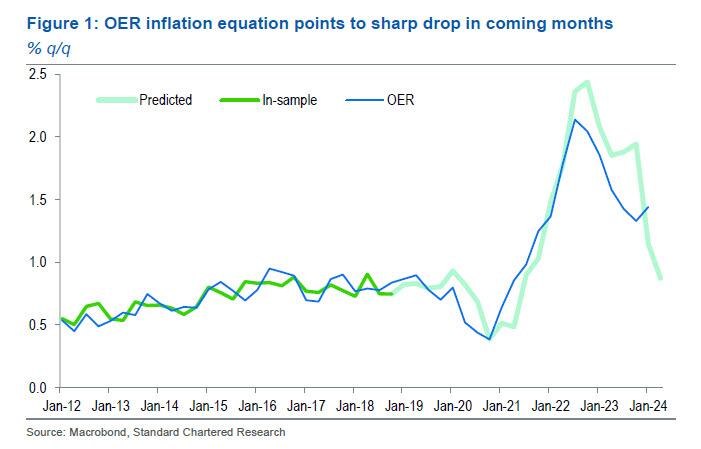
1. Slowdown in Rent Inflation: Analysts, including Standard Chartered's Chief Currency Strategist Steven Englander, foresee a significant reduction in Owners’ Equivalent Rent (OER), a critical component of the CPI. Regression analysis predicts an average inflation of only 0.29% month-over-month in the second quarter for OER, which is substantially lower than the 0.48% observed in the first quarter of 2024.
OER (Owner Equivalent Rent)
2. Political Impact on Rate Cut Expectations: With the approaching US presidential elections and political statements indicating a possible rate cut by the Federal Reserve before the year's end, there's an expectation that inflation will need to decrease to justify such cuts. This may influence how data is presented or perceived, leading to a potential negative surprise in the report. We can notice this by observing Powell's confidence in delivering a dovish speech at the last FOMC meeting on May 1st. We also have Yellen and the BoJ intervention: what timing!
CPI Shelter Inflation
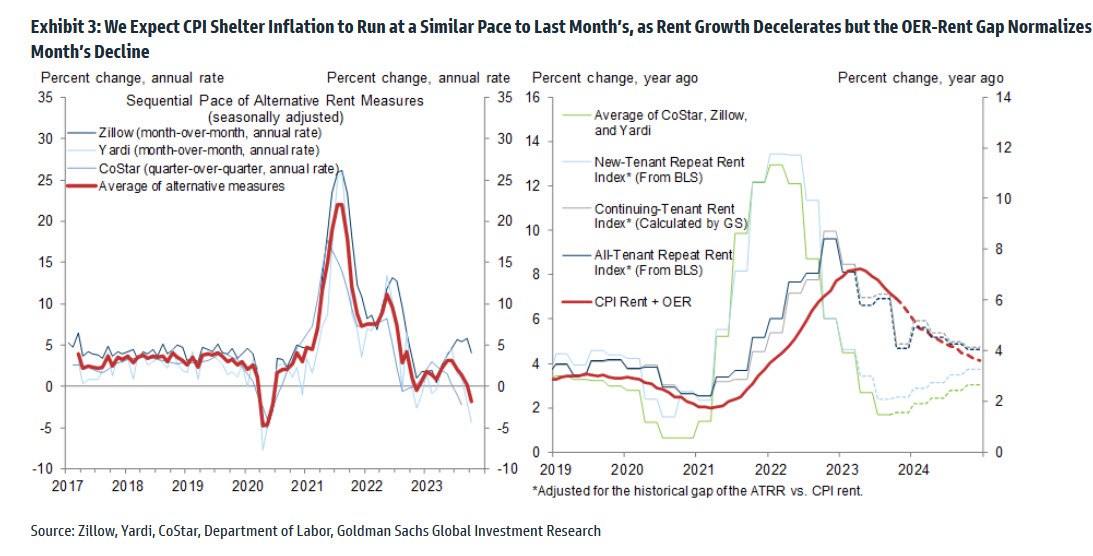
3. Lagged Data and Random Fluctuations: The experimental data used to estimate the OER are based on a small sample of rented single-family homes and are collected quarterly. This can lead to random fluctuations in monthly data, resulting in estimates that may not fully capture current trends in the rental market.
4. Disconnection between Real-Time Metrics and CPI Data: There is a significant lag between real-time metrics in the rental market and their representation in the CPI. Currently, even if rents are starting to rise in various parts of the country, this will not be reflected in CPI data until 2025, which may result in lower-than-expected numbers for the upcoming months.
OER carries a weight of 33% in the core CPI, so a decline of this magnitude (from 0.48% m/m to 0.29% m/m) would reduce the core inflation by 0.06% m/m, meaning that this variable alone would push the core estimate from 0.3% to 0.2% (if not lower). If a few more items come in colder than expected, we could have an even colder reading.
On Monday, Federal Reserve Vice Chair Jefferson adopted a hawkish stance, emphasizing the need to keep rates in restrictive territory until there is clear evidence of consistent inflation reduction. He emphasized the importance of clear and cautious communication to avoid misunderstandings and generate market certainty. "The continued emphasis on observing and responding to inflation reflects a firm policy against persistent inflationary pressures, reiterating the Fed's commitment to stabilizing prices and sustaining economic progress.
Now, having all of this in hand, we can understand why the CPI came in lower, because the rental prices as well as energy prices are dropping in the USA. But just a reminder is that this data is easily able to be manipulated. I’m not saying it was, but there is a high probability that it has been, as elections are looming, and Biden needs to maintain his good reputation. Therefore, working with the Central Bank is a good option. But another reminder is that the Fed claims to be an “independent institution,” meaning that they don’t take anyone's opinions or demands or rely on third-party opinions to act on the monetary policy of the USA.
Having all of this in hand, the only position that makes sense for me is the EURUSD long, as the EUR still has some strength despite inflation coming in lower in Europe. But compared to the USA, the GDP there is much better. You can access this link to have a look at my previous post where I talk about the GDP comparison of Europe and the USA: https://acy.com.au/en/market-news/market-analysis/eurozone-growth-weakens-usd-continued-expectations-reflect-trend-l-s-100720/
This content may have been written by a third party. ACY makes no representation or warranty and assumes no liability as to the accuracy or completeness of the information provided, nor any loss arising from any investment based on a recommendation, forecast or other information supplies by any third-party. This content is information only, and does not constitute financial, investment or other advice on which you can rely.
ACY Securities is one of Australia's fastest growing multi-asset online trading providers, offering ultra-low-cost trading, rock-solid execution, technologically superior account management and premium market analysis.

Select the categories and companies you wish to follow directly to your person rss feed.
Create Custom RSS FeedSign up and join over 5,000 professional members who receive personalized news alerts, curated professional connections, and more for free!
Theorem has integrated Symbiotic’s Liquid Lane RFQ network, letting holders of tokenised real-world assets trade against on-chain pool liquidity and market-maker quotes. The integration is live on Ethereum, with Midas’s yield-bearing mHYPER fund as the first supported asset. Holders can trade for the USDC stablecoin.
US equities were volatile with technology selloff erasing much of the earlier rebound.
FM Summit London 2026 returns to Old Billingsgate on 24 November for its 15th edition, with LMAX Group, Plus500 and oneZero among confirmed exhibitors. The one-day event adds Business Connect meetings and roundtables, and opens with a networking evening at The Folly on 23 November.
Finance Magnates Summit London returns to Old Billingsgate on 24 November 2026 for its 15th edition. The one-day event brings together brokers, liquidity providers, institutional firms, trading technology vendors, payments businesses and digital asset firms.
iSAM Securities Apex has integrated with Match-Prime, giving brokers access to liquidity across more than 2,000 instruments, with tailored pricing and up to 10 levels of market depth.
propfunding.com's free-entry instant funding changes the order of prop funding. Start trading first. Its free-entry instant funding model offers two qualification attempts without an upfront activation fee.
US stocks closed higher on Wednesday, with the Nasdaq gaining 1%, the S&P 500 rising 0.6%, and the Dow advancing 0.7%, as renewed enthusiasm for AI-related stocks lifted market sentiment.
SpaceX went public in June as a rocket company. On October 20 it reported as something else entirely: an AI infrastructure business, financed by a satellite broadband network, with a launch division attached. Rockets generated 12% of third quarter revenue and lost money. The AI segment generated 52% of revenue and consumed 84% of capital expenditure. Starlink generated 85% of operating profit.
Standard Chartered has signed definitive agreements to acquire 100% of Zodia Custody UK Limited, folding its regulated digital asset custody business into Securities Services. Zodia Solutions will be set up under SC Ventures with bank investors including Northern Trust, NAB Ventures, Emirates NBD and Investcorp.
Bybit Fintech FZE has secured a Virtual Asset Service Provider licence from Dubai’s Virtual Assets Regulatory Authority for Exchange Services, covering spot trading. Bybit’s Peter Loo said the firm hopes to add derivatives, subject to regulatory approvals. Its international Dubai headquarters opened in 2022.