
Search Companies, News, Members & more
Terms of ServicePrivacy PolicySecurity PolicyLegal InformationCommunity GuidelinesSitemapsCookie Settings
2026 Copyright © Liquidity Finder Ltd. All rights reserved.
Liquidity Finder Ltd is incorporated in England and Wales, company number 10610740, registered address 167-169 Great Portland Street, Fifth Floor, London W1W 5PF, United Kingdom.
Amana’s Reality Check: Muhammad Rasoul on Swap-Free Accounts, Financing, and Fair Access to Markets
Published on Nov 9, 2025
Updated on Mar 7, 2026

I recently caught up with Muhammad Rasoul, the CEO of amana in their office in Dubai, along with VPs of Business Development Elie Harfouche and Amr Masri. As Muhammad says, he is “an open book”. A very refreshing conversation with a very candid CEO about some of the approaches he has brought to amana to create a quiet, honest, consistency and long-term approach to customers. Listening to someone who has been in the industry from both sides, as a trader and then as a broker, and who is applying life-lessons to create a fair trading environment was really refreshing.
The company culture is to provide a trusted and safe place for clients to do business, and this is paying off. The word ‘amana’ in Arabic, generally means trust, honesty, loyalty, or responsibility. It refers to the deep moral duty to uphold a safeguard or entrust something valuable to another person or entity.
Under the leadership of Rasoul, the Dubai-based, multi-regulated broker embodies the meaning of the company’s name and has grown its direct-to-consumer business ten-fold in three years — while refusing to aggressively market products that Rasoul says are not grounded in how markets actually work. Personally, I love what they have done with their branding, having known amana for many years. I am sure this change from what (I hope they don’t mind me saying this) looked like a Craig’s List type website in the past to where it is today (fresh, modern and open), has really helped with growth and trust.
“The goal that I told the guys when I started was we’re gonna create something that I would want like my mom or my cousin or my brother to trade on,” Rasoul says. “… we’re just trying to give people fair access.”
“Financing Exists Everywhere Leverage Exists”
One of his most pointed observations concerns the notion of swap-free trading. At a time when many retail brokers promote “swap-free” or “Islamic” accounts to attract clients in the Middle East, amana has chosen a different route.
“If you are dealing with a broker that offers you swap-free, they have to be internalizing your order flow, and they have to want you to lose,” he explains.
“Because if they externalize your order flow, swap-free doesn’t exist. That’s not how the markets work. Anytime you use leverage, there’s a financing component, always.
It doesn’t matter if you’re JP Morgan or a startup broker — there’s always that. That’s the reality.”
Rasoul stresses that amana does not build its marketing around such products.
“We don’t promote things like swap-free,” he says. “The amount of swap-free accounts that we have are so small, they don’t even show up.”
The Religious and Economic Reality
When asked whether amana’s Middle-East focus means it must offer swap-free accounts, Rasoul replies bluntly:
“No. Because it goes against the first premise, which is reality.”
He elaborates that leveraged derivatives, by their nature, carry financing.
“Anytime you use leverage, there’s a financing component,” he says. “So if you are dealing with a broker that offers you swap-free, they have to be internalizing your order flow and they have to want you to lose.”
For traders seeking products aligned with Islamic principles, Rasoul’s advice is candid: “If you have a practicing Muslim that is worried about financing, then the way that we should speak to them is to say, well, we don’t offer that, because even if I didn’t offer you that … it’s still haram.”
He notes that the underlying issue is not onlymerely the interest/riba charge but the leverage itself. “You’re basically buying and selling more than what you actually have money to control, which is a part of what makes it not permissible. The interest and/or the Riba associated with it also makes it not permissible.”
What Is Permissible? Fully Funded Trading
Rasoul distinguishes between leveraged speculation and fully funded investing.
“Fully funded FX is fine. Fully funded gold is fine,” he says. “Speculation is not haram. Gambling is haram. So if your speculation bleeds into ‘oh my God, I gotta make this money back no matter what, I think it’s going up,’ you’re kind of gambling.
If you spend a couple of days analyzing the market and you think gold is going to break out … and you buy $100,000 worth of gold with $100,000, okay? There’s no interest or ribaebate inon it — you’re just speculating on price movement. It’s like buying a house… and hoping that over time it will appreciate in value. Wwe don't really cater to that kind of fictitious world, because the dynamic between you and the customer is very, it just starts from a bad spot, you know what I mean?”
That, he says, is the moral line amana operates within: enabling funded speculation (like physical gold) while offering fair and transparent access to leveraged products—not disguised gambling.
“Well, that was a condition, actually, with me accepting this job, and the shareholders have been great, because there was lots of things that I told them that I wouldn't do. I'm just not gonna do this, you know? What I've managed to convince them on is that I think that we can create a great business that's not deceptive, that tells it like it is, and then we have a really good value proposition to customers”
And we hope that they have a good experience. And if a customer doesn't have a good experience, and it's something that we've done wrong, then we make them whole. And that's our promise to the customer base.
Building a Business on Honesty
For Rasoul, refusing to disguise leverage as “interest-free” or “shariah compliant” is part of a broader ethical framework.
“We’re just trying to provide a fair place,” he says. “Whether or not I agree with if people can make money over the long term, they still deserve a fair place to do their business, and whether or not I agree with leverage, they still deserve, if they choose to use it, a fair option.”
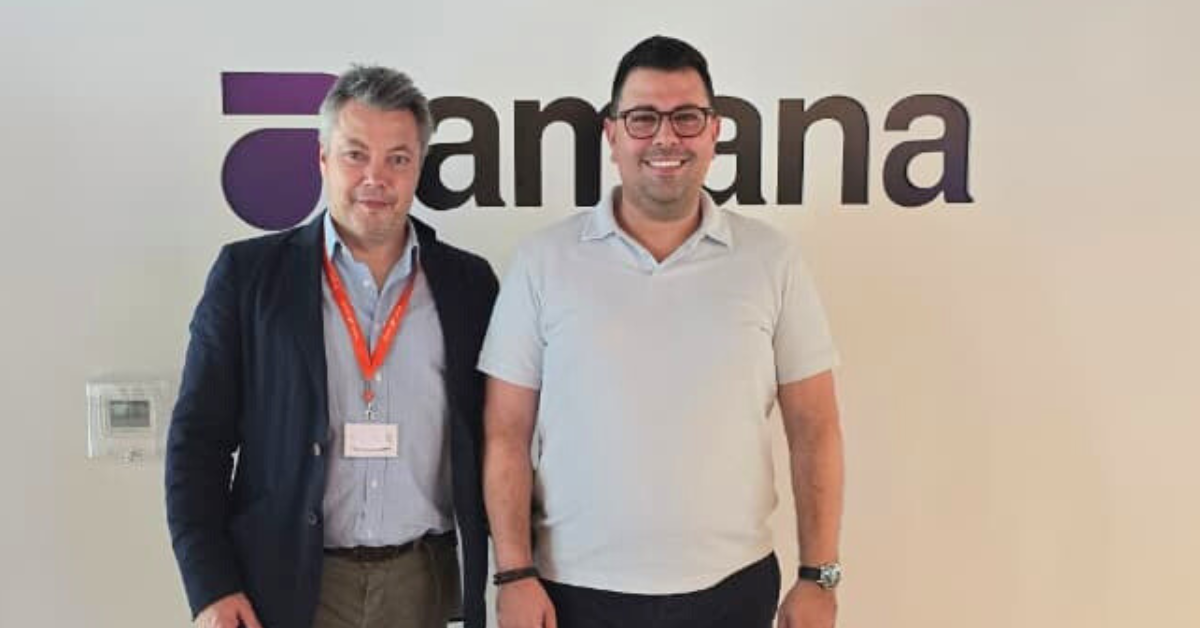
Sam Low, Founder, LiquidityFinder & Elie Harfouche VP Business Development, amana
Elie Harfouche also confirmed the approach to leverage “We offer them this product and it's up to people how to use it.”
Rasoul: “It's like everything in life. We try to caution them, I mean, our standard onboarding of customers is 25 times leverage (lower than ESMA’s minimum)…but any more than that is just Russian Roulette.” The hope is to have longer-term customers, so that amana is not playing the churn game the whole time.
Rasoul says that some customers still ask for more leverage, “But about 15% of our customer base come in and immediately say, can I get more leverage? And about half of the 15% are like, can I get even more? So when they request it, we basically tell them, okay, but, you know, this is dangerous. That's why I put the lightning bolt on all the products in the app with leverage.”
“Then we tell people that. If you look at some of the content on our website, you know, we're pretty clear with people about it. If you choose to use leverage, the vast majority of these people lose money.”
All Rasoul’s videos on social media are very clear about the cautious approach to trading - don’t over trade and don’t overleverage:
Elie Harfouche, who has been with amana through the transformation, credits that candour for changing both the culture and the client base.
“Before, it was a mix of IBs, corporates and some retail,” Harfouche recalls. “Now we’re 90–95 percent B2C. The culture is completely different — open, healthy, transparent.”
A Fair Place to Trade
That philosophy also shapes amana’s product design and client communication. The broker’s onboarding leverage is capped at 25 times, and clients are warned explicitly about the odds.
“If you use leverage, nine out of ten people are gonna lose money. Then we tell people that,” Rasoul says. “Just understand that going into it.”
In an industry where marketing often overshadows meaning, Rasoul’s pragmatism feels unusual.
“Free markets for free men and women,” he adds. “That’s a key first principle.”
Contact Elie Harfouche at amana to learn more
Found this interesting? Become a member of LiquidityFinder and get daily industry news direct to your inbox — join here.
Author
 |
Sam Low is the Founder of LiquidityFinder. With over 18 years in working with FX trading technology, Sam has deep experience in the FX (forex) trading industry, working with brokers, liquidity providers and end traders themselves. You can message Sam directly here. |
What is a “swap” in FX/CFD trading?
A swap (also called overnight financing or rollover) is the financing adjustment applied when you hold a leveraged FX or CFD position past the market’s daily rollover time. Because you’re controlling exposure with margin rather than paying the full notional, a financing cost (or credit) is applied based on interest rate differentials, broker schedule, and the product you trade.
What is a “swap-free” or Islamic trading account?
A swap-free account is marketed to clients who wish to avoid overnight interest charges on leveraged products for religious reasons. Instead of displaying a daily swap line, some brokers show no swap while applying alternative fees such as administration charges, widened spreads, or fixed commissions to cover the financing component.
How do “swap-free” accounts usually work in practice?
Implementation varies by broker. Common approaches include:
(1) Admin fees charged per day after a grace period,
(2) Wider spreads to embed financing,
(3) Fixed commissions per lot, or
(4) Holding limits (time/instrument) to manage financing risk. Always review the fee schedule to understand the total cost of carry.
Does “swap-free” mean there is no financing cost at all?
Not necessarily. With leverage, a financing component exists even if the broker doesn’t label it a “swap”. Costs can be re-packaged as admin fees, spread mark-ups, or other charges. For accurate comparisons, evaluate the effective cost of carry across account types, not just the presence or absence of a “swap” line item.
Why might “swap-free” not actually be swap-free in economic terms?
Because the financing reality of leveraged exposure doesn’t disappear. If a broker removes visible swaps, it typically recovers financing via other fees, spread adjustments, or position limits. The key question is the total cost you pay for holding positions overnight, not the label used.
How are overnight swaps/financing typically calculated?
Methods differ, but a common model uses: position notional × daily financing rate × days held, with credits/debits influenced by interest rate differentials, tom/next pricing (for FX), product basis, and the broker’s markup. Many brokers publish daily swap tables per instrument.
Why do swap rates and fees vary by broker and instrument?
Variations reflect underlying funding costs, liquidity providers, risk models, and admin/markup policies. Instruments with tighter liquidity windows or higher basis risk may carry larger debits. Check the broker’s product schedule and compare like-for-like (same symbol, position side, and date).
Fully funded vs. leveraged trading — what’s the difference?
Fully funded trading uses your own cash to buy exposure (e.g., spot FX with full notional, physical gold, or cash-equity purchases). Leveraged trading uses margin to control larger notional, introducing financing costs and higher risk of rapid losses. Choose based on your time horizon, risk tolerance, and costs.
Is leveraged CFD trading permissible under Islamic principles?
Opinions differ among scholars and market participants. Questions arise around interest/financing and controlling exposure beyond fully funded capital. Traders seeking Sharia-aligned solutions should review product terms carefully and consult qualified religious advisors.
Disclaimer: This is not religious advice. Traders should consult qualified advisors for guidance.
How can I compare swap vs. swap-free costs fairly?
Build a like-for-like scenario: same instrument, direction, notional, entry time, and holding period. Then add up all costs (spreads, commissions, admin fees, and any financing) to get the effective cost of carry. This reveals whether “swap-free” is economically cheaper or just differently itemised.
Risk warning: CFDs and other leveraged derivatives are complex instruments and carry a high risk of rapid losses due to leverage. Consider whether you understand how these products work and whether you can afford the high risk of losing your money.
Share this article
Comments
Most Recent
Find The Right Partners for
Your Trading Business
Sign up and join over 5,000 professional members who receive personalized news alerts, curated professional connections, and more for free!
n in-depth review of TMGM (TradeMax Global Markets), the ASIC-regulated ECN broker offering raw spreads from 0.0 pips, MT4 and MT5, copy trading via HUBx and ZuluTrade, and 24/7 multilingual support across four regulated jurisdictions. Find out if TMGM belongs on your shortlist.
LiquidityFinder's Sam Low sits down with Nathan Sage, founder and CEO of Sage Capital Management, to trace his journey from FX fund manager to running a Bitcoin fund doing $1BN a day in 2016 — and how that experience of pain built one of the most connected prime brokerages in the digital assets market today.
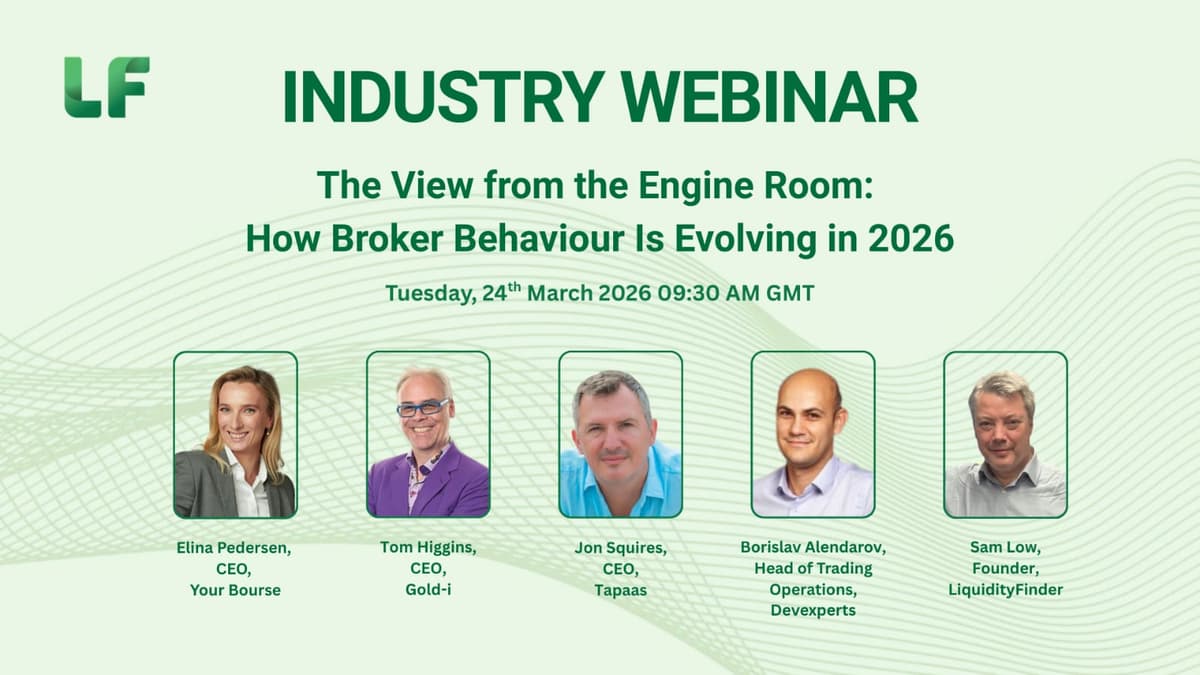
Gold at record highs, oil as a meme stock, and crypto exchanges eyeing your clients. Watch our expert panel - Gold-i, Your Bourse, Tapaas and Devexperts - discuss broker risk management, , AI trading and the MetaTrader debate.

Over a long tapas lunch in Shoreditch, London, Sam Low sits down with Peter Brooks and Jess Reed from ADMISI eFX, the dedicated electronic FX desk operating inside one of the world's largest agricultural commodities companies. What emerges is a compelling case for why this largely unknown operation deserves serious attention from brokers, payments firms, corporate treasuries, and digital asset companies alike.
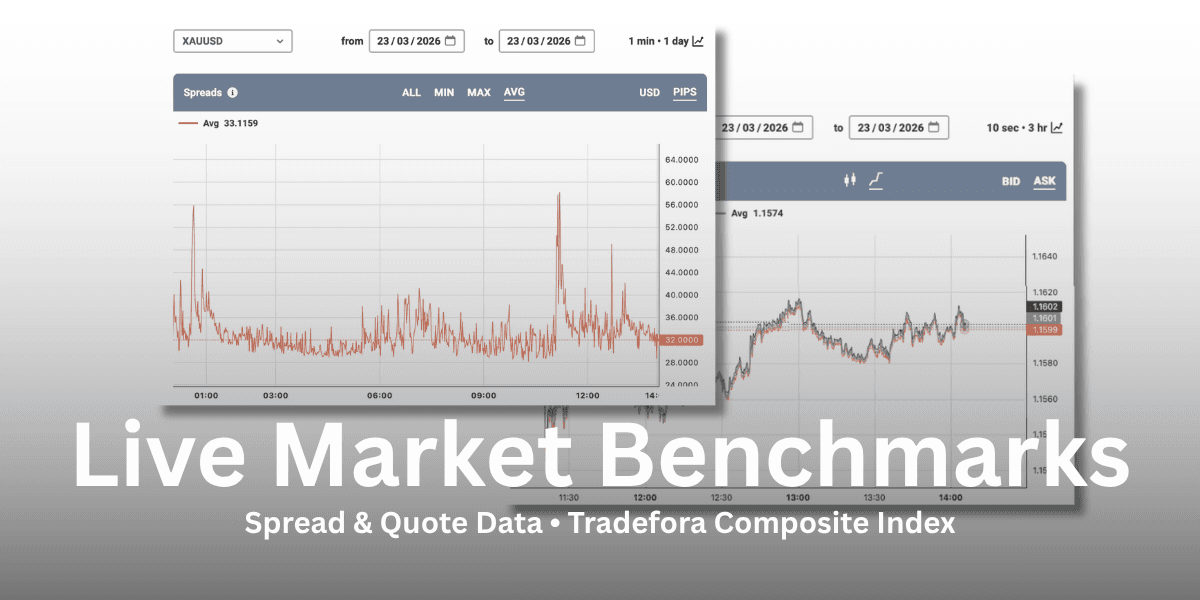
Explore live spread and quote benchmarks powered by the Tradefora Composite Index (TCI), an independent dataset aggregated from multiple FX and CFD brokers. View average, minimum and maximum spreads by instrument and timeframe, plus composite bid/ask quote data updated continuously at millisecond precision.

In Part 6 of his A-Book STP series, Youssef Bouz from GCC Brokers looks at how the rise of algorithmic and AI-assisted trading is forcing brokers to rethink risk models, revenue strategy, and long-term sustainability, and why trader longevity, not short-term extraction, is the real measure of a resilient execution business.
Fusion Capital is a specialist crypto liquidity provider offering brokers over 350 crypto CFD pairs with bespoke pricing, pure A-book execution, and access to decentralised exchange liquidity through Hyperliquid. In this broker profile, LiquidityFinder's Sam Low speaks with Head of Product Jasper Cooney about how Fusion's in-house trading bots monetise flow across centralised and decentralised venues, why crypto exchanges handle toxic flow differently to FX, and how brokers can now offer clients pre-IPO perpetual futures through their existing MT5 infrastructure.
In Part 5 of his A-Book STP series, Youssef Bouz from GCC Brokers provides a guide to distinguishing healthy algorithmic trading from latency arbitrage and structural abuse — and why behavior, not profitability, is the real risk indicator.
Create Your FREE Account
Get access to latest news, updates, real-time data, brokerage and trading firm insights and customized information feeds.


Understand trading psychology and learn how a clear strategy, risk management and a trading journal help build discipline and day trading consistency.


Ripple Prime has launched support for real-world asset perpetual swaps, giving institutional clients including Virtu exposure to more than 100 reference markets across equities, indices, ETFs, metals, energy and FX. The swaps reference Trade.xyz perpetual futures on Hyperliquid and trade and settle around the clock.


iSAM Securities Apex has integrated with Crossover Markets, connecting brokers to CROSSx, its institutional digital asset ECN, through Apex’s ultra-low-latency technology stack.


Your Bourse and 4XPORTAL highlight their existing partnership, combining client onboarding, CRM and payment solutions with liquidity, execution and risk-management infrastructure for brokers.


The partnership brings together 4XPORTAL’s brokerage technology capabilities with Your Bourse’s connectivity, liquidity aggregation, and risk-management infrastructure.

Clearstream has appointed Philippe Mueller as Head of Digital Products and Transformation for Clearstream Fund Services, succeeding Olivier Portenseigne. He will lead digital fund distribution, DLT-enabled fund processing and transfer agency innovation. He has over 25 years at Clearstream and Deutsche Börse Group.

Learn how to detach from trading outcomes by focusing on entry, exit, and risk. Build trading discipline with clear rules and a repeatable process.

CMC Markets has retired the CMC Connect name and will now present its institutional business as CMC Markets Institutional.

The SEC has approved Cboe's binary options tied to key performance indicators reported by 23 companies, covering more than 100 metrics such as iPhone revenue. The cash-settled contracts pay a fixed $1, Robinhood plans to be the first retail broker to offer them, and trading awaits clearing registration.


Gold is trading around $4,150, recovering sharply after falling to a recent low of $4,073.
Feed