just now


Liquidity Finder Ltd is incorporated in England and Wales, company number 10610740, registered address 167-169 Great Portland Street, Fifth Floor, London W1W 5PF, United Kingdom.
Published: just now
Yields are at 22-year highs and the consensus explanation is inflation. It is wrong. The 10-year nominal yield has risen roughly 100 basis points since June. Of that move, approximately 85-90% has come from real yields. Breakeven inflation rates have contributed about 14 basis points. The bond market is not pricing in an inflation spiral. It is pricing in an economy that is genuinely, structurally strong.
This distinction is not academic. It determines how equities, credit, and commodities behave from here. If yields were rising on inflation, you would expect broad equity weakness, commodity spikes, and a flight to gold. Instead, equities are rangebound and selective, credit spreads are widening on quality not panic, commodities are bifurcated between industrial demand and geopolitical premium, and gold is falling. Every asset class is behaving consistently with a demand-driven yield regime, not an inflationary one. The market is telling you what kind of cycle this is. Most people are not listening.
The Real Yield Story
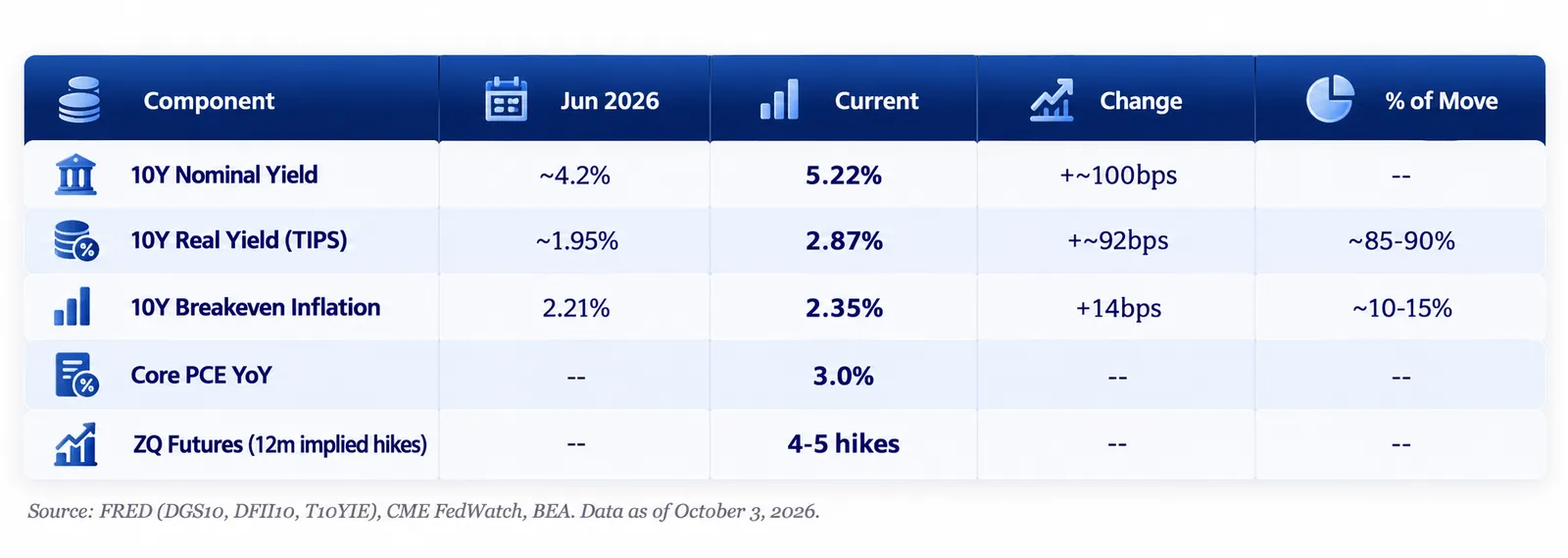
The table above is the most important chart in macro right now. Nominal yields at 5.22%. Real yields at 2.87%, a level not seen since 2007. Breakevens at 2.35%, barely above their June trough of 2.21% and well within the range they have traded for over a year. The yield move is overwhelmingly a real yield move.
What drives real yields higher? Real growth expectations, term premium, or tighter expected monetary policy. All three are in play. The ISM Manufacturing PMI at 57.0 with 15 of 17 industries expanding is the strongest real growth signal in years. The term premium has risen as duration risk reprices for a world where rates stay elevated. And ZQ futures are pricing 4-5 Fed hikes over the next 12 months, despite core PCE sitting at 3.0%, not 4% or 5%.
That last point deserves emphasis. The Fed is not hiking because inflation is running away. It is hiking, or expected to hike, because the real economy is too strong to let inflation fall back to target. This is a tightening into strength, not into a crisis. The implications for equities are fundamentally different. A Fed fighting runaway inflation is destructive to earnings. A Fed managing an overheating economy is a headwind to multiples, but not to cash flows. That is why the S&P is rangebound rather than down 15%. The market has digested the rate move because it understands the source.
The Quality Filter
The ICE BofA High Yield OAS has widened from cycle lows around 250 basis points to approximately 300 basis points. This is not a credit crisis. For context, the index hit 450bps in late 2023 and spiked above 450bps during the April 2025 tariff shock. But the direction matters more than the level. Spreads are widening not because defaults are spiking, but because the math has changed for leveraged issuers.
A company that refinanced at 7.5% all-in (5% base plus 250bps spread) in early 2026 is now looking at 8.2% or higher (5.2% base plus 300bps). The spread widens because the probability of distress rises mechanically with higher debt service costs, and because investors have an increasingly attractive risk-free alternative. The crowding-out effect is straightforward: why accept high yield credit risk for 8% when Treasuries offer 5.3% with no default risk? This does not require a default cycle to push spreads wider. It only requires a better competing asset.
The same dynamic is showing up in investment-grade spreads for A and AA-rated issuers. The absolute cost of capital is rising across the board, but the impact is not uniform. Companies with net cash positions, strong free cash flow generation, and limited refinancing needs are insulated. Companies levered 3x that need to roll 2021-vintage term loans are not. The quality factor, which has outperformed this year, still has legs. Balance sheet strength is not just a defensive screen right now. It is the primary discriminant between companies that can invest through this rate environment and those that are fighting it.
The Rate-Sensitive Consumer
The sectors most exposed to the short end of the curve are the ones already feeling it. Communications services, consumer discretionary, consumer durables, automotive, and travel are all rate-sensitive through the credit channel. A significant share of consumer credit card rates are driven off the 5-year and 7-year Treasury yields, not the overnight rate. When the 5-year is above 4.8%, the consumer is paying 24-27% on revolving balances regardless of what the Fed funds rate does.
The upside scenario for these sectors is that inflation rolls over meaningfully, which pulls rate expectations lower, which compresses the 5Y/7Y, which eases consumer credit conditions. That is a real possibility if the PMI cycle cools or if the demand impulse from defense and AI capex stabilizes rather than accelerates. However, the sequencing matters. The much-discussed $5,000 midterm dividend creates a temporary demand boost that could delay the very rate relief these sectors need. More consumer spending feeds services inflation, which keeps core PCE sticky, which keeps the Fed hawkish, which keeps the 5Y/7Y elevated. The stimulus gives the consumer cash in one hand while the rate environment takes it back in the other. Timing determines whether the net effect is positive or self-defeating.
The S-1 That Proved the Capex Thesis
Anthropic's leaked S-1 filing, submitted confidentially to the SEC in June and reported publicly on September 29, is the first time a major AI model company has opened its books under SEC disclosure standards. The numbers are not guidance, management commentary, or sell-side estimates. They are audited financial statements filed with a regulator. For anyone tracking the AI infrastructure capex cycle, this is the most important document published this year.
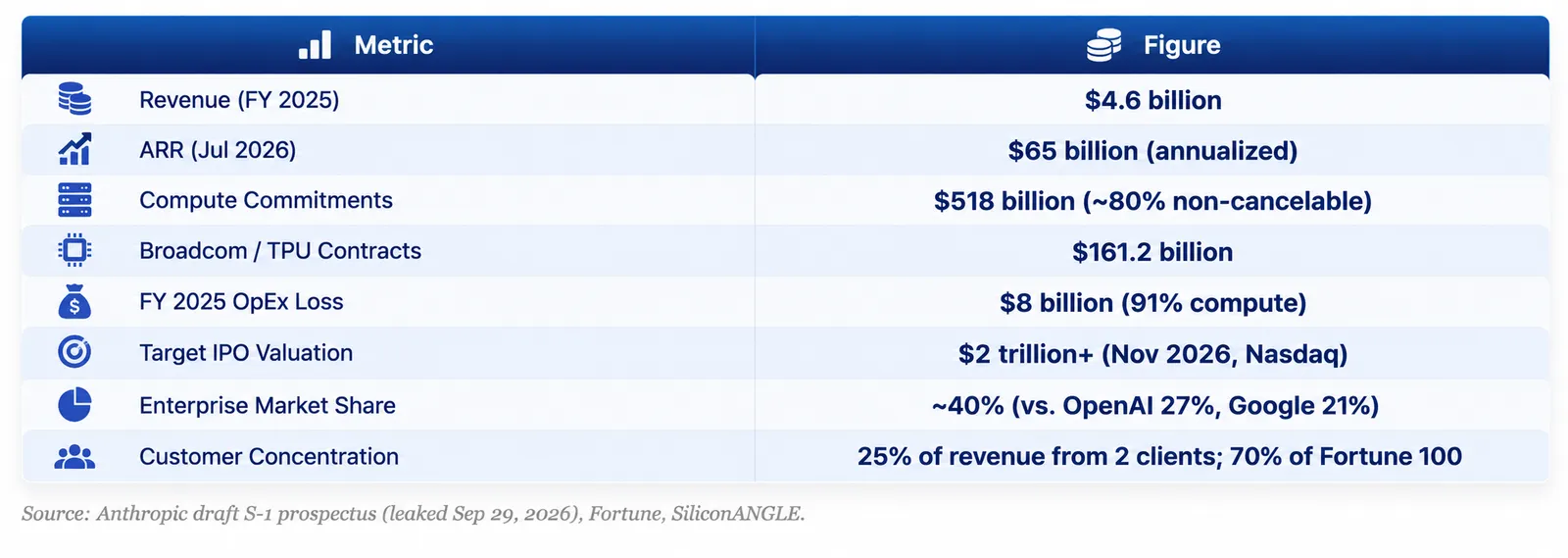
Revenue grew from $400 million in 2024 to $4.6 billion in 2025 to an annualized run-rate of $65 billion by July 2026. Q2 2026 delivered the company's first operating profit. The IPO targets a $2 trillion valuation for a November Nasdaq listing, with Morgan Stanley, Goldman Sachs, JPMorgan, and Citigroup leading the book.
The headline that matters for equity markets is not the revenue growth. It is the $518 billion in future compute and infrastructure commitments, approximately 80% of which are non-cancelable or pay-for-capacity contracts. This is one company, not even the largest AI player by revenue, contractually locked into half a trillion dollars of infrastructure spending. The demand for AI compute is not speculative, aspirational, or subject to management discretion. It is a contractual obligation disclosed in an SEC filing.
Within that $518 billion, the most specific line item is $161.2 billion in Broadcom contracts for Google TPU capacity. This is a direct design-win for Broadcom's custom ASIC business. Unlike GPU purchases, which can be deferred, switched, or replaced with custom silicon, a TPU contract locks in the chip designer for the life of the architecture. You cannot swap the ASIC vendor mid-generation without redesigning the entire compute stack. This is the kind of revenue visibility and switching-cost moat that GPU makers do not have, and it flows to Broadcom's semiconductor segment at 60%+ operating margins.
The FY 2025 operating loss of $8 billion, of which 91% went to compute infrastructure, tells you exactly where the value capture sits in the AI chain. Anthropic is the application layer burning cash to buy infrastructure from NVIDIA, Broadcom, and the cloud hyperscalers. The picks-and-shovels thesis is not a metaphor. It is literally in the P&L. For the hyperscaler cloud providers, the Anthropic commitment de-risks capex by guaranteeing utilization. Nearly half of the $518 billion is allocated to AWS, Microsoft, and Google Cloud. These are not speculative capacity builds. They are contracted demand.
Oil and Gold: The Headline Trades
The Brent-WTI spread has widened to approximately $16, with WTI at $89 and Brent above $105. The spread is almost entirely a Strait of Hormuz disruption premium embedded in the international benchmark but not in the landlocked US benchmark. US producers are largely insulated from tanker route disruption. This tells you how much of the oil price is geopolitical premium versus fundamental demand. If and when the Middle East conflict de-escalates, Brent compresses toward WTI, and the "oil as inflation driver" narrative softens meaningfully.
The conflict dynamics are shifting. Yemeni government forces are looking to reclaim Houthi-dominated areas. Iran is sending conflicting signals, proposing peace last week while warning of an escalated offensive. Pressure appears to be mounting as Iranian oil exports plummet under sustained enforcement. The tide that was initially with the Iran-Houthi alliance may be turning, but these are headline-driven moves with no clear structural resolution timeline.
Gold continues to trade as a yield-spread instrument rather than a geopolitical hedge. The counterintuitive pattern is that worsening war headlines are negative for gold, because they keep oil elevated, which keeps inflation sticky, which keeps yields elevated, and yields at 5%+ are the gravitational force pulling gold lower. Gold at $4,181 is down 26% from its February peak near $5,500, and the drawdown has tracked the yield rip almost perfectly. The crisis bid only reasserts if the conflict escalates to the point where it threatens financial system stability, not just shipping routes. For now, both oil and gold offer tactical opportunities that are purely headline-driven: trades, not positions.
What We Are Watching
Real yields vs. breakevens. The decomposition is the signal. If breakevens start rising meaningfully toward 2.5%+, the narrative shifts from demand-driven to inflationary, and the equity playbook changes. As long as real yields are doing the heavy lifting, the g > r framework holds.
HY OAS trajectory. The current 300bps is manageable. A move toward 350-400bps would signal that the rate environment is creating genuine credit stress, not just repricing. Watch refinancing activity and maturity walls in the leveraged loan market.
Quality over leverage. Balance sheet strength is the discriminant in this environment. Net cash, strong free cash flow, limited refinancing needs. The quality factor still has room to run. Companies that can self-fund through a 5%+ rate environment are structurally advantaged over those fighting their capital structure.
AI capex beneficiaries. The Anthropic S-1 validates the infrastructure thesis with contract data. Custom ASIC designers (AVGO) with non-cancelable design wins have more durable revenue visibility than commodity GPU sellers. Hyperscaler cloud providers (AMZN, GOOGL, MSFT) with contracted utilization are de-risked on capex returns.
Brent-WTI spread. The $16 spread is the geopolitical premium gauge. Narrowing signals de-escalation and removes a key input to the inflation narrative. Widening signals escalation and extends the rate overshoot.
The consensus is fighting a phantom. Yields are elevated because the economy is strong, not because inflation is spiraling. The bond market knows this. The credit market is repricing for it. The equity market is digesting it. And the first major AI company to open its books under SEC standards just showed you $518 billion in non-cancelable infrastructure commitments. The demand is real. The fear is misplaced. Position for growth and quality, not for a crisis that is not coming.
Research | BitDelta Pro
Disclaimer
This document is for informational and educational purposes only and does not constitute investment advice, a solicitation, or a recommendation to buy or sell any security or financial instrument. All data sourced from public filings, government releases, and third-party providers as cited. Forward-looking statements reflect the author's analysis as of the publication date and are subject to revision. Past performance is not indicative of future results.
BitDelta Securities Financial Services LLC, regulated by the Capital Market Authority under Category 5 (Introduction Only), acts solely as an introducer and does not provide trading, execution, dealing, advisory, portfolio management, or custody services. All trading, execution, and investment-related services are provided by BitDelta Limited, Mauritius, a licensed Investment Dealer excluding underwriting. All trading and investments involve risk. The value of investments may fluctuate, and you may receive less than your initial investment.
Appendix: Sources
Rates & Inflation
FRED: 10-Year Treasury Constant Maturity Rate (DGS10)
FRED: 10-Year Real Yield, Inflation-Indexed (DFII10)
FRED: 10-Year Breakeven Inflation Rate (T10YIE)
CME FedWatch: Federal Funds Rate Probabilities
BEA: Personal Income and Outlays (PCE Price Index)
ISM: Manufacturing Report on Business, September 2026
Credit Spreads
FRED: ICE BofA US High Yield Index OAS (BAMLH0A0HYM2)
Anthropic S-1 / AI Capex
Fortune: Anthropic $2 trillion IPO S-1 prospectus has leaked
SiliconANGLE: Leaked Anthropic IPO filing reveals $8B operating loss
Anthropic: Confidential draft S-1 submission
Middle East & Energy
Kpler: Global Crude Flows and Tanker Tracking
CENTCOM: Official Press Releases on Maritime Security Operations
EIA: Petroleum & Other Liquids Weekly Supply Estimates
Reuters: Yemen conflict and Houthi territorial control updates
Al Jazeera: Iran peace proposal and offensive escalation warnings
Gold & Precious Metals
Institutional multi-asset market access across MT5 Ultency, CQG, Iress Pro and BitDelta Terminal, with transparent execution standards and global market coverage.

Select the categories and companies you wish to follow directly to your person rss feed.
Create Custom RSS Feed
just now
just now
Sign up and join over 5,000 professional members who receive personalized news alerts, curated professional connections, and more for free!
Learn how to improve trading psychology, manage fear and greed, avoid revenge trading, and follow your trading strategy with discipline and a trading journal.
GTC Prime has announced a strategic partnership with Centroid Solutions to manage and distribute its liquidity through CS 360 Bridge, Centroid's multi-asset connectivity and execution engine, giving brokers and institutional clients access to tailor-made pricing, low-latency execution and real-time risk management.
CMC Markets Founder and CEO, Lord Peter Cruddas, discusses the structural evolution of the Group, the accelerating opportunity across B2B and institutional markets, major global partnerships including Revolut, Westpac, and ASB, and his outlook for the remainder of the financial year ahead.
Clear Street has announced an exclusive partnership with Seawolf Capital to bring market commentary from Danny Moses, Vincent Daniel and Porter Collins to its clients and the wider investing community, including live market calls, digital content and events. New programming will sit alongside Seawolf's podcast.
Yields are surging. But is inflation really the reason? This week’s BitDelta Pro Weekly Outlook looks beyond the headline explanation to examine what is actually driving the move in rates, and what that could mean across equities, credit and commodities. We also explore the growing importance of balance-sheet quality, the signals emerging from the AI infrastructure cycle, and what oil and gold may be telling markets about the current macro regime. Read the full Weekly Outlook. BitDelta Securities Financial Services LLC, regulated by the Capital Market Authority under Category 5 (Introduction Only), acts solely as an introducer and does not provide trading, execution, dealing, advisory, portfolio management, or custody services. All trading, execution, and investment-related services are provided by BitDelta Limited, Mauritius, a licensed Investment Dealer. All trading and investments involve risk. The value of investments may fluctuate, and you may receive less than your initial investment.
Devexperts has appointed Rainer Fuchsluger as Global Group Chief Executive Officer, effective immediately. His career spans LSEG, Wolters Kluwer, SS&C and Thomson Reuters, and he follows Ben Hurley, who was CEO for two years. His mandate covers international growth, cloud computing and AI across the portfolio.
ATFX has been named Best Global Forex Broker at Forex Expo Dubai 2026, held on 22 and 23 September at the Dubai World Trade Centre. ATFX MENA's Mohammad Shanti also presented on designing currency pairs and FX portfolios for 2026 macro regimes at the event, which drew more than 23,000 attendees and 270 exhibitors.
Yapı Kredi Kripto has selected Integral's digital asset trading technology for its soon-to-launch regulated cryptocurrency business in Türkiye. The deployment covers pricing, liquidity and risk management as the country's new digital asset framework comes into effect, building on an FX relationship with Yapı Kredi.
Institutional brokerage and financial infrastructure provider Clear Street has joined TradingView’s broker network, allowing its clients to trade US stocks, exchange-traded funds and options directly through the charting and analysis platform.
AUDJPY price forecast: Watch resistance at 110.045–110.403 for bearish rejection toward 109.283 or a bullish breakout targeting 111.550.