
Search Companies, News, Members & more
Terms of ServicePrivacy PolicySecurity PolicyLegal InformationCommunity GuidelinesSitemapsCookie Settings
2026 Copyright © Liquidity Finder Ltd. All rights reserved.
Liquidity Finder Ltd is incorporated in England and Wales, company number 10610740, registered address 167-169 Great Portland Street, Fifth Floor, London W1W 5PF, United Kingdom.

(updated September 10, 2026)
Bitget is a cryptocurrency exchange platform that offers a variety of trading options, such as spot and derivative trading, as well as copy trading (a similar mechanic to eToro). Bitget is currently among the ten largest crypto exchanges in the world.
In this article, we cover everything you need to know about Bitget, including the various features the platform offers, where it is and is not regulated, and how safe the platform is.
Overview of Bitget
Bitget was founded in 2018 and is led by CEO Gracy Chen. Bitget's founding team started in 2015 after a fascination with Bitcoin's whitepaper and the creation of Ethereum.
Bitget is incorporated in the Seychelles. It says it now serves more than 120 million registered users across over 150 countries, up from around 100 million in early 2025. As with most exchanges, that figure counts registered accounts rather than active traders. Its separate self-custodial wallet product, Bitget Wallet, passed 100 million users in mid-2026.
The platform has a wide range of products and continues to make advances with its offering and its sponsorship activity.
Is Bitget regulated?
Bitget is incorporated in the Seychelles and does not have a single home regulator overseeing the whole business. Instead it holds a collection of licences and registrations in individual countries, and how protected you are depends entirely on where you live. That patchwork is genuinely wide, covering El Salvador, Georgia, Argentina, Italy, Poland, Bulgaria, Lithuania, the Czech Republic and Australia among others, but it has two significant gaps in the markets that now demand the most.
The first is the European Union. Bitget does not hold a MiCA licence and does not appear on ESMA's register of authorised crypto-asset service providers. Its EU entity applied to Austria's financial regulator in June 2026 and set up a European headquarters in Vienna, but an application is not an approval. The MiCA transitional period ended on 1 July 2026, and firms without authorisation have to stop serving EU clients and wind their operations down, moving customer assets to licensed providers. Bitget has said it will not offer services in the European Economic Area until its own authorisation comes through. If you are an EU resident, this is the most important thing in this article, because rivals including Kraken, Coinbase, Binance, OKX, Bitstamp and Bitpanda already hold the licence and Bitget does not.
The second is the United Kingdom. Bitget is not authorised by the FCA. It reaches UK customers by having its marketing signed off by an FCA-authorised firm, Archax, under Section 21 of the Financial Services and Markets Act, an arrangement that paused in May 2025 under tighter promotion rules and restarted that November. That covers how Bitget advertises, not how it holds your money, so UK users have no access to the Financial Ombudsman and no FSCS protection if the platform fails. All of that changes soon. Parliament brought cryptoasset activity inside the regulatory perimeter in February 2026, the FCA published its final rules that June, and the new regime takes effect on 25 October 2027. The authorisation window runs from 30 September 2026 to 28 February 2027, and exchanges that miss it will not be able to take on new UK customers.
Outside Europe the record is mixed. Bitget's strongest position is in El Salvador, where it holds both Bitcoin Services Provider and Digital Asset Service Provider licences covering trading, derivatives, staking and custody, and it has been building out in the UAE through Dubai. It is registered with AUSTRAC in Australia, though ASIC warned in July 2025 that Bitget holds no Australian Financial Services licence and cannot promote its financial products to Australian investors. Japan's regulator has named it among exchanges operating without registration, Saskatchewan's regulator issued a similar notice in 2025, and Bitget is not available in the United States at all. None of this means Bitget is unsafe to use. It does mean that if something goes wrong, the protections available to you will depend far more on your passport than on the exchange itself.
Key features of Bitget
Bitget is a centralised exchange (CEX) with a substantial presence in the crypto industry, offering several hundred cryptocurrencies, a range of fiat currencies and a broad set of trading pairs. Here are some of the main features of the platform.
Spot trading
The core purpose of Bitget is for users to buy and sell cryptocurrencies at current market prices and receive immediate delivery. Bitget supports a wide variety of cryptocurrencies and trading pairs, so users have options across most of the assets they are likely to be interested in.
Futures trading
Bitget, like several other large CEXs, offers a range of futures contracts, including USDT-margined and USDC-margined futures. Users have access to perpetual and quarterly contracts with high leverage available. Leverage magnifies losses as well as gains, and the maximum available varies by contract and by jurisdiction.
Copy trading
For users who are not necessarily interested in trading themselves, or who do not have the time or the expertise, Bitget offers the option to copy another trader. Positions are mirrored in proportion to the capital allocated. It is worth noting that copying a trader does not remove risk, it transfers the decision to someone else.
Bitget Wallet
Users have the option to use Bitget Wallet to store their crypto. It is a self-custodial multi-chain wallet that supports swaps, integration with other wallets and access to a wide range of chains. Being self-custodial means the user holds the keys, so responsibility for security sits with them rather than with Bitget.
Bitget Token (BGB)
The Bitget Token (BGB) is the main utility token of the Bitget ecosystem, spanning both the exchange and the wallet. It launched on Ethereum as an ERC-20 token.
BGB offers a range of benefits, such as:
• Trading fee discounts
• Access to exclusive events and launchpad participation
• Staking rewards
• Payment of multi-chain gas fees in Bitget Wallet
BGB's supply has been actively reduced. In December 2024, Bitget burned 800 million BGB, representing 40% of the original 2 billion supply, cutting the total to 1.2 billion. Since 2025 the exchange has run a quarterly buyback and burn tied to on-chain usage, moving the token towards a deflationary model. As with any exchange token, holders should treat published supply figures as a moving target.
Is Bitget safe?
Bitget is a legitimate platform on which to buy and sell cryptocurrency. As a centralised exchange, it operates several layers of security, and it publishes monthly proof of reserves alongside a protection fund.
That said, complaints have been reported about Bitget's customer service and about funds being difficult to access, which we cover below. And as the regulatory section sets out, the consumer protections available to you depend heavily on where you are based.
Bitget Cold Storage
One of the main safety features of Bitget is its cold storage. Cold storage involves holding digital assets offline in multi-signature wallets, which significantly reduces the attack surface compared with assets held in hot wallets connected to the internet.
Withdrawal whitelisting
Bitget employs a method of withdrawal verification known as withdrawal whitelisting. Users must add a specific wallet to a whitelist, and only the added wallets are available as withdrawal destinations.
Adding a new address requires confirmation by email or two-factor authentication (2FA). By only allowing pre-approved addresses for withdrawals, the risk of funds being drained by an attacker who gains account access is significantly reduced.
Bitget Protection Fund
One of the more substantial security measures Bitget operates is the Bitget Protection Fund, a self-insurance fund established in August 2022, shortly before the collapse of FTX. It is among the larger self-insured funds in the cryptocurrency industry.
A portion of the platform's revenue, taken from trading fees and listing fees, is channelled into the fund. It is backed by bitcoin, so its dollar value moves with the BTC price rather than growing in a straight line. In July 2026 it averaged $351 million, against a stated commitment to keep it above $300 million. The valuation is published daily.
In the event of a security breach or a platform failure, the fund is intended to compensate affected users. It would not cover the entirety of user balances, but incidents typically affect a portion of users, so the fund would meaningfully reduce the impact.
Bug bounty programme
Bitget also runs a bug bounty programme, which incentivises researchers and white hat hackers to find vulnerabilities in the Bitget network. The bounties can be found on BugRap.
Common complaints
The most persistent complaint about Bitget concerns accounts being frozen or locked without explanation, followed by slow response times when users try to recover their funds. Account freezes are common across centralised exchanges and often stem from compliance and anti-money laundering checks, but the recurring criticism of Bitget is the lack of communication around them rather than the freezes themselves.
Conclusion
Bitget is an established exchange with meaningful security infrastructure behind it, including cold storage, published proof of reserves and a protection fund that is verifiable on-chain. On the technical side, it holds up.
The more important question in 2026 is not whether Bitget is secure but whether it is available and protected where you are. It has no MiCA licence and is not currently able to serve EU customers. In the UK it operates through an approver arrangement that is being replaced by a full authorisation regime in October 2027. Its strongest licences sit in El Salvador, Georgia and the UAE, and several regulators elsewhere have issued notices about it.
If you are in a market where Bitget holds a licence, the platform's security record is a reasonable one, tempered by the customer service complaints. If you are in the EU or the UK, the regulatory position should carry more weight in your decision than the feature set does.
If you are looking for a different type of exchange, decentralised exchanges such as Uniswap operate without a central authority holding your assets, though they come with their own trade-offs around liquidity, user experience and recourse.
At LiquidityFinder, we host a wide range of liquidity providers including crypto exchange providers who can help with your crypto liquidity.
It takes just a few minutes to register with LiquidityFinder, and once you do, you will have immediate access to our exclusive network of liquidity providers, as well as tools such as our Match Matrix and our multi-provider request form.
Stay up to date with our Insights, where we cover everything our audience needs to know about liquidity, crypto and more.
Author
Caleb is a financial copywriter with a specialisation in fintech and forex. Former copywriter at Barclays and Paysafe. Contributing writer for LiquidityFinder.
This article was reviewed and updated by the LiquidityFinder editorial team in September 2026 to reflect changes in Bitget's regulatory position and corrections to figures that had become out of date.
Share this article

Comments
Most Recent
Find The Right Partners for
Your Trading Business
Sign up and join over 5,000 professional members who receive personalized news alerts, curated professional connections, and more for free!
BitMart announced on July 26, 2026 that it is winding down its trading platform: new registrations and deposits stopped immediately, spot and futures trading ends August 26, 2026, and operations fully close by January 31, 2027. Anyone still holding funds on BitMart needs a reliable replacement exchange immediately.
A new stablecoin backed by 140+ firms, from Visa to BlackRock. Can Open USD challenge USDT and USDC, and will it clear MiCA? Olaf Ransome weighs in.

LiquidityFinder's Sam Low sits down with Maria Pittashi, General Manager of Cyprus-based broker technology firm PLUGIT, to discuss its modular YOONIT platform, the Dynamic Margin tool brokers ask for by name, fixed-fee versus volume-based pricing, the hidden cost of manual KYC, and the AI features coming next.

As tokenisation and digital assets move from niche curiosity to mainstream expectation, banks and financial institutions face an uncomfortable truth: their legacy core banking systems were never built for this. From order execution and pre-funding to custody, portfolio management and gas fees, Olaf Ransome explores the key infrastructure challenges FIs must navigate and asks whether to re-use, buy or build their way to a solution that actually scales.

LiquidityFinder's Sam Low sits down with Nathan Sage, founder and CEO of Sage Capital Management, to trace his journey from FX fund manager to running a Bitcoin fund doing $1BN a day in 2016 — and how that experience of pain built one of the most connected prime brokerages in the digital assets market today.

Discover whether KuCoin is still “The People’s Exchange” in 2026. This in-depth KuCoin review breaks down fees, KYC, security, Proof of Reserves, supported coins, deposits/withdrawals, futures, margin, Earn and the platform’s standout free trading bots — plus who it’s best for (and who should avoid it).
Gas fees can be the most confusing part of using Ethereum and other blockchains. This guide explains what gas fees are, why they exist, how costs are calculated (including EIP-1559’s base fee and priority tip), and the key factors that drive price spikes. You’ll also learn practical ways to reduce fees using gas trackers, smarter timing, batching, and Layer 2 networks like Arbitrum, Optimism, Polygon and zkSync.

Generating and sustaining liquidity requires a strategic approach across centralized exchanges, decentralized pools, and market-making relationships. This guide covers every stage of the process for crypto projects.
Create Your FREE Account
Get access to latest news, updates, real-time data, brokerage and trading firm insights and customized information feeds.

Multi-asset trading broker AvaTrade has agreed to acquire the majority of FXCM Group’s business and brand, in a transaction that would bring a longstanding retail FX franchise into the AvaTrade Group.

LSEG and CMC Markets have signed a multi-year strategic data agreement expanding CMC's access to LSEG's real-time and delayed pricing, reference and corporate actions data, news and analytics, plus AI-ready content, to support new products, entry into new markets and the growth of CMC's institutional and B2B partnerships.

The Tel Aviv Stock Exchange is considering a bid for the Cyprus Stock Exchange, with Israeli media citing its EU licence, trading platform and clearing house. Euronext’s Athens exchange and India’s National Stock Exchange are also seen as contenders, and Cyprus aims to sign a sale agreement by the end of this year.

CME Group will launch baseball futures on 12 October, pending regulatory review, tracking CME FutureSports Performance Indexes built on Official League Data. Standard and micro contracts will start with the 2026 Postseason and the four clubs in the League Championship Series, trading around the clock.

ESMA has published an opinion stating that MiCA-authorised crypto-asset service providers should cease services tied to non-MiCA-compliant stablecoins for EU clients across MiCA crypto-asset services. National authorities should require remediation of existing exposures within three months, by early January 2027.

Nasdaq Ventures has made a strategic investment in Amsterdam-based derivatives and crypto exchange One Trading, with both firms to explore 24/7 trading of equity futures. The undisclosed investment follows Nasdaq's US$100 million investment in Payward, the parent of Kraken, and CME Group's move to 24/7 trading.
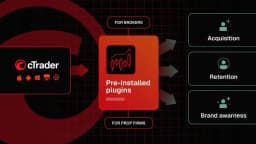
cTrader has opened multi-platform plugins to brokers and prop firms, which can pre-install their own tools for clients or list them in cTrader Store. The plugins run across Mobile, Web, Windows and Mac, and can be built and launched independently of core-platform releases, including trading journals and calculators.
Institutional brokerage and financial infrastructure provider Clear Street has joined TradingView’s broker network, allowing its clients to trade US stocks, exchange-traded funds and options directly through the charting and analysis platform.


Learn how to improve trading psychology, manage fear and greed, avoid revenge trading, and follow your trading strategy with discipline and a trading journal.
GTC Prime has announced a strategic partnership with Centroid Solutions to manage and distribute its liquidity through CS 360 Bridge, Centroid's multi-asset connectivity and execution engine, giving brokers and institutional clients access to tailor-made pricing, low-latency execution and real-time risk management.
Feed