
Search Companies, News, Members & more
Terms of ServicePrivacy PolicySecurity PolicyLegal InformationCommunity GuidelinesSitemapsCookie Settings
2026 Copyright © Liquidity Finder Ltd. All rights reserved.
Liquidity Finder Ltd is incorporated in England and Wales, company number 10610740, registered address 167-169 Great Portland Street, Fifth Floor, London W1W 5PF, United Kingdom.

How do liquidity pools work?
Liquidity is the foundation of both the financial and cryptocurrency markets. Sufficient liquidity in the market is what determines how easily an asset can be bought or sold.
If liquidity is too low, then it creates difficulty for buyers and sellers to enter or exit positions, and also causes swings in the market with large orders. This also means there is a direct correlation between liquidity and volatility – the more illiquid a market, generally the more volatile it is.
Liquidity in crypto is crucial as a lot of cryptocurrencies generally have lower market volume than a lot of other assets such as large cap equities and currencies. These lower market cap and less traded digital assets are therefore prone to extreme volatility. Where central exchanges can’t always provide sufficient liquidity, a liquidity pool provides a source of liquidity.
Crypto liquidity pools are a cornerstone of decentralised finance (DeFi), powering many innovative financial applications on blockchain networks. These pools function as automated market makers (AMMs), facilitating token swaps without traditional order books. Liquidity providers deposit equal values of two tokens into a smart contract, creating a pool that traders can use to exchange those assets efficiently.
Decentralised exchanges (DEXs) rely heavily on liquidity pools to enable seamless trading experiences. By removing intermediaries and utilising smart contracts, these pools offer continuous liquidity and more predictable pricing compared to traditional exchanges. This system incentivises liquidity providers with fees generated from trades, fostering a symbiotic relationship between traders and pool contributors.
Key Takeaways
- Liquidity pools use smart contracts to automate token exchanges without order books
- Decentralised exchanges leverage liquidity pools to offer efficient, permissionless trading
- Participants earn fees by contributing assets to pools, but face potential risks like impermanent loss
If you are looking for a liquidity provider specifically for a crypto exchange, then take a look at our list of the best crypto liquidity providers.
The Fundamentals of Liquidity Pools
Liquidity pools form the backbone of decentralised exchanges, enabling efficient asset swapping and yield generation. These innovative mechanisms rely on automated market makers and incentivised liquidity provision to facilitate seamless trading.
What is a liquidity pool?
Liquidity pools are a huge part of the decentralised finance (DeFi) system. In simple terms, a liquidity pool is a store of cryptocurrency locked into one place. This is to create liquidity, and ensure that transactions are kept relatively smooth. Liquidity providers can be anyone, and in DeFi liquidity pools, liquidity providers can contribute in small or large amounts.
Liquidity pools are smart contracts containing locked tokens that create trading markets for specific token pairs. These pools allow users to trade cryptocurrencies without the need for traditional order books or counterparties.
The pools maintain a constant balance of assets using algorithmic pricing models. When a user trades, they add one token to the pool and remove another, altering the ratio and price.
Most pools use the constant product formula (x * y = k) to determine prices. As one asset is removed, the other becomes more expensive, maintaining balance: 'x' and 'y' represent the quantities of two tokens in the pool (let's say ETH and USDC), k is a constant number that must stay the same after every trade. When someone trades, they add one token and remove another, but the product must remain constant.
Example: If a pool has 10 ETH (x) and 20,000 USDC (y), k = 200,000
When someone buys 1 ETH, the new amounts must still multiply to 200,000 - this automatically determines the price
Liquidity pools enable instant trades with minimal slippage for popular pairs. They also provide a foundation for other DeFi activities like yield farming, lending on platforms like Liquidium, and flash loans.
Role of Liquidity Providers
Liquidity providers (LPs) are crucial participants who supply assets to liquidity pools. They deposit equal values of both tokens in a trading pair to the pool.
In return for their contribution, LPs receive special tokens representing their share of the pool. These LP tokens can often be staked for additional rewards.
LPs earn a portion of the trading fees generated by the pool, typically 0.1% to 1% of each trade. This incentivises users to provide liquidity, ensuring pools remain well-funded.
However, LPs face risks like impermanent loss if token prices diverge significantly. They must carefully consider potential returns versus risks when selecting pools.
Understanding Automated Market Makers
Automated Market Makers (AMMs) revolutionised decentralised exchanges by enabling trustless trading without order books. They utilise smart contracts and liquidity pools to facilitate token swaps automatically.
The AMM Model
AMMs rely on mathematical formulas to determine asset prices and execute trades. The most common is the constant product formula, which maintains a constant product of token quantities in a pool. This ensures liquidity for all trade sizes, albeit with price slippage for larger orders.
Liquidity providers deposit token pairs into pools, earning fees from trades. The AMM adjusts prices based on supply and demand, without needing a centralised entity. This model enables 24/7 trading and reduces counterparty risk.
Types of AMMs
Different AMM designs cater to various trading needs:
-
Constant product AMMs (e.g. Uniswap):
- Use x * y = k formula
- Suitable for most token pairs
- Higher slippage for large trades
-
Stable swap AMMs (e.g. Curve):
- Optimised for similar-value assets
- Lower slippage for stablecoin swaps
-
Weighted pool AMMs (e.g. Balancer):
- Support multiple assets with custom weights
- Allow for index-like token baskets
Each type offers unique benefits, from simplicity to capital efficiency. Crypto-asset liquidity pools continue to evolve, with innovations addressing slippage and impermanent loss challenges.
Decentralised Exchanges and Liquidity Pools
Decentralised exchanges (DEXs) have revolutionised cryptocurrency trading by utilising liquidity pools instead of traditional order books. This approach enhances trading efficiency and accessibility for users.
How DEXs Operate
DEXs function without intermediaries, allowing direct peer-to-peer trading. They rely on automated liquidity pools instead of order books. These pools contain pairs of cryptocurrencies, such as ETH/USDT, supplied by liquidity providers.
When a user wants to trade, they interact with these pools rather than other traders. The exchange rate is determined by an algorithm based on the ratio of assets in the pool. This system, known as an automated market maker (AMM), ensures constant liquidity.
Popular DEXs like Uniswap and SushiSwap use this model. Liquidity providers earn fees from trades, incentivising them to maintain pool balance. The more liquidity in a pool, the lower the price impact of trades, benefiting users with better rates.
Comparison with Traditional Exchanges
Traditional centralised exchanges use order books, matching buyers and sellers directly. DEXs, in contrast, offer several unique advantages:
1) Accessibility: Users can trade without creating accounts or undergoing Know Your Customer (KYC) procedures.
2) Security: Funds remain in users' wallets until trades are executed, reducing hacking risks.
3) Transparency: All transactions are visible on the blockchain, enhancing trust.
However, DEXs face challenges:
- Slippage: Large trades can significantly impact prices in smaller liquidity pools.
- Front-running: Miners may exploit pending transactions for profit.
- Limited trading pairs: Less popular tokens may lack sufficient liquidity.
Liquidity Pool Tokens and Incentives
Liquidity pool tokens and incentives play a crucial role in attracting and rewarding participants who provide liquidity to decentralised exchanges. These mechanisms help ensure sufficient trading liquidity whilst offering potentially lucrative opportunities for liquidity providers.
LP Tokens Explained
LP tokens, or liquidity provider tokens, represent a user's share in a liquidity pool. When depositing assets into a pool, users receive these tokens proportional to their contribution. LP tokens serve as proof of ownership and can be redeemed for the underlying assets plus any accrued fees.
These tokens are typically ERC-20 compatible on Ethereum-based platforms, allowing them to be traded or used in other DeFi protocols. The value of LP tokens fluctuates based on the pool's performance and the ratio of assets within it.
Some platforms allow LP token holders to participate in governance decisions, giving them a say in the protocol's future development.
Yield Farming and Rewards
Yield farming involves strategically providing liquidity to earn maximum returns. Liquidity providers can earn rewards through various mechanisms, including trading fees and additional token incentives.
Many protocols offer extra incentives to liquidity providers in the form of native tokens. This practice, known as liquidity mining, aims to bootstrap liquidity and distribute governance tokens to users.
Rewards are often calculated based on the amount of liquidity provided and the duration it remains in the pool. Some platforms implement dynamic reward structures to incentivise liquidity in less popular trading pairs.
Yield farmers must consider factors such as impermanent loss, gas fees, and market volatility when assessing potential returns. Advanced strategies may involve leveraging LP tokens across multiple protocols to maximise yields.
Financial Risks and Considerations
Crypto liquidity pools come with significant financial risks that investors must understand. Two key areas of concern are impermanent loss and smart contract vulnerabilities, which can impact returns and potentially lead to loss of funds.
Smart Contract Risks
Smart contract vulnerabilities pose a significant threat to liquidity pool participants. These self-executing contracts manage the pools, and any flaws in their code can lead to catastrophic losses. Hackers may exploit these vulnerabilities to drain funds or manipulate the pool's operations.
Common smart contract risks include:
- Reentrancy attacks
- Integer overflow/underflow
- Front-running
- Logic errors
To minimise these risks, thorough audits and formal verification of smart contracts are crucial. However, even audited contracts can have undiscovered vulnerabilities. Investors should research the security measures implemented by the protocol and consider using insurance products designed for DeFi.
Additionally, liquidity providers must be aware of potential slippage and high gas fees, which can erode profits, especially during periods of network congestion.
Integration with DeFi Ecosystem
Liquidity pools serve as the backbone of decentralised finance (DeFi), enabling seamless interactions between various protocols and services. They facilitate lending, borrowing, and the creation of innovative financial products within the DeFi landscape.
Lending and Borrowing
Liquidity pools play a crucial role in DeFi lending and borrowing platforms. Protocols like Aave and Compound utilise these pools to provide users with instant access to funds. Lenders deposit their assets into pools, earning interest on their contributions.
Borrowers can then access these funds by providing collateral, often in the form of other cryptocurrencies. The interest rates for both lending and borrowing are typically determined algorithmically based on supply and demand within the pool.
This system eliminates the need for traditional intermediaries, allowing for more efficient and accessible financial services. It also enables users to earn passive income on their crypto holdings whilst providing liquidity to the broader ecosystem.
Composable DeFi Services
The integration of liquidity pools extends beyond simple lending and borrowing. They enable the creation of composable DeFi services, where multiple protocols can interact seamlessly.
Projects like Yearn Finance leverage liquidity pools to create automated yield farming strategies. These strategies optimise returns for users by moving funds between different pools and protocols based on current market conditions.
Bancor utilises liquidity pools to provide decentralised exchange services with minimal slippage. This integration allows for more efficient trading and better price discovery across the DeFi ecosystem.
Governance and Evolution of Liquidity Pools
Governance tokens and decentralised models play a crucial role in shaping the future of liquidity pools. As these systems evolve, new developments aim to enhance efficiency and user participation.
Decentralised Governance Models
Governance tokens grant holders voting rights on key decisions affecting liquidity pools. These tokens enable users to propose and vote on changes to pool parameters, fee structures, and protocol upgrades.
Decentralised Autonomous Organisations (DAOs) often manage liquidity pools, allowing token holders to collectively guide the project's direction. This model promotes transparency and community involvement.
Some protocols implement quadratic voting, where voting power increases at a slower rate than token holdings. This approach aims to prevent large token holders from dominating decision-making processes.
Governance participation incentives, such as additional rewards or fee discounts, encourage active involvement from a broader range of stakeholders.
Future Developments
Liquidity pools are exploring cross-chain functionality to enhance interoperability between different blockchain networks. This development could significantly expand the reach and utility of these pools.
Advanced pool designs are being researched to optimise capital efficiency and reduce impermanent loss. Concentrated liquidity pools, for instance, allow liquidity providers to focus their assets within specific price ranges.
Integration with layer-2 scaling solutions aims to reduce transaction costs and increase throughput for decentralised exchanges (DEXs) utilising liquidity pools.
Machine learning algorithms are being developed to dynamically adjust pool parameters based on market conditions, potentially improving returns for liquidity providers.
Joining a Liquidity Pool
Becoming a liquidity provider requires specific steps and tools. Participants need a compatible crypto wallet and sufficient tokens to contribute to the pool.
Steps to Get Started
To join a liquidity pool, first select a decentralised exchange (DEX) that offers this feature. Popular options include Uniswap and SushiSwap on the Ethereum network. Next, connect your crypto wallet to the chosen DEX's website.
Navigate to the 'Pool' or 'Provide Liquidity' section. Choose the token pair you wish to supply liquidity for. Ensure you have equal values of both tokens in your wallet.
Enter the amount you want to deposit. The interface will show the expected returns and fees. Review the details carefully before confirming the transaction.
After approval, sign the transaction in your wallet. Pay the required gas fees to complete the process.
Tools and Wallets Required
A compatible crypto wallet is essential for joining liquidity pools. MetaMask is a widely used option for Ethereum-based DEXes. It's a browser extension that allows easy interaction with decentralised applications.
Other popular wallets include Trust Wallet and Coinbase Wallet. Ensure your chosen wallet supports the blockchain network of your selected DEX.
You'll need sufficient tokens to provide liquidity This includes the token pair you're contributing and some extra ETH for transaction fees.
A reliable internet connection is crucial for executing transactions smoothly. Some users prefer hardware wallets for added security when dealing with large amounts.
Frequently Asked Questions
Cryptocurrency liquidity pools offer various benefits and risks for participants. Understanding key aspects like potential returns, investment strategies, and associated risks is crucial for those considering involvement in these pools.
What are the key benefits of participating in cryptocurrency liquidity pools?
Liquidity providers can earn passive income through trading fess. These fees are typically proportional to the amount of liquidity provided. Liquidity pools enable decentralised trading and can improve market efficiency.
Can participating in a liquidity pool result in a loss of cryptocurrency?
Yes, participants may experience impermanent loss if token prices in the pool change significantly. This occurs when the value of tokens in the pool diverges from their value outside the pool. Market volatility and smart contract vulnerabilities can also lead to losses.
How does one begin investing in cryptocurrency liquidity pools?
To start, investors need to choose a compatible blockchain and decentralised exchange. They must acquire the necessary tokens for the chosen pool. Connecting a cryptocurrency wallet to the platform and depositing funds into the pool are the final steps.
What factors should be considered when choosing a liquidity pool to invest in?
Investors should assess the pool's trading volume, as higher volume often means more fee revenue. The stability of the token pair is important to minimise impermanent loss. Pool size and liquidity depth can indicate the pool's health and potential for returns. Here is a good resource for comparing liquidity pools and their depth volume.
In what ways do liquidity providers earn fees from liquidity pools?
Liquidity providers earn a share of the trading fees generated by the pool. These fees are typically distributed proportionally based on each provider's share of the pool. Some pools also offer additional rewards in the form of governance tokens or other incentives.
What are the typical risks associated with cryptocurrency liquidity pools?
Impermanent loss is a significant risk, especially in volatile markets. Smart contract vulnerabilities can lead to hacks or exploits. Regulatory changes may impact the legality or operation of liquidity pools. Market manipulation and rug pulls are also potential risks in some pools.
Why do we need liquidity pools in crypto?
As we have established, low liquidity is bad for an exchange. Even high-volume cryptos such as Bitcoin and Ethereum are prone to wild volatility, so further down the list of cryptos where the liquidity decreases, the volatility can be huge.
Order books are where all the buying and selling transactions are recorded, but due to the limited numbers of buyers and sellers, this can be unstable, and liquidity has to be increased for the risk to become manageable.
Liquidity pools aim to remedy this, particularly for lower volume cryptos. Users are encouraged to become liquidity providers themselves, and provide a portion of their assets to be ‘locked in’ to allow for liquidity in the DEX.
It also provides security, as a liquidity pool ensures that a sufficient amount of capital is locked in. This means that trades cannot be manipulated as easily, and scams such as rug pulls are far less likely. Communities can also be better created and fostered with a liquidity pool.
How liquidity pools work?
A user will enter a liquidity pool either intentionally as part of a yield farming process, or as a prerequisite for the cryptocurrency.
Entering a liquidity pool will require the user to deposit some of their cryptocurrency into the pool. This is what will create the liquidity for the exchange, and traders will then find buyers and sellers more easily.
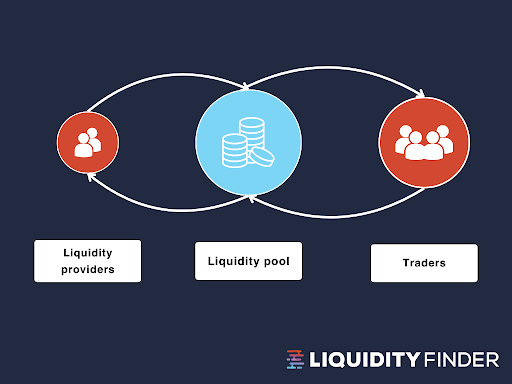
In return, liquidity providers will receive a reward such as liquidity pool tokens or a small amount of compound interest, which is known as yield.
Liquidity pool tokens, or LP tokens represent a share of the pool’s overall liquidity, and can even be traded as cryptocurrencies themselves.
Entering a liquidity pool
Within a liquidity pool, liquidity providers stake a portion of their cryptocurrency into the liquidity pool, and it is locked in by the smart contract.
When a trade is made, the traders will trade directly from the pool, essentially forming the DEX. Traders then exchange on the DEX, which is controlled by the liquidity pool.
Here is a slightly more detailed diagram:
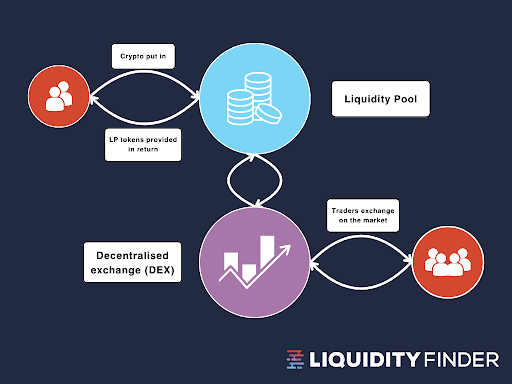
The market is kept stable with liquidity provided by the users. This is where automated market makers (AMMs) come along. These work by automatically calculating the price of the assets in the pool based on the demand and adjusting the price in real-time.
Exiting a liquidity pool
Exiting a liquidity pool is simple. All a liquidity provider will need to do is sell their cryptocurrency, and therefore their stake in the liquidity pool. They will need to exchange or ‘burn’ their LP tokens in order to receive their assets back.
However, due to the compounding benefits of remaining within a liquidity pool (yield farming), there is an incentive to stay within it for as long as possible.
Each time a cryptocurrency is bought or sold, liquidity providers will be given LP tokens. LP tokens represent shares of the liquidity pool but have many other uses, not just monetary returns. For example, LP tokens can also provide users access to certain crypto loans, and also give the users voting rights in some cases on changes to the cryptocurrency.
Conclusion
Liquidity pools are a key part of DeFi, and as cryptocurrency becomes more popular, as will liquidity pools and DEXs.
At LiquidityFinder, we host a wide range of liquidity providers including crypto exchange providers.
Register with LiquidityFinder in minutes, and you’ll join our exclusive network of liquidity providers, as well as gain access to tools such as our Match Matrix and our multi-provider request form.
Author
 | Caleb is a financial copywriter with a specialisation in fintech and forex. Former copywriter at Barclays and Paysafe. Contributing writer for LiquidityFinder. You can message Caleb here. |
Share this article
Comments
Most Recent
Find The Right Partners for
Your Trading Business
Sign up and join over 5,000 professional members who receive personalized news alerts, curated professional connections, and more for free!
Sign Up with LinkedIn

Olaf Ransome’s latest article on liquidity management explores PORTS (Perpetual Overnight Rate Treasury Securities) and how they could expand the supply of on-chain high-quality liquid assets (HQLA) for treasury and cash management. He explains why long cash balances create risk, how stablecoins and tokenised money market funds need safe short-duration assets, and what PORTS could mean for reverse repo, liquidity management and wholesale banking.

African FX liquidity is shaped by hard-currency scarcity and capital controls. Roland Schilling, COO at Sika Financial, explains how interbank reference rates differ from parallel markets, and how Sika settles via CCP/PvP.

Guest insight from Olaf Ransome on UNITE Global FMI and a “single pool of liquidity” vision to reduce nostro reliance, cut buffers and enable real-time PvP/DvP.
Gas fees can be the most confusing part of using Ethereum and other blockchains. This guide explains what gas fees are, why they exist, how costs are calculated (including EIP-1559’s base fee and priority tip), and the key factors that drive price spikes. You’ll also learn practical ways to reduce fees using gas trackers, smarter timing, batching, and Layer 2 networks like Arbitrum, Optimism, Polygon and zkSync.

At the top of the FX liquidity hierarchy sit Tier 1 banks, the institutions that set interbank rates and define the depth of the global forex market. This article explains how they operate, how their pricing flows down to retail brokers, and what it means for execution quality at every level.
Decentralized exchanges (DEXs) allow peer-to-peer trading without intermediaries. This guide covers how AMMs work, how to connect a wallet, understand liquidity pools, manage slippage, and trade safely across Ethereum, BNB Chain, and Solana.

Gold-i CEO Tom Higgins explains why most crypto exchanges are still retail-first and what must change to win institutional flow — including FIX support, independent custody, predictable liquidity, and pricing models that reward aggregator-driven volume.

Why buy-side and sell-side firms are turning to tokenised collateral for efficient liquidity management.
Create Your FREE Account
Get access to latest news, updates, real-time data, brokerage and trading firm insights and customized information feeds.
Market drivers and catalysts Equities: US equities rose, Europe paused near highs, and Asia’s chip-heavy markets rallied as AI optimism broadened. Fixed Income: US long treasury yields ease lower, Sho…

Markets keep climbing as if nothing can go wrong. While oil prices remain volatile, global yields surge, economic data weakens and recession risks build beneath the surface, investors are once again c…
Your Bourse will be exhibiting as a Gold Sponsor at the Online Trading Expo Hong Kong 2026, taking place May 27 and 28 at AsiaWorld-Expo. The expo is one of the primary industry gatherings for brokers…

Yes, people have used AI trading bots and some have made money, but it’s not as simple as “turn on and earn profit.” AI trading bots are automated systems that analyze market data and execute trades b…
Discover how news filters in forex trading help avoid high-impact events, protect trades, and enhance strategies with trade copiers. Learn to stop copy trading during volatile news.... Read more on tr…



Binance has launched Pre-IPO perpetual futures contracts, providing early market exposure to high-profile private companies like SpaceX, democratising access to pre-public listing trading opportunities for eligible users.

Cantor, a global investment bank, has received approval from the Financial Services Regulatory Authority (FSRA) of ADGM to conduct regulated financial activities in Abu Dhabi, marking a significant expansion in the Middle East.


Curious about the latest Bitcoin price action? Discover if BTC/USD will keep dropping using daily chart analysis and a proven crypto trading strategy.

Empire FX has appointed Sahil Patel as Chief Operating Officer to lead its global operations and accelerate expansion across Africa, the Middle East, and Asia. Patel brings extensive experience from Pepperstone and IG Group to strengthen infrastructure and enhance client experience.
WTI dropped below $100 after reports suggested a US-Iran agreement could be getting closer, with Arab media outlet Al Hadath reporting that Pakistan’s army chief Asim Munir may visit Iran to announce…


Sui has announced gasless stablecoin transfers, a new protocol-level feature enabling users and businesses to send supported stablecoins without gas fees. Fireblocks has already integrated the solution, marking a significant step towards simplifying digital asset payments for institutional and retail users.
Discover what reverse copy trading is, explore social trader tools and copy trading platforms for online trade copying. Optimize your strategy with professional insights on reverse trading techniques.…



NVDA enters tonight's $5.7T print with a stacked deck against it — the bear case needs only one leg to break, the bull case needs all three to clear elevated whispers.
dxFeed has integrated Kalshi, a CFTC-regulated prediction market exchange, into its Event-Based Contracts Market Data Feed, offering real-time data on binary outcome markets.
MEXC reports a sharp increase in traditional finance futures trading, with AI semiconductor assets leading the surge. The platform highlights how crypto exchanges are becoming a preferred route for users to gain exposure to TradFi markets, offering zero fees and stablecoin settlement.
Bitget Wallet has integrated xStocks, expanding its tokenised equities and RWA offering to over 300 assets for its 90 million users. The move provides self-custodial access to tokenised stocks, ETFs, and commodities, alongside cryptocurrencies, with low fees and gasless execution.
MARKET REPORT UK jobs data adds to GBP uncertainty ahead of tomorrow's CPI To talk to us about your next trade, call 020 7778 7500 or hit the button below Email us USD falls for the first time…

Market drivers and catalysts Equities: US stocks were mixed, Europe rose on energy and de-escalation hopes, while Asia struggled with oil and yields. Volatility: VIX eases, bond yields ele…


LiquidityMatch LLC, the parent company of FXSpotStream, has launched RateStream LLC, a dedicated streaming solution for the Fixed Income markets that applies the commercial model that transformed FX trading over the past decade to one of the largest and most actively traded markets in the world.
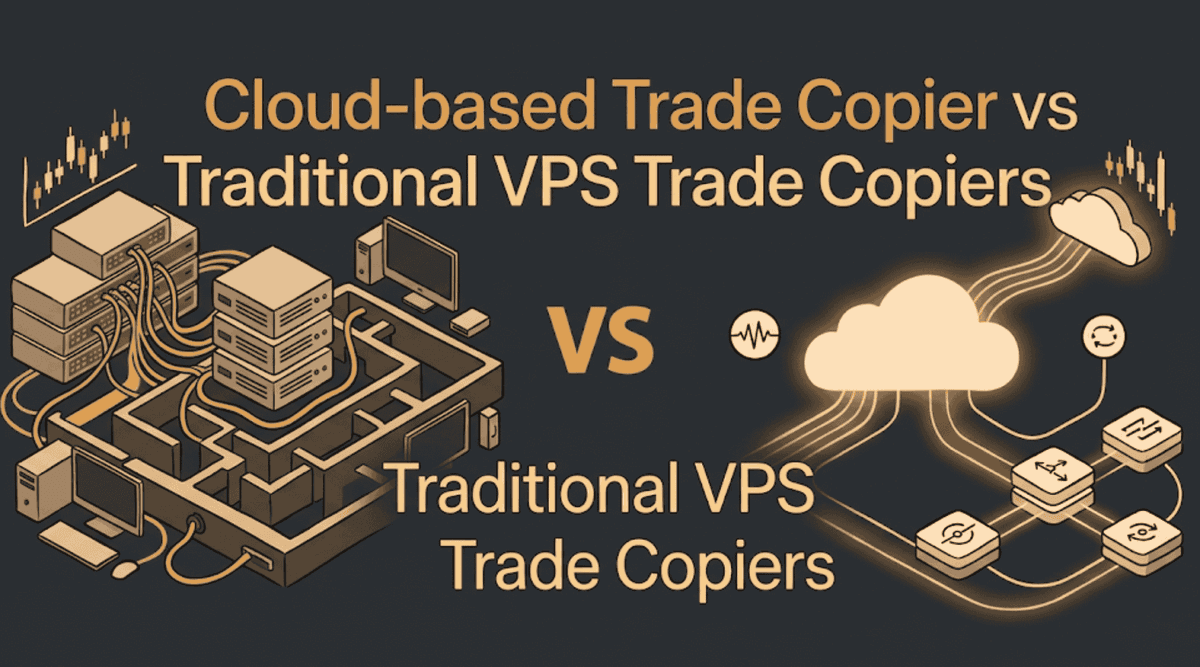
Yes, a cloud-based trade copier can be significantly more flexible than a traditional VPS-based setup, especially for traders or signal providers managing multiple accounts across different platforms.…
Feed